Meat Pack: Hijack

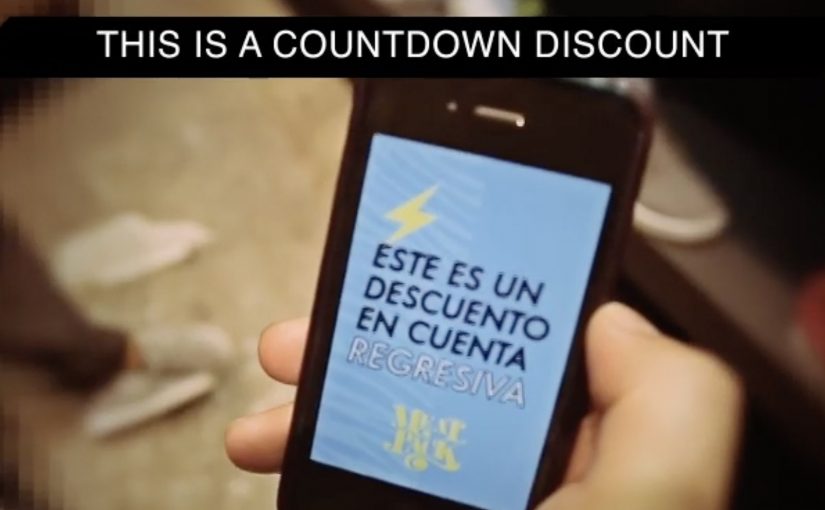
You walk into a competitor’s store to browse shoes. Your phone buzzes. Meat Pack offers you a discount that starts at 99%, then drops by 1% every second. If you want the deal, you have to move.

For a new discount promotion, Meat Pack, a shoe store in Guatemala known for an edgy, irreverent style, created Hijack, described as a GPS-based enhancement to their official smartphone app. Each time a customer entered the official store of one of the brands sold at Meat Pack, the app triggered a promotional message with a countdown offer. The discount started high and decreased every second, then the countdown stopped when the customer reached Meat Pack’s store.

Definition tightening: This is geofencing. A mobile app uses location signals to detect when you enter a defined physical area, then triggers a message based on that location event.

Turning a discount into a race

The mechanism is deliberately ruthless. The offer is so large it interrupts whatever you were doing, and the time pressure converts curiosity into action. The “best possible price” is available only at the exact moment your intent is hottest, while you are literally standing inside a competitor’s store.

In dense urban retail environments where shoppers compare options across nearby stores, location-triggered pricing can create an immediate switching incentive precisely at the point of decision.

Why it lands

It lands because it is a clean behavioural hack. The discount is not just a number. It is a ticking loss. Every second you hesitate, you feel the deal slipping away, which makes running across the street feel rational. The campaign also bakes in bragging rights by reportedly posting successful redemptions to Facebook, turning individual wins into social proof.

Extractable takeaway: If you want people to switch behaviours fast, combine a dramatic incentive with a visible countdown that makes hesitation feel expensive, then make the “next step” unmissable and immediate.

The business intent behind the provocation

This is conquesting with teeth. It aims to convert high-intent foot traffic that is already shopping the category, and to do it at the moment a competitor is paying the cost of acquisition. Reported results from the period describe hundreds of customers being “hijacked” and discounted inventory selling through quickly.

This is smart conquesting, but it only works when the store is close enough for the sprint to feel real. The real question is whether the route from trigger to redemption is short enough to make switching feel instant.

What this retail ambush gets right

  • Trigger at the true decision point. Not at home. Not later. At the shelf moment.
  • Make the offer legible in one second. “99% now, dropping” beats a paragraph of terms.
  • Use urgency with a real rule. A countdown works when it actually changes the outcome.
  • Design the route. If people cannot act quickly in real geography, the mechanic collapses.
  • Handle social sharing carefully. If you auto-post, consent and control decide whether it feels fun or creepy.

A few fast answers before you act

What is Meat Pack “Hijack”?

A location-triggered promotion inside Meat Pack’s app that detects when customers enter competitor brand stores, then offers a discount that decreases by 1% every second until the customer reaches Meat Pack.

What is the core mechanism?

Geofencing triggers an offer at the competitor location. A countdown reduces the discount each second. The timer stops when the shopper reaches Meat Pack, turning the offer into a physical sprint.

Why is the countdown so important?

It converts interest into movement. The value loss is visible and immediate, so delaying feels like paying extra.

What are the biggest risks in copying this?

Customer trust and permission. Location tracking and social posting require clear opt-in. Poor transparency turns a clever mechanic into backlash.

What kind of business does this fit best?

Retailers with nearby competitors, fast redemption, and inventory they can afford to discount aggressively for short bursts.

Nike: Jordan Melo M8 Water Projection

I have seen plenty of projection mapping in the last year or so, but this Nike execution for the Jordan Melo M8 takes a different route. Instead of treating a building as the canvas, it turns the Hudson River into the screen and uses a water curtain to make the visuals feel alive. A “water curtain” is a thin sheet of mist or falling water used as a temporary projection surface.

Trade coverage describes the launch as a live event at Pier 54, where a crowd gathered for performances and then got hit with a large-scale water projection moment featuring Carmelo Anthony and the Melo M8, layered with mapped effects that made the “explosive” theme feel physical.

When projection mapping stops being “mapping”

The mechanic is simple and smart. Water gives you motion for free, so the visuals do not need to do all the work. Every splash, ripple, and mist edge amplifies the animation and makes the illusion feel bigger than it would on a flat wall.

It also creates a built-in contrast. The shoe is a hard, engineered object. The canvas is fluid and unpredictable. That tension is what makes people stare.

In global sportswear launches, the fastest way to earn attention is to make the product reveal feel like a public event, not a private ad.

Why the water screen is the brand message

The most important thing this stunt communicates is not “this is a new shoe”. It is “this is an event-level product”. The audience reads production scale as product importance, especially in a category where new drops appear constantly.

Extractable takeaway: If the reveal mechanic is instantly retellable and the footage visibly signals scale, you get product importance and distribution without needing to explain a single feature.

The real question is whether the spectacle gives people a story they can repeat that makes the drop feel inevitable.

Using water also supports the narrative hook that appears in reporting around the event. Melo “walks on water” as a visual flex. Whether you call it projection, illusion, or theatre, the point is the same. The launch gives people a story they can retell without describing a single feature.

Business intent

This is launch-week acceleration. Get a live crowd. Create a spectacle that looks unreal on camera. Seed the footage. Then let the audience do the distribution, because the clip is more shareable than a standard product film.

Steal this from water-screen projections

  • Choose a canvas that adds value. Water, smoke, ice, and mirrors all contribute “movement” that visuals can ride.
  • Make the environment part of the claim. A river-scale reveal says “major” before any copy does.
  • Design for the recap video. If it does not look unbelievable on a phone screen, it will not travel.
  • Give people one sentence to repeat. “They projected Melo and the shoe onto the Hudson” is enough.

A few fast answers before you act

What is a water screen projection?

A water screen projection uses a thin curtain of mist or falling water as the surface. A projector throws imagery onto it, creating a floating effect that feels more dimensional than a wall projection.

Why does projection on water feel more “real”?

Because the surface moves. Ripples and spray add natural variation, so the visuals feel integrated with the environment rather than pasted onto it.

What makes this kind of stunt effective for a product launch?

It signals importance through scale, creates immediate talk value, and produces recap footage that performs better than a standard reveal because it looks like an event, not an ad.

What is the main operational risk?

Reliability. Water, wind, sightlines, and crowd control can all degrade the experience. If the image is not crisp and the moment does not land fast, the spectacle becomes confusion.

What metrics matter most?

Earned pickup, social share rate of the hero clip, completion rate, and correct retelling of the mechanic. If people remember “Hudson water projection” and connect it to the shoe, the stunt did its job.

NikeID Loop: Sneaker Customization Concept

Here is another interesting concept coming out of Miami Ad School, this time for Nike.

Since Nike has a huge range of sneakers, it’s next to impossible to try each one of them at the store. In fact, it’s not even possible to find them all at the store.

So a unique interactive mirror using Microsoft’s Kinect technology was created to customize the sneakers on the user’s feet. This way, one could try on every pair of Nike sneakers ever made in record time.

The core problem this concept tackles

Retail has a physical constraint. Shelf space. Inventory. Time. Nike’s catalog depth makes “try everything” impossible, even in flagship stores.

This concept flips the constraint by moving variety from physical inventory into a digital layer, while keeping the try-on moment anchored in the body. By “digital layer” here, I mean a live overlay that swaps variants in the mirror without needing physical stock. Your feet. Your stance. Your movement.

The real question is how you let shoppers explore more options without turning the store into a warehouse or the decision into homework.

Why the mirror mechanic is powerful

Because the mirror tracks movement and renders variants instantly, it keeps the try-on believable in motion, which is what makes fast switching persuasive instead of gimmicky.

Extractable takeaway: When you can add choice in software while preserving an embodied try-on moment, you reduce assortment friction without reducing confidence.

  • It keeps context real. You see the shoe on you, not on a product page.
  • It compresses decision time. Rapid switching creates a new kind of “browsing”.
  • It turns discovery into play. The experience is inherently interactive, which increases dwell time.
  • It reduces inventory friction. The store can showcase breadth without stocking breadth.

In retail environments where shoppers want high-confidence fit and style decisions in minutes, embodied digital try-on can expand perceived assortment without expanding stock.

What this implies for customization and personalization

NikeID is already about making a product feel personal. A Kinect-style mirror extends that by making customization immediate and visual, which can increase confidence before purchase.

This kind of embodied customization is worth betting on, because it makes breadth feel real without demanding more shelf space.

The concept also suggests a future where “catalog” becomes a service layer. The physical store is the stage for decision-making, not a warehouse for options.

What to take from this if you run retail CX

  1. Start with the constraint. Space and assortment are physical limits. Digital can expand them.
  2. Keep the experience embodied. Seeing a product on yourself is stronger than seeing it on a screen.
  3. Design for speed. Rapid iteration can become a feature, not a compromise.
  4. Make the output actionable. The experience should flow naturally into saving, sharing, or ordering.

A few fast answers before you act

What is the NikeID Loop concept?

It is a Miami Ad School concept for Nike that uses an interactive mirror and Microsoft Kinect technology to let users customize and “try” different Nike sneakers on their feet digitally.

What problem does it solve in stores?

It addresses the fact that Nike’s full range of sneakers cannot be stocked or tried in one location, by shifting variety into a digital interface.

Why use Kinect or motion tracking?

Motion tracking lets the system align the visual shoe to the user’s feet in real time, keeping the experience believable as people move.

Is this a product or a concept?

In this case, it is presented as a concept coming out of Miami Ad School, showing a possible direction for interactive retail.

What is the transferable lesson?

If you can remove physical constraints through an embodied digital layer, you can increase choice, speed, and confidence without expanding inventory.