
Golf Digest: Desert Disruption

Golf Digest wanted to remind golf enthusiasts that they can improve their game with the magazine. Rather than saying it in a predictable headline, Memac Ogilvy Dubai chose a faster route to attention. A prank designed to disrupt the region’s biggest golf event and get people to pick up the magazine.

The point is not to out-shout the tournament. It’s to create a moment of interruption that only resolves when you engage with the brand asset sitting right there in your hands.

Disruption as distribution

A prank at a live event works when it forces a choice. Ignore it and stay confused. Or reach for the one object that explains what’s happening. In this case, the magazine becomes the “decoder”, meaning the one object that explains what’s happening, which makes pickup feel like participation, not like being sold to.

In sports event marketing, a well-timed interruption can convert spectators into participants, as long as the payoff is immediate and easy to understand.

Why this lands

This works because it ties the brand benefit to a behaviour you can measure. Magazine in hand. Pages opened. Content consumed. The prank is not the product. It is the trigger that makes people re-experience Golf Digest as a practical tool for better play, instead of as background media. The real question is whether the interruption makes the magazine feel more useful, not merely more visible.

Extractable takeaway: If you need to revive a “useful” product people have stopped actively choosing, design an event moment where the product is the simplest way to regain control and understand what’s going on.

What to steal from event disruption

  • Make the brand the resolution. The disruption should only make sense once someone engages with your asset.
  • Use the right arena. Do it where your core audience is already emotionally invested.
  • Keep the explanation short. If the prank needs a long briefing, the moment dies.
  • Turn interest into a physical action. Pickup, flip, keep. Behaviour beats impressions.

A few fast answers before you act

What is Golf Digest’s “Desert Disruption” idea?

It’s a prank-based event activation designed to interrupt attention at a major golf event and prompt spectators to pick up the magazine as the way to understand the moment.

Why use a prank to sell a magazine?

A prank creates immediate curiosity. If the magazine is positioned as the fastest explanation or payoff, pickup becomes a natural reaction.

What does this communicate about Golf Digest?

That it is not only entertainment. It is positioned as a practical resource for improving your game.

What is the key success condition for this pattern?

The disruption must be legible quickly, and the magazine must clearly resolve the confusion with an instant payoff.

What can go wrong with event disruption?

If it feels unsafe, disrespectful to the sport, or unclear, it can trigger annoyance instead of curiosity. The tone and timing matter as much as the idea.

Ford C-Max Augmented Reality

A shopper walks past a JCDecaux Innovate mall “six-sheet” screen (poster-format) and stops. Instead of watching a looped video, they raise their hands and the Ford Grand C-MAX responds. They spin the car 360 degrees, open the doors, fold the seats flat, and flip through feature demos like Active Park Assist. No printed marker. No “scan this” prompt. Just gesture and immediate feedback.

What makes this outdoor AR execution different

This is where augmented reality in advertising moves from a cool, branded desktop experience to a marker-less, educational interaction in public space. Marker-less here means the experience does not need a printed marker or “scan this” prompt to start. The campaign, created by Ogilvy & Mather with London production partner Grand Visual, runs on JCDecaux Innovate’s mall digital screens in UK shopping centres and invites passers-by to explore the product, not just admire it.

The interaction model, in plain terms

Instead of asking people to download an app or scan a code, the screen behaves like a “walk-up showroom.”

  • Hands up. The interface recognises the user and their gestures.
  • Virtual buttons. On-screen controls let people change colour, open doors, fold seats, rotate the car, and trigger feature demos.
  • Learning by doing. The experience is less about spectacle and more about understanding what the 7-seat Grand C-MAX offers in a few seconds.

How the marker-less AR works here

The technical leap is the move away from printed markers or symbols as the anchor for interaction. The interface is based on natural movement and hand gestures, so any passer-by can start immediately without instructions.

Under the hood, a Panasonic D-Imager camera measures real-time spatial depth, and Inition’s augmented reality software merges the live footage with a 3D, photo-real model of the Grand C-MAX on screen.

Because the interface responds to natural hand movement, the interaction starts without instruction and keeps the focus on learning the product, not learning the UI.

In retail and out-of-home environments, interactive screens win when they eliminate setup friction and teach the product in seconds.

The real question is whether your outdoor screen is a passive impression machine or a walk-up product experience that teaches in under 30 seconds.

Why this matters for outdoor digital

If you care about outdoor and retail-media screens as more than “digital posters,” this is a strong pattern. This pattern is worth copying: design for viewer control and fast product education, not just looping impressions.

Extractable takeaway: Remove setup friction first, then use a small set of high-value interactions to teach one product truth quickly.

  • Lower friction beats novelty. The magic is not AR itself. The magic is that the user does not need to learn anything first.
  • Gesture makes the screen feel “alive.” The moment the passer-by sees the car respond, the display stops being media and becomes a product interface.
  • Education scales in public space. Showing how seats fold, how doors open, or what a feature demo looks like is hard to compress into a static ad. Interaction solves that.

Practical takeaways if you want to build something like this

  • Design for instant comprehension. Assume 3 seconds of attention before you earn more. Lead with one obvious gesture and one obvious payoff.
  • Keep the control set small. Colour, rotate, open, fold. A few high-value actions beat a deep menu.
  • Treat it like product UX, not campaign UX. The success metric is “did I understand the car better,” not “did I watch longer.”
  • Instrument it. Track starts, completions, feature selections, and drop-offs. Outdoor can behave like a funnel if you design it that way.

A few fast answers before you act

What is the core innovation here?

Marker-less, gesture-driven AR on mall digital screens that lets passers-by explore product features without scanning a code or using a printed marker.

What does the user actually do?

They raise their hands to start, then use on-screen controls to change colour, open doors, fold seats, rotate the car, and trigger feature demos like Active Park Assist.

What technology enables it?

A depth-imaging camera measures real-time spatial depth, and AR software merges live footage with a 3D model of the vehicle.

Why does “marker-less” matter in public spaces?

Because it removes setup friction. Anyone walking by can immediately interact through natural movement and gestures.

What should you measure to know it worked?

Track starts, completions, feature selections, and drop-offs so you can see which interactions people choose and where they bail out.

XS4ALL: Tonga Time

Switching internet providers in the Netherlands is often a time-consuming business, which is exactly why many people prefer not to switch at all.

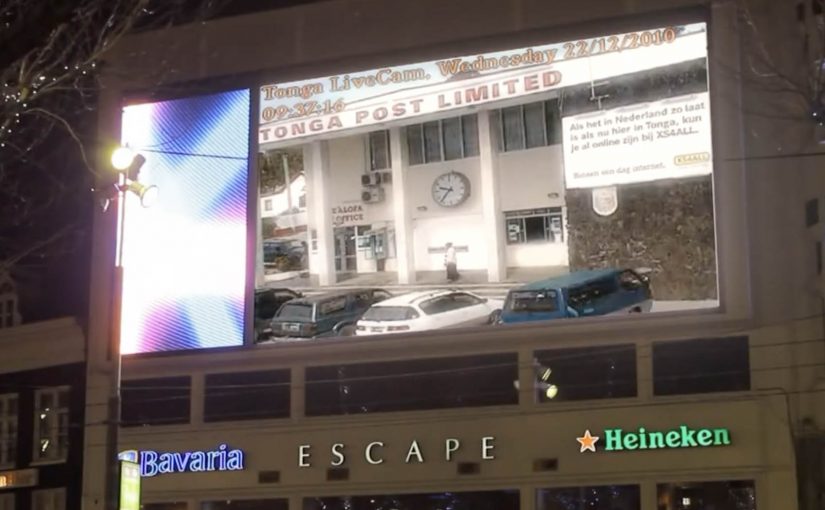
XS4ALL sets out to change that with a promise that sounds almost like a hack. A connection in one day. The campaign idea is framed as “Tonga: Where Time Begins”. Order your connection at 11am Tonga time, and you can have it installed before it is 11am Netherlands time on the same day.

Putting “one day” on a clock

To make the promise tangible, Ogilvy Amsterdam erects a billboard on the Tonga post office. Alongside the billboard, a clock shows the local time in Tonga, described as being about 11 hours ahead of the Netherlands. The clock turns the claim into a visible countdown. Tonga is already “tomorrow”, so the installation can happen “today”.

The real question is not whether XS4ALL can claim speed, but whether it can make that claim feel believable before people experience the service. The strongest move here is turning service logistics into something viewers can verify in one glance.

In telecom markets where switching friction creates inertia, the fastest way to sell speed is to make the time advantage physically visible, not just verbally promised.

Why it lands

The idea works because it uses a real-world fact as the proof mechanism. Time zones are non-negotiable, so the promise borrows credibility from geography, not copywriting. The billboard and the clock also do something important. They take a service promise that feels abstract and make it photographable, retellable, and easy to understand in one glance.

Extractable takeaway: When your differentiator is speed, anchor it to a constraint the audience already trusts, then build a single physical artifact that turns the claim into a visible demonstration.

How to turn speed into visible proof

  • Make the promise measurable. A clock beats a tagline when the benefit is time.
  • Borrow credibility from a fixed reality. Geography, physics, rules, and infrastructure can outperform persuasion.
  • Create a shareable proof object. A single photo should communicate the idea without explanation.
  • Translate operations into a story. “Installed in one day” becomes a narrative people can repeat.

A few fast answers before you act

What is the core idea of “Tonga Time”?

Use Tonga’s head-start time zone to demonstrate that XS4ALL can deliver a new connection within a day, and make that promise tangible with a public clock and billboard.

Why choose Tonga for this message?

Because it is positioned as “where time begins”, so it provides a simple, memorable way to explain how the installation can happen before the Netherlands reaches the same clock time.

What does the clock add that a normal billboard cannot?

It turns a claim into a live reference. People can see the time difference and understand the “within one day” logic immediately.

What is the main risk of using time zones as proof?

If the exact time difference changes seasonally or is reported inconsistently, the concept still holds, but the numeric detail can be challenged.

When is this pattern most useful?

When you are selling speed or responsiveness, and you can tie the benefit to a trusted external constraint that makes the claim feel undeniable.