

Coca-Cola: Santa’s Forgotten Letters

When childhood letters get answered years later

The city of Santa Claus is situated in the state of Indiana, USA. The museum in the city brings together different objects related to Santa Claus and has long received letters from people around the world, described as doing so for more than 70 years.

Coca-Cola with its ad agency Ogilvy Brazil selected 75 forgotten letters, meaning letters written to Santa as children that sat unanswered for years, and set out on an impossible task to find the writers and give them exactly what they asked for. The result was a touching movie that reinforces the magic of Christmas.

The impossible brief behind the film

The mechanism is straightforward and brutal in effort. Find a place where old letters to Santa were kept. Read through decades of messages that never got a reply. Select a small set of letters. Then track down the original writers and recreate the exact gifts they once requested.

In global FMCG holiday marketing, the fastest route to belief is to make generosity observable in the real world, not just promised in a tagline.

Santa’s Forgotten Letters is a Coca-Cola Christmas campaign by Ogilvy Brazil that turns archival letters into real deliveries, using the act of fulfilment as the proof of the story.

Why it lands: belief becomes physical

This works because it reverses the usual Christmas-ad formula. Instead of asking the audience to feel something while watching a film, it shows a real-world action first. The emotion is earned by the logistics.

Extractable takeaway: If you want “magic” to read as real, put the proof in the world first, then let the film simply document the effort.

The letters also do the writing for the brand. Each request is specific, personal, and time-stamped by childhood. That specificity makes the surprise feel less like marketing and more like closure.

The business intent hiding inside the sentiment

Coca-Cola is reinforcing a familiar role in the season. It wants to be the brand that protects the “magic” adults quietly miss, and it does that by staging a story people retell without needing to mention product features.

The real question is whether you can prove the sentiment with a concrete act, not just narrate it.

Done well, this is the right kind of sentiment-led brand work because it earns emotion through effort the audience can verify.

This is brand meaning built through a single, high-signal act that generates a long tail of earned conversation.

Steal this structure for earned emotion

  • Start with an artifact, not an insight. Real letters, real handwriting, real specificity.
  • Make the work visible. Show the searching, the tracking, the making, the delivery.
  • Let the recipients carry the truth. The reactions are the credibility layer.
  • Limit the scope to protect authenticity. A small number of deliveries can feel more believable than a mass stunt.

A few fast answers before you act

What is Coca-Cola’s Santa’s Forgotten Letters campaign?

It is a Christmas film built around a real-world fulfilment stunt. Coca-Cola and Ogilvy Brazil selected 75 old letters to Santa from Santa Claus, Indiana, tracked down the writers, and delivered the gifts they once asked for.

Where did the letters come from?

The letters were kept in Santa Claus, Indiana, where a local Santa-related museum had reportedly received letters for decades.

What is the mechanism, step by step?

Locate an archive of unanswered letters. Select a small set. Identify the original writers years later. Recreate the exact requested gifts. Deliver them, and film the search and the moment of fulfilment.

Why does the “old letters” device work so well?

Because it carries built-in specificity and credibility. A handwritten childhood request feels personal and time-stamped, so the fulfilment reads as earned rather than manufactured.

What should brands learn from this execution?

If you want belief, let the action do the persuading. Make the work visible. Keep the claim simple. Let real reactions carry the credibility.

What is the main risk with this kind of sentiment-led work?

If the fulfilment feels staged, scaled too broadly, or too polished, it can lose authenticity. Limiting scope and showing real effort helps protect trust.

Budweiser: Poolball, football on a pool table

Coming to a Buenos Aires pub near you is the newly minted sport of Poolball, created by Ogilvy Argentina for Budweiser.

Two teams meet on a giant 7×3 meter pool table. Fifteen soccer balls are reskinned to look like pool balls. The competitors use their feet instead of cues to score.

A new bar sport with a brand stitched into it

Poolball takes two things that already belong in the same evening. Football and beer. Then it adds a third. The “I could play that” simplicity of pool. The result feels less like a stunt and more like a playable product.

Extractable takeaway: Poolball is a brand activation that fuses two familiar games into one instantly understandable format, so people stop watching and start participating without needing instructions.

The mechanic: one rulebook, two rituals

The mechanic is the entire idea. A pool table scaled up to human size. Pool-ball visuals on footballs. Pool rules translated into foot play. When the mechanic is this legible, the content is self-explaining and the crowd becomes the amplification layer.

BTL is often used as shorthand for below-the-line activity. In practice, it means a brand experience designed to be felt in the real world, then shared because it is worth retelling.

In busy city bars and event spaces, the formats that spread fastest are the ones everyone can read at a glance.

Why it works in a pub

Bar-friendly activations win when they create quick status moments. You either played it, you watched someone nail a shot, or you filmed the chaos. Poolball naturally creates all three, because every “pocket” attempt is a mini highlight.

It also lowers the risk of participation. You are not learning a new sport. You are remixing two you already know, with rules you can copy by watching one play.

The intent behind the fun

The real question is whether your activation is a game people still want to play when the camera is off.

Budweiser is not selling a feature here. It is selling association. Big-game energy. Competitive banter. Social proof that the brand belongs in the centre of group nights out.

When the game is branded but not fragile, the brand becomes the host of the experience rather than the interruption inside it.

Poolball patterns worth stealing

  • Fuse, don’t invent. Combine two known behaviours so the audience understands the format instantly.
  • Make the object the media. A giant playable artefact beats a screen when your goal is participation.
  • Design for highlights. Build in repeatable “shot” moments people want to film and replay.
  • Keep rules visible. If someone can learn it by watching one round, you have the right complexity level.
  • Let branding be structural. Brand the experience itself, not every surface area with logos.

A few fast answers before you act

What is Poolball?

Poolball is a branded game format that combines football and pool. Players kick footballs designed like pool balls on a giant pool table and score using pool-style goals.

Why does this kind of activation travel well across venues?

Because it is easy to understand, easy to spectate, and it produces repeatable highlight moments. Venues like it because it creates crowd energy. Brands like it because the crowd documents it.

What makes the mechanic “shareable” without forcing sharing?

The visual contrast does the work. A human-scale pool table and “pool ball” footballs create an immediate “what is that” reaction, so filming feels natural rather than incentivised.

How do you keep a branded game from feeling like a gimmick?

Make it genuinely playable. Simple rules. Clear scoring. Quick rounds. If the experience is fun without the brand name, the brand credit comes for free.

What’s the minimum viable version of this idea?

A single hybrid rule, one striking physical cue, and one repeatable scoring moment. If people can explain it in one sentence, you have the right foundation.

iFOLD: Fold More, Save Paper

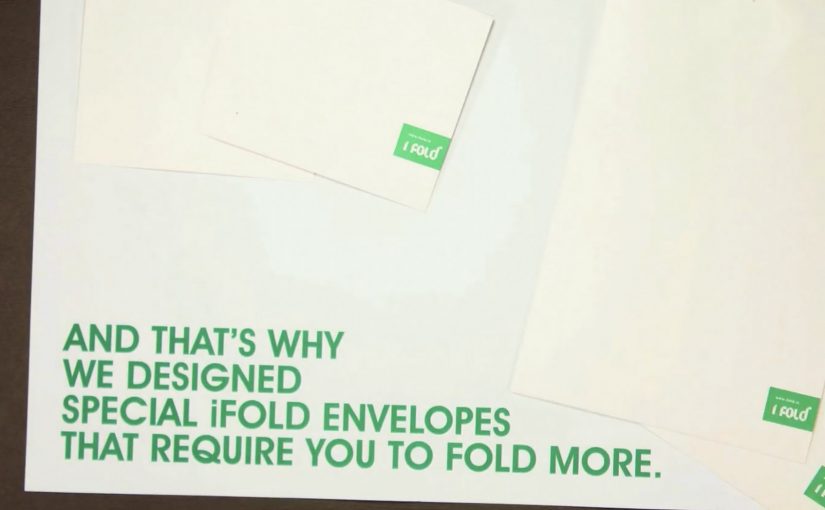
Billions of business envelopes are used every day. Imagine how much paper can be saved if we just halved their size.

So while posting a letter, ask: can it be folded once more. If it can, fold more.

Use a smaller envelope. Save trees. It’s that simple. It’s called iFOLD.

A tiny behavior change, packaged as a system

The mechanism is effort-to-impact math: a simple rule where one extra fold creates a visible downstream saving. One extra fold reduces envelope size. Reduced envelope size reduces paper consumption. That works because the cause and effect are easy to understand immediately, so the behavior feels practical rather than preachy. The campaign frames this as a repeatable rule anyone can apply without new infrastructure or technology.

In high-volume corporate mailrooms and customer communications, small process changes compound into meaningful material savings.

The real question is how to turn a trivial action into a default business habit. The smart move is to build the fold into standard mailing practice, not treat it as a one-off reminder.

Why it lands

This works because it does not ask for a lifestyle shift. It asks for a micro-habit that fits inside existing routines. The instruction is binary, memorable, and immediately testable. You can literally try it with the next letter in your hand.

Extractable takeaway: When you want behavior change at scale, give people a single, repeatable decision rule that requires almost no extra effort, and make the benefit feel cumulative and obvious.

Steal this envelope logic

  • Make the rule portable: one sentence people can remember and repeat.
  • Target a high-frequency routine: boring, repetitive processes are where scale lives.
  • Prefer “do this instead” over “stop doing that”: substitution habits stick better than abstinence messages.
  • Connect the micro to the macro: one fold feels trivial. Aggregate savings makes it feel worth doing.
  • Design for adoption inside organizations: the best ideas fit procurement, operations, and compliance realities.

A few fast answers before you act

What is iFOLD?

iFOLD is a paper-saving idea that encourages people to fold letters one extra time so they can be mailed in smaller envelopes.

Why focus on envelope size?

Because envelopes are used at massive volume in business and government. Small reductions per unit add up quickly at scale.

What makes this a strong sustainability message?

It is a concrete action, not an abstract appeal. People can do it immediately without buying anything new.

Where does this work best?

In organizations that send large quantities of letters and statements, where a standard change in folding and envelope formats can be implemented consistently.

What could prevent adoption?

Template constraints, inserts that cannot be folded further, window placement, and operational inertia. The idea works best when mail formats are designed with folding flexibility in mind.