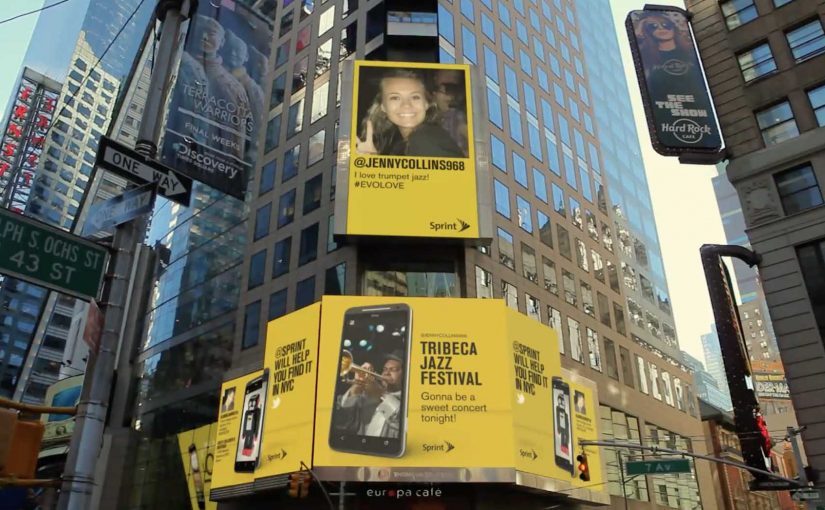
You are in Times Square and a billboard asks a simple question. What do you love. You tweet your answer with #EVOLOVE to @sprint, and the screen answers back with places in New York City where you can find it.
Sprint in the USA created an integrated advertising campaign for the launch of the HTC EVO 4G LTE phone on their network. To launch EVO in New York City they set up an interactive billboard in Times Square that encouraged visitors to tweet things they love with #EVOLOVE to @sprint. Then, with the help of local experts, the billboard re-tweeted locations of where these things of love could be discovered in New York City.
Why the mechanic works
The mechanism is a clean exchange. You give the brand a public signal. A tweet about something you love. The brand gives you an immediate, useful response. A location you can act on right now. That “reply with value” is what turns a hashtag prompt into participation.
Extractable takeaway: Interactive OOH works best when the public input reliably triggers a fast, specific reply that helps someone decide what to do next.
It also creates a visible social proof layer. The billboard is not only showing Sprint’s message. It is showing other people’s messages, which makes the campaign feel alive and current while you are standing there.
In consumer technology launches and telco marketing, a social-to-DOOH loop, where a social post immediately changes what the screen shows, turns a landmark screen into a real-time recommendation engine that people can influence from their own phones.
What Sprint is really buying
This is a launch tactic that behaves like service. It positions the EVO as a device you use to discover the city, not just a phone with specs. At the same time, it lets Sprint demonstrate “unlimited” as a lived experience. Always on, always connected, always responding in real time.
The real question is whether you can keep the reply layer fast, relevant, and brand-safe in public.
If you cannot operationalize that reliably, a simpler DOOH idea will outperform an “interactive” one that feels slow or generic.
Steal this reply-with-value billboard pattern
- Make the input obvious. One hashtag. One handle. One sentence prompt.
- Return something concrete. Maps, directions, a nearby place, a clear next action.
- Curate the response layer. “Local expert” guidance beats generic automation for relevance and trust.
- Design for the crowd and the clip. The street moment should be fun to watch. The video should still work without being there.
A few fast answers before you act
What is the Sprint #EVOLOVE Times Square billboard?
A digital billboard that invites people to tweet what they love with #EVOLOVE to @sprint, then responds by showing where in New York City they can find that thing.
Why connect Twitter to a billboard instead of running a normal DOOH spot?
Because participation becomes the content. The screen stays fresh, people feel seen, and the interaction creates a public spectacle that attracts more participants.
What is the “value exchange” in this campaign?
The user provides a public message and attention. The brand provides a timely, useful recommendation and makes the user visible on a high-profile screen.
What makes this different from simply displaying tweets on a screen?
The reply layer. The billboard does not only mirror tweets. It answers them with specific places and directions, which turns social chatter into utility.
What is the biggest execution risk?
If the responses feel slow, generic, or off-topic, people stop playing. The campaign only works when the replies feel genuinely relevant in the moment.