
ActionAid: Donate Your Profile

ActionAid is an organisation committed to many projects, like fighting hunger and poverty. But in Italy it is known primarily for sponsoring children.

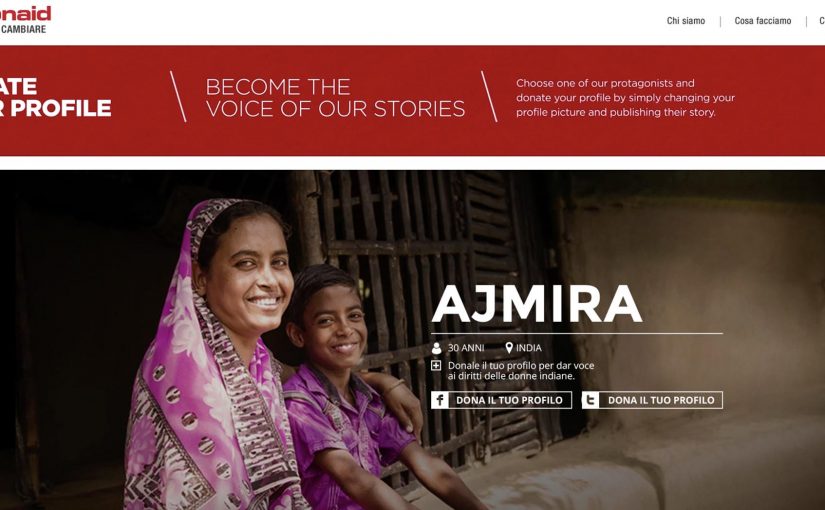
To communicate the broader work of ActionAid with a small media and production budget, DLV BBDO created “Donate Your Profile”. Participants donated their Facebook and Twitter profile pictures so that awareness could be generated for the stories of people ActionAid helped.

How “Donate Your Profile” worked

The mechanism is a simple identity swap. People hand over the most visible square in their social presence. Their profile photo. In return, they display a campaign image tied to a real person’s story, so every comment, like, and share carries that story into everyday social traffic.

Support from Radio 105, Radio Deejay, La Stampa, Marc Marquez and other Italian celebrities and brands helps normalise the behaviour. Once well-known accounts participate, the “donate your picture” action looks safe, easy, and socially endorsed.

In Italian cause marketing, borrowing social identity can outperform paid media when budgets are tight, because it turns personal networks into distribution.

The real question is how to turn a low-budget act of support into something people carry through their normal social behaviour.

Why the profile swap spreads

This works because it converts passive support into a visible, persistent signal. A profile picture is not a post that disappears in a feed. It is a durable badge that travels wherever you show up online, and it prompts questions that naturally lead to explanation and sharing.

Extractable takeaway: If you need earned reach without heavy spend, move the call to action from “share a post” to “change a default”. When people change a default surface, the campaign rides along with their normal behaviour.

The reported impact

The project was described as becoming the 5th most trending topic on Twitter and generating over 79 million media impressions, with more people joining in as the support network grew.

What to borrow from the profile-swap pattern

  • Pick a high-frequency surface. Defaults like profile photos travel more than one-off posts.
  • Make the action reversible. People participate faster when the commitment feels temporary.
  • Seed with credible partners. Media brands and recognisable faces reduce hesitation.
  • Turn participation into a conversation starter. The best mechanics invite questions, not just clicks.

A few fast answers before you act

What is “Donate Your Profile”?

It is a campaign where people replace their Facebook and Twitter profile pictures with a campaign image, so ActionAid stories gain awareness through everyday social interactions.

Why use profile pictures instead of posts?

A profile picture is persistent and high-visibility. It shows up repeatedly across comments and interactions, so the message travels without requiring constant re-posting.

How did the campaign scale beyond early participants?

Reportedly through support from media brands and celebrities, which makes the behaviour feel normal and increases follow-on participation.

What results were reported?

Reported results included reaching the 5th most trending topic on Twitter and generating over 79 million media impressions.

What is the main risk with this pattern?

Trust. If people are unclear about what is being changed, for how long, and what they are authorising, participation drops. The exchange must be transparent and easy to undo.
KLM: Fly2Miami Dance Party

In the past couple of years, airlines like KLM, SAS, Lufthansa and Air China have pushed social media beyond “posting and promoting” by turning it into a stage for real-world moments.

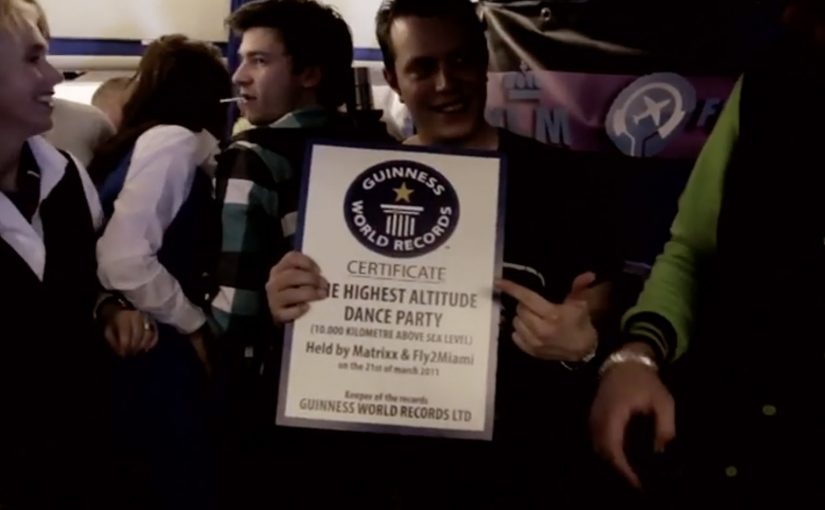
In its Fly2Miami campaign, KLM creates a wave of buzz by hosting a record-billed, meaning promoted as record-setting, in-flight dance party at 35,000 feet, tied to the launch of a new non-stop route from Amsterdam to Miami.

A route announcement that becomes a public challenge

It starts with KLM announcing the new service. Dutch DJ Seid van Riel and producer Wilco Jung tweet KLM asking if the inaugural flight can move up by a week so they can make a Miami music festival. KLM replies with a challenge: fill the plane, and KLM will reschedule. The flight sells out within hours.

How the mechanic works

Mechanically, KLM turns a scheduling request into a participatory social goal with a clear payoff. People do not just “like” the announcement. They help unlock the outcome by committing to seats, then join a one-off experience that can only happen because the flight exists.

In airline route launches, social stunts work best when they turn a schedule announcement into a shared story people can join.

Why it lands

The genius is not the party alone. It is the sequence: a believable trigger (a tweet), a public condition (fill the plane), a fast-resolution arc (sold out), then a payoff that photographs and travels. It works because the public condition turns individual bookings into visible momentum, making the payoff feel earned rather than bought. The campaign makes KLM feel responsive, playful, and culturally plugged in, without needing to shout about fares.

Extractable takeaway: When the condition is public and the payoff is inseparable from the product, participation becomes both demand and distribution, because people feel they helped make the outcome real.

What KLM is really buying

This is conversion disguised as entertainment. The “buzz” is a byproduct of a very practical outcome: a plane filled with the right kind of passengers, at the right time, with a story worth retelling. The real question is whether your stunt pulls demand forward inside the product, or just borrows attention for a day. By “retellability,” I mean how easily the story can be repeated accurately in one sentence and shared without extra explanation. If the Guinness claim is how it was billed, that label simply amplifies the retellability.

Route-launch moves worth copying

  • Start with a real trigger. A genuine request beats a manufactured “activation” premise.
  • Set one public condition. A simple target (fill the plane) creates momentum and accountability.
  • Make the payoff inseparable from the product. The experience must only be possible because your product exists.
  • Design for a tight story arc. Setup, challenge, resolution, payoff. No fluff.

A few fast answers before you act

What is Fly2Miami in one line?

A route launch turned into a Twitter-fueled “fill the plane” challenge, culminating in an in-flight dance party on the inaugural Amsterdam to Miami service.

What is the core mechanism?

A public conditional promise: if the community fills the flight fast enough, KLM changes the schedule and delivers a one-off onboard experience.

Why is the “sold out in hours” detail important?

Because it proves participation was real, not symbolic. It converts attention into bookings, then turns the bookings into a story.

What makes the challenge believable?

A condition that is simple to verify and directly tied to the product, like filling seats, keeps the story grounded and prevents it from feeling like a manufactured “activation.”

What is the transferable lesson for other brands?

Turn a product moment into a challenge with a clear condition and a tangible payoff, then let the audience do the distribution by earning the outcome.

Hire Us: Twitter Follow Stunt Lands a Job

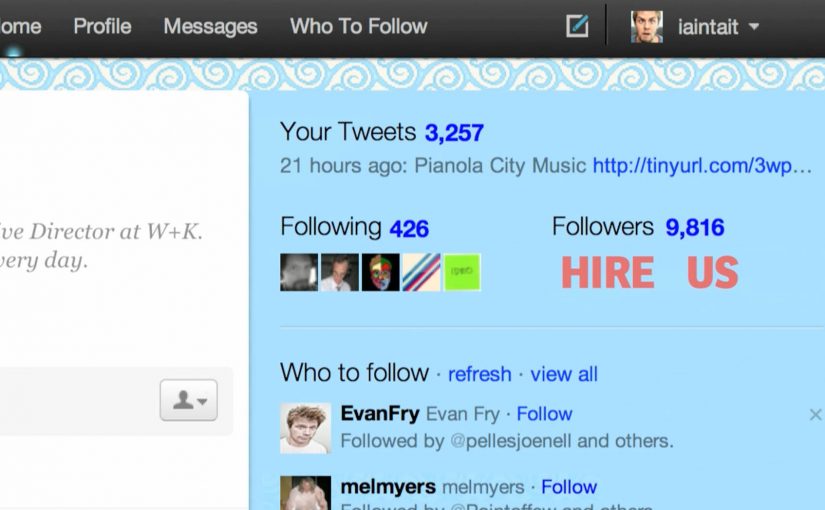
Dutch creative team Bas van de Poel and Daan van Dam set up five separate Twitter accounts and started following various Dutch Creative Directors on Twitter. Their message was simple: HIRE US.

Even though the idea is very similar to the Jeep Twitter Puzzle campaign, the execution is different and innovative. It gets them noticed and finally a job with Boondoggle in Amsterdam.

Why five accounts is the point, not the gimmick

The mechanism is engineered repetition. By “engineered repetition,” I mean deliberately creating multiple small signals that form an obvious pattern in the target’s notifications. One account can be ignored. Five accounts create a pattern. When multiple new followers arrive with the same blunt message, it triggers curiosity and a small sense of social pressure. Someone is doing something intentional, and it is hard not to look.

It is also highly targeted. They do not broadcast “hire us” into the void. They place it directly in the attention stream of the people who can change their outcome.

In creative hiring markets, attention is scarce, so using a platform’s native behaviours to deliver an instantly legible message is often the fastest way to get noticed.

Why it lands: interruption plus clarity

This works because it is instantly legible. No clever puzzle to decode. No long portfolio pitch. The call to action is the entire creative idea. That clarity is what makes it feel confident. And because it happens inside Twitter’s native behaviours, following, notifications, profile clicks, it does not require extra friction. The recipient can react in seconds.

Extractable takeaway: When you need attention from specific decision-makers, create a small pattern using the platform’s native behaviours that communicates the ask in one glance and makes the next step easy.

The intent: turn hiring into a creative brief

The business intent is obvious. Get hired. But the deeper intent is to reframe the hiring process. Instead of asking for a meeting, they create a live demonstration of how they think. Targeted, lightweight, and culturally fluent in the medium.

The real question is how you create an impossible-to-ignore signal for the right people without turning the medium into spam.

Done with tight targeting and restraint, this approach is a legitimate creative proof point. Done broadly or repeatedly, it backfires as noise.

Borrow this for your own career marketing

  • Be specific about who you want. Target decision-makers, not “everyone”.
  • Design an interruption that fits the platform. Use native behaviours, not extra hoops.
  • Make the message instantly legible. One idea. One line. No explanation required.
  • Turn the ask into proof. Show your creativity in the method, not in a PDF pitch.
  • Keep it respectful and reversible. Clever is good. Spammy is not.

A few fast answers before you act

What did Bas van de Poel and Daan van Dam actually do?

They created five Twitter accounts and followed Dutch Creative Directors with a single message: “HIRE US”.

Why did using multiple accounts matter?

It created a noticeable pattern and a stronger interruption than a single follow, prompting curiosity and profile clicks.

How is this different from the Jeep Twitter Puzzle?

It is similar in spirit, but the execution is simpler and more direct. A single clear call to action rather than a puzzle mechanic.

What made it effective as self-promotion?

High targeting, low friction, and a message that communicates confidence in one second.

What is the main takeaway for personal branding?

If you want attention from decision-makers, design a small, platform-native experience that demonstrates how you think and makes the next step easy.