
Volkswagen: Image Search SEO as an “Organic Ad”

When the “ad” is the search results page

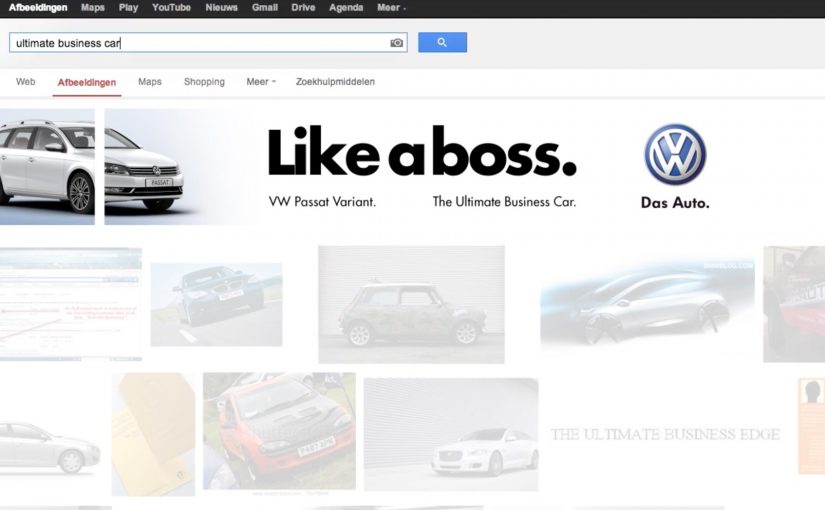
Everyday millions of people are searching for products and brands on Google. So in this latest example of search optimisation, SEA Team from UK created a search engine advertising campaign for Volkswagen which positioned the car in a unique “organic ad” created by optimising the first five individual URLs of a Google Image Search.

The campaign does feel realistic but when I searched for “ultimate business car”, I got only images from people posting about the campaign.

The hack: assemble a creative out of ranked tiles

The idea is essentially compositional SEO. You do not buy a placement. You engineer multiple image results so the grid itself becomes one coherent “ad.” The medium is the interface people already trust.

Why it is both clever and fragile

It feels native because it lives inside an everyday behavior. searching. But the moment the campaign becomes the story, the query gets polluted. Your “proof” starts returning meta-content about the stunt, not a stable, normal-looking result set.

What this is really trying to achieve

Borrow the credibility of organic results while delivering the impact of a designed creative. A brand moment that lives exactly where intent lives.

What to steal. And what to watch out for

  • Use interface-level creativity. Sometimes the container is the canvas.
  • If you rely on organic authenticity, plan for contamination once the stunt spreads.
  • Pick queries and mechanics where the effect can survive time, press, and copycats.

A few fast answers before you act

What was the Volkswagen “organic ad” concept?

A campaign that optimized the first five source URLs in a Google Image Search so the image grid formed a single Volkswagen creative.

Who created it?

The post credits SEA Team from the UK.

Why does it feel realistic at first?

Because it appears inside an organic search behavior and uses the familiar image-results interface as the placement.

What problem did the post observe when trying it later?

Searching for “ultimate business car” returned mostly images of people posting about the campaign, rather than a clean, normal-looking result set.

Mountain Dew: Paintball Street Art in London

Paintballing meets street art in Mountain Dew Energy’s UK campaign. The idea is built around a simple collision: take the raw physicality of paintballing and merge it with graffiti culture.

The campaign is centred on a Facebook app designed to find and showcase the brand’s official street artists. Rather than appointing talent from the top down, Mountain Dew Energy lets fans decide who represents the brand on the street.

The campaign video shows the Graffiti Kings creating large-scale street art using paintballs inside London’s graffiti hub, the Leake Street Tunnel. The featured artists, Knoxville and Grohl, are not random selections. They were chosen by fans following a teaser phase that invited participation before a single wall was painted.

When the medium becomes the spectacle

The mechanism is the twist on technique. Graffiti is usually associated with spray cans and markers. Paintballs introduce unpredictability, force, and performance. The act of creation becomes as interesting as the final artwork, giving the campaign strong visual momentum.

In youth and culture-led marketing, credibility rises when the brand builds a participatory system and lets the community validate the outcome.

Why fan selection changes the power dynamic

Letting fans choose the artists shifts authorship. The brand steps back from curating taste and instead creates a framework where the community validates talent. That makes the outcome feel earned rather than manufactured, which matters in street culture.

This also gives the campaign a built-in narrative arc. The teaser phase creates anticipation. The vote creates ownership. The execution becomes a payoff that fans feel partially responsible for.

The intent behind the paintballs

The business intent is not just awareness. It is cultural alignment. Mountain Dew Energy positions itself close to street culture, creativity, and youth expression. By avoiding polished studio aesthetics, the brand signals that it understands the messier, louder edges of its audience.

What to steal from this campaign

  • Hybridise formats. Combining two cultures can create immediate distinction.
  • Make creation performative. If the process is entertaining, it becomes shareable.
  • Let fans decide. Participation before execution increases emotional investment.
  • Choose the right setting. Leake Street Tunnel adds credibility that no set could replicate.
  • Design the buildup. Teasers and voting give the campaign a rhythm, not just a reveal.

A few fast answers before you act

What makes this campaign different from typical street art sponsorships?

The use of paintballs turns graffiti into a live performance, not just a finished visual, and makes the act of creation central to the story.

Why involve fans in choosing the artists?

It transfers credibility. When the community selects the talent, the brand avoids looking like it is imposing taste from above.

Does the Facebook app actually matter?

Yes. It is the coordination layer that turns passive viewers into active participants and gives the campaign a reason to unfold over time.

What audience behaviour is this trying to encourage?

Engagement, sharing, and identification with the brand as part of a creative subculture rather than just a beverage choice.

What is the key takeaway for brand-led cultural campaigns?

Create a platform, not just a placement. When people can influence the outcome, they are more likely to care about the result.

AR Cinema: London Movie Scenes on iPhone

Turn London into a living movie map

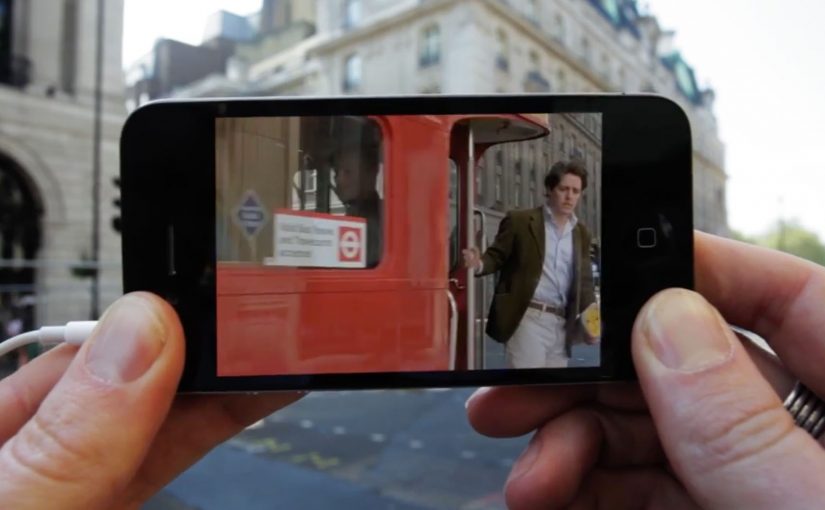
The Augmented Reality Cinema app for the iPhone allows you to walk around London and discover all the places where movies have been shot. Just point your iPhone in the direction of a sweetspot and get a replay of the movie scene that was shot there.

The app is currently a work in progress prototype. But if and when it does see the light of day, I am sure it will make a great gizmo for all the movie buffs out there.

The magic is not AR. It is time travel

The clever part is the juxtaposition. You stand in the real location. Then you pull the filmed moment back into that exact space. That overlap between “here” and “then” is what makes the concept feel instantly shareable and instantly fun.

In city exploration experiences, the strongest mechanics turn real-world wandering into a lightweight mission with an instant payoff.

Why this fits the way people explore cities

It turns wandering into a mission without forcing a route. You move naturally, and the city rewards curiosity with a scene. That is a strong mechanic for tourists and locals alike because it makes discovery feel personal.

What this prototype is really aiming for

A new kind of location-based entertainment. Part guided walk, part trivia, part nostalgia. Built around the simplest action. Point. Watch. Move on.

What to steal if you build AR experiences

  • Anchor the experience to real places people already want to visit.
  • Give the user one simple gesture that unlocks the payoff. Point and replay.
  • Use “before vs now” contrast as the hook. It creates emotion without heavy storytelling.

A few fast answers before you act

What does the Augmented Reality Cinema app do?

It lets you walk around London, point your iPhone toward a location “sweetspot,” and replay the movie scene filmed there.

Is the app available?

The post describes it as a work-in-progress prototype.

Who is it for?

Movie buffs and anyone who enjoys exploring film locations while walking the city.

What is the core mechanic?

Location-based discovery paired with an AR replay that overlays a movie scene onto the real place where it was shot.