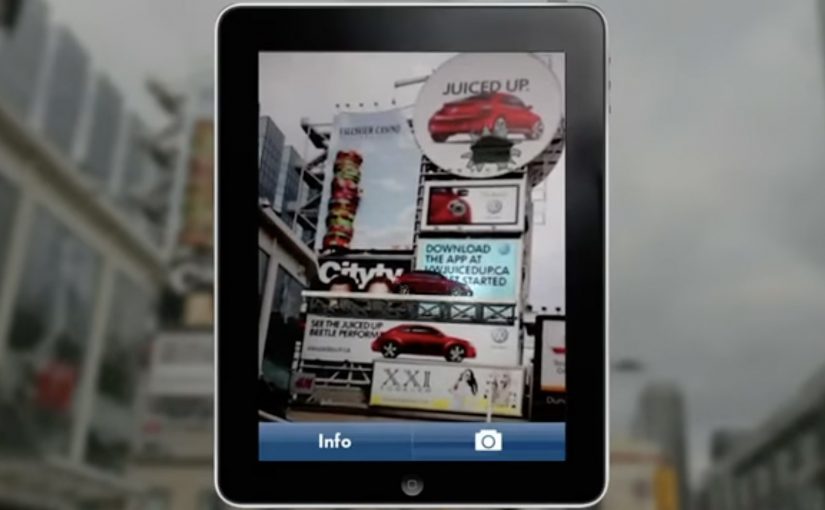
A billboard looks normal until you point your phone at it. Then the Beetle “juices up” into a 3D scene that spills out of the frame, turning a static poster into something you can explore.
That is the twist behind Volkswagen’s Beetle “Juiced Up” launch, created with Red Urban. Traditional out-of-home placements like billboards and bus shelters double as augmented reality markers. Download the custom app, scan the printed ad, and a 3D experience unlocks on your screen.
An AR marker is a printed visual pattern that a camera can recognize. When the app detects it, it anchors digital 3D content to the real-world poster so the animation appears to sit on top of the physical ad.
The best out-of-home work turns “I noticed it” into “I did something with it”, without asking people to learn a new behaviour.
Why AR markers work so well in out-of-home
Out-of-home already has the two things AR needs. Scale and repetition. People pass the same placements multiple times, which makes it easier for curiosity to build. Once someone scans, the experience feels like a hidden layer you only get if you engage. In global consumer brands running large-scale launches, out-of-home works best when it functions as a repeated trigger, not a one-time impression. A revamp is hard to communicate through copy alone. A 3D reveal makes the “newness” feel more tangible, even if the viewer only plays for a few seconds.
Extractable takeaway: Treat the physical placement as the interface. Make the first scan feel like the poster is “unlocking”, and keep the payoff immediate so the viewer control feels effortless.
What this launch is really optimizing for
This is not just about feature education. It is about reframing the Beetle’s personality and making the redesign feel more assertive and contemporary. The real question is whether your out-of-home is only a reminder, or a trigger that rewards interactivity. The app is a proof device, meaning it proves “this is different” by behaving differently than a normal poster campaign. This approach is worth doing only when the interaction reinforces the product story, not when it is novelty for its own sake.
What to steal for your next OOH-led activation
- Make the trigger obvious. A single prompt, scan here, is enough. Let the payoff do the persuasion.
- Anchor the interaction to the medium. If it is out-of-home, the phone should feel like a lens on the poster, not a separate experience.
- Keep the first moment fast. If the 3D reveal does not land immediately, the novelty collapses.
- Design for “I have to show you”. The best activations create a demo impulse that spreads in person.
A few fast answers before you act
What is “Volkswagen Beetle: Juiced Up”?
It is an out-of-home launch activation where Volkswagen posters and billboards act as AR markers. A dedicated mobile app unlocks a 3D Beetle experience when viewers scan the ads.
Why use AR markers instead of a standard QR code?
Markers make the poster itself the interface. That keeps the experience visually seamless, and it helps the 3D content feel physically attached to the real ad.
What is the main benefit of this approach for a product revamp?
It makes “newness” experiential. A 3D reveal can communicate attitude and redesign energy faster than a feature list.
What is the biggest practical risk with AR OOH?
Friction. If the app install and scan flow is slow, most people will not complete it. The reward has to justify the effort quickly.
What is the simplest way to improve completion rates?
Reduce steps and increase immediate payoff. Clear instruction at the poster, fast recognition, and an instant 3D moment that feels worth showing to someone else.