
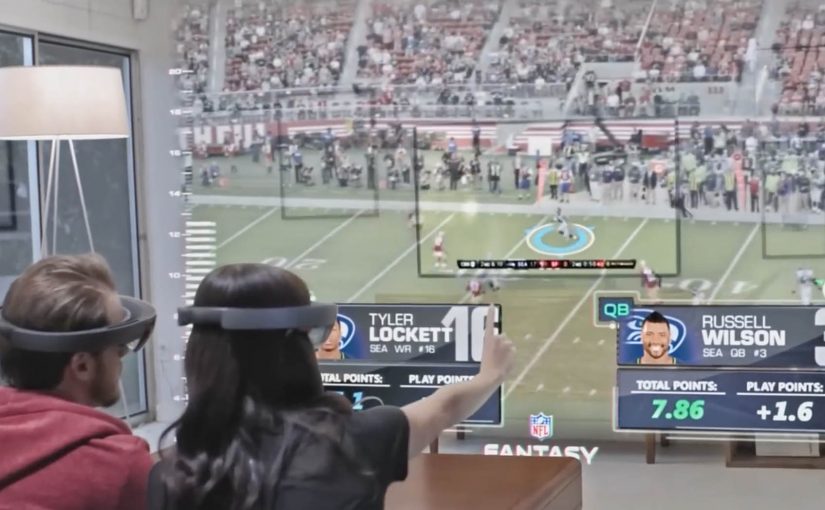
TV Viewing: Super Bowl Meets HoloLens

TV viewing is overdue for a real change

The TV viewing experience does not change drastically for years. Bigger screens, better resolution, smarter interfaces. But the core behavior stays familiar.

That is why sophisticated headsets like Microsoft HoloLens feel like a genuine breakpoint.

They do not just improve the screen. They change the environment around it.

Microsoft and the NFL re-imagine the Super Bowl

In a recently released video, Microsoft and the NFL re-imagine how a Super Bowl game could be watched with multiple friends and family members.

The scenario pushes beyond passive viewing. It turns the living room into an interactive layer, where the game experience becomes more immersive, more social, and more spatial.

By spatial, I mean the content is anchored to the room, not confined to the TV frame.

This is the kind of concept that makes the future of TV feel tangible.

In mass-market entertainment, the constraint is not what immersive concepts can show, but when consumer hardware becomes affordable, comfortable, and mainstream.

Why this lands for co-viewing

TV should prioritize co-viewing, meaning multiple people watching and reacting together in the same room, because a shared, spatial layer creates viewer control that a single rectangle cannot. The real question is whether you are designing for shared viewer control in the room, or just adding data overlays to a screen.

Extractable takeaway: When you move sports content into the room, design the experience around shared reference points, lightweight interaction, and conversation pacing, not around more screen real estate.

Immersive viewing is real. Consumer timing is not

The video shows how immersive TV watching can get. But Microsoft is not fast-tracking HoloLens for consumer consumption.

For now, only developers can order HoloLens, shipping this year.

No one knows when consumers get access, or when scenarios like this become a reality.

That uncertainty is part of the story. The vision is clear. The rollout timeline is not.

Steal these design cues for living-room sports

  • Design for the room. Treat the TV as one surface among many, then anchor the key moments and data where people naturally look and point.
  • Make co-viewing explicit. Support multiple viewers and viewpoints, so participation feels shared instead of “one person driving.”
  • Prototype for constraints. Assume headsets stay niche for a while, and test what still works when only one person has the device.

A few fast answers before you act

Is this still “TV” or something else?

It starts as TV content, but behaves more like a shared, spatial experience than a single screen.

What is the core shift headsets enable?

They move content off the rectangle and into the room, so viewing becomes environmental and interactive.

What is the biggest constraint right now?

Availability and consumer readiness. Until mainstream hardware adoption happens, this remains concept-led.

What should experience designers take from this?

Design for co-viewing and spatial context. Multiple people, multiple viewpoints, and shared interaction become first-class requirements.

What should you prototype first?

Prototype the simplest “shared moments” layer, so two to four people can compare and discuss the same play without anyone leaving the game flow.
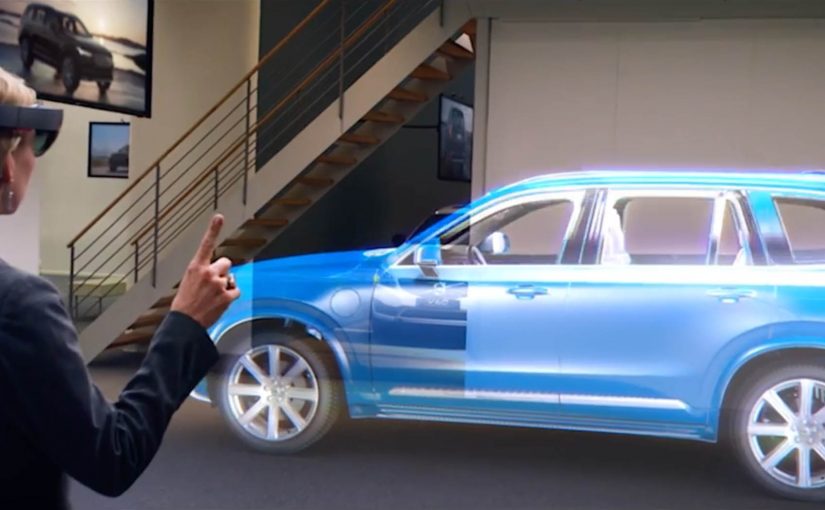

Volvo HoloLens Showroom: Virtual Dealership

The showroom no longer needs cars

Car dealerships traditionally depend on physical inventory.

Space, logistics, and availability limit what customers can see, touch, and configure. That constraint disappears when Volvo introduces a showroom experience powered by Microsoft HoloLens.

Instead of walking around parked cars, customers step into a virtual environment where full-size vehicles appear as holograms.

How the HoloLens showroom works

Using HoloLens, customers explore Volvo cars at real scale. This is mixed reality, digital objects anchored to the physical space around you.

They walk around the vehicle. Look inside. Inspect details. Colors, trims, and configurations change instantly. The experience feels physical, even though no car is present.

The showroom becomes software-driven. Inventory becomes optional.

In high-consideration retail, the job is helping people visualize options confidently before commitment, even when the product is not physically present.

Why this matters for automotive retail

This is not a gimmick. Virtual showrooms reduce the need for large floor space and allow dealerships to showcase the full portfolio, including models and options that are rarely stocked physically. Because customers can see the car at full scale and switch configurations instantly, they can compare options without relying on imagination, which makes commitment feel safer.

Extractable takeaway: If you can make options visible at real scale and changeable in seconds, you can sell preference, not availability, even when the product is not physically present.

For customers, the experience becomes calmer and more focused. There is less pressure. More exploration. Better understanding before committing.

Experience beats inventory

The deeper shift is about viewer control.

The real question is whether your showroom is designed for preference discovery or for stocking convenience.

Dealerships should treat mixed reality as a configuration layer that complements physical touchpoints, not as a tech demo.

Customers explore at their own pace. Sales staff guide rather than push. The conversation moves from availability to preference.

The dealership turns into a configuration studio, not a warehouse.

  • Make configuration the starting point. Let customers explore options first, then map the shortlist to what they can test and buy.
  • Keep staff in guide mode. Use people to frame trade-offs and confirm choices, not to gate access to information.
  • Design the experience like software. Treat the showroom as a repeatable configuration studio, not a one-off installation.

A few fast answers before you act

Is this replacing test drives?

No. A mixed reality showroom helps customers narrow configurations before a physical test drive.

What do customers actually do in the HoloLens showroom?

They walk around a life-size hologram, look inside, inspect details, and switch colors, trims, and configurations in real time.

What is the real business benefit?

Reduced reliance on physical inventory, clearer configuration conversations, and better use of showroom space.

Why does mixed reality fit automotive retail?

Cars are high-consideration purchases, so visualization can carry as much weight as specification.

What has to be true for this to feel real?

The hologram must stay aligned to the physical space, and configuration changes must respond instantly so customers trust what they are seeing.

Lexus Hoverboard: Engineering a Brand Moment

Lexus builds a hoverboard. On purpose.

Lexus did not build a hoverboard to sell it. They built it to show what the brand stands for when you strip away the brochure.

The real question is whether you can prove engineering credibility in public without turning it into an ad.

The Lexus Hoverboard is presented as a rideable board that levitates above the ground using magnetic levitation. The campaign frames it as engineered, tested, and demonstrated rather than simulated.

This is brand storytelling executed through engineering, not advertising copy.

How the hoverboard is described to work

The hoverboard uses magnetic levitation technology. Magnetic levitation means the board is held up by magnetic forces rather than wheels or air pressure.

Superconductors inside the board are described as being cooled with liquid nitrogen. When placed above a specially designed magnetic track, the board “locks” into position and floats.

The result is controlled levitation. Not free roaming, but stable, directional hovering that makes riding possible. The constraint becomes part of the proof, because it makes the mechanism legible to viewers.

In premium automotive and consumer technology categories, the fastest path to trust is often a visible demonstration of real capability rather than another layer of messaging.

Why it feels like engineering, not hype

Lexus positions itself around precision, control, and advanced engineering. The hoverboard compresses those values into a single, highly visual artifact. You do not need to read a brochure to understand it. You see it.

Extractable takeaway: If you want people to believe a capability, build a demonstration where the constraints are obvious and the work is hard to fake.

By putting professional skateboarders on a levitating board in a purpose-built environment, Lexus turns technical credibility into a cultural moment.

What Lexus is really doing here

The hoverboard is not positioned as a prototype for future mobility. It is a brand signal.

By “brand signal,” I mean a deliberate proof point that tells the market what you are capable of, even when no one can buy the thing you built.

Lexus frames the execution as complex technology made real and presented with control rather than chaos. In categories where trust in engineering is everything, that framing is the product.

Demonstrations beat declarations when your differentiation is engineering, because they create belief before the copywriting starts.

What this says about modern brand building

Brands increasingly compete on what they can demonstrate, not what they can claim. When technology is real, visible, and difficult to fake, it carries more weight than messaging.

The Lexus Hoverboard works as a brand moment because it is unnecessary. It exists only to make a point.

What to steal for your next credibility play

  • Choose a proof, not a promise. Build one artifact that makes the capability undeniable.
  • Make the constraints visible. If people can see what makes it hard, it reads as real.
  • Turn the demo into a scene. Put the proof in a context people recognize and want to share.
  • Separate “signal” from “SKU.” Treat this as brand equity work, not product pipeline.
  • Design for replay. Aim for a story people can retell in one sentence.

A few fast answers before you act

Is the Lexus Hoverboard real or CGI?

In the campaign, it is presented as a real levitating board demonstrated in-camera, not a visual effects sequence.

How does the hoverboard create levitation?

It is described as using superconductors cooled with liquid nitrogen over a magnetic track, producing magnetic levitation.

Why does it only work in specific locations?

Because the magnetic infrastructure is part of the system. Without the track, the “hover” mechanism has nothing to levitate against.

What is Lexus actually selling with this stunt?

Confidence in engineering. The point is to compress precision, control, and advanced capability into one unforgettable proof moment.

What makes this kind of demo believable to audiences?

Visible constraints plus visible performance. When the audience can see what makes it hard to fake, the claim carries more weight.

When should a brand copy this pattern?

When your differentiation is technical credibility and your category runs on trust. Build a proof artifact that makes the capability obvious in seconds.