
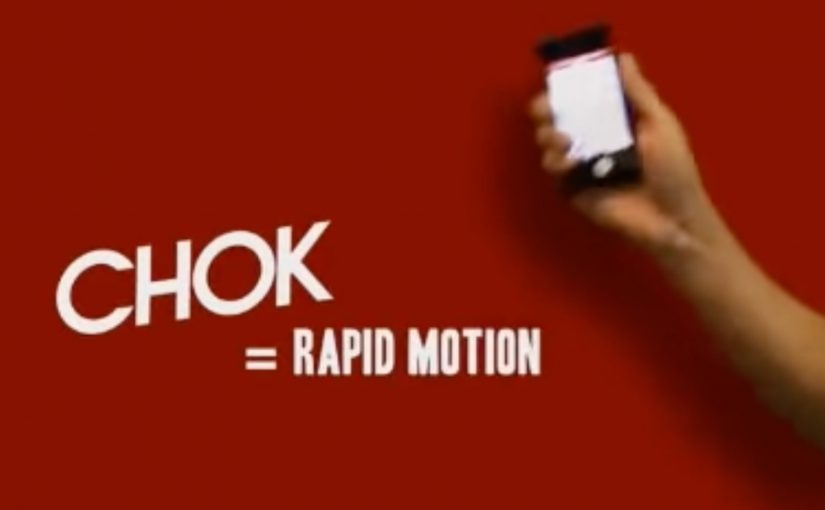
Coca-Cola: Chok Chok

Mobile and creative thinking can come together to create really compelling marketing campaigns. In this example, Coca-Cola Hong Kong created a “Chok Chok” mobile app that turned the viewer’s smartphone into a remote control for their TV ad.

To collect the Coca-Cola bottle caps that appeared on the TV screen, viewers had to swing their phones when the ad came on. Those who successfully managed to swing and collect were instantly rewarded with prizes that included cars, sports apparel, credit card spend value, travel coupons and movie tickets.

As a result the campaign was seen by 9 million people and the app got over 380,000 downloads.

The real question is whether your second-screen idea creates a one-step action people can do instantly when the media moment appears.

For those wondering, the bottle cap collection was enabled through the audio signal of the ad, which triggered the application and synced the user’s motion with the ad. The accelerometer in the phone was also used to assess the quality of the motion. Together they were used to catch the bottle caps virtually.

However as far as I know, Honda in the UK was the first to pioneer this kind of an interactive TV ad, even though it did not receive results like Coca-Cola.

In mass-reach consumer campaigns where TV attention and smartphone use overlap, audio-synced interactivity can turn a passive spot into a short participation window.

Why this works so well

It works because it gives the viewer control in a way TV usually does not. Here, “viewer control” means one deliberate physical action that directly drives what you get from the ad. Because the ad’s audio triggers the app and the accelerometer judges motion quality, the “catch” feels causally tied to the on-screen moment instead of feeling random.

Extractable takeaway: If you want participation in real time, design a one-second action that maps cleanly to an on-screen event, then make the feedback and reward immediate.

  • Viewer control is the hook. The ad is not just watched. It is “played” through a simple physical action.
  • Timing creates urgency. You have to act when the ad is live, which turns media time into a moment of participation.
  • Feedback is immediate. You swing, you collect, you win. The loop is easy to understand and easy to repeat.

Steal this second-screen loop

Start with a single, unmistakable behavior the viewer can do in one second. Then use a reliable synchronization trigger (here, the ad’s audio) and a sensor input (here, the accelerometer) to connect the phone action to what happens on screen. This is the right level of interactivity for broadcast media: simple action, obvious timing, instant payoff.

  • One-second action. Choose a gesture the viewer can do immediately when the spot starts.
  • Reliable sync trigger. Use a broadcast-carried signal to trigger the experience, such as the ad’s audio.
  • Sensor validation. Use the phone sensor input to assess whether the action quality is good enough to “count”.
  • Immediate feedback. Keep the loop legible: swing, collect, win.

A few fast answers before you act

What is Coca-Cola “Chok Chok”?

It is a Coca-Cola Hong Kong mobile app that synchronizes with a TV ad and lets viewers swing their phones to collect on-screen bottle caps for prizes.

How did the app sync with the TV ad?

The app used the audio signal of the ad as the trigger, then aligned the on-screen moments with the user’s motion so “collection” happened at the right time.

What role did the accelerometer play?

The accelerometer assessed the quality of the swinging motion, helping determine whether the viewer “caught” the bottle caps virtually.

What is the main takeaway for interactive TV and second-screen work?

Make participation effortless, tie it to a tight timing window, and reward the action immediately so the viewer feels impact in the moment.
Augmented toys and games from Toy Fair 2013

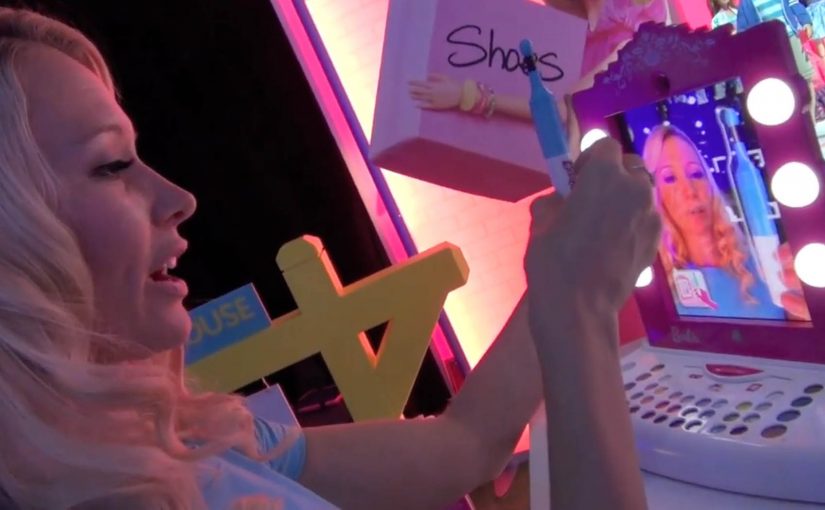
A Barbie vanity frame turns an iPad into a make-up mirror, then “virtual lipstick” stays aligned to a moving face in real time. That single mechanic explains why Toy Fair in New York suddenly feels like a preview of hybrid play, where the screen becomes a window and the physical object remains the star.

Most of the standout demos share the same blueprint. A physical toy, book, or playset provides the anchor. The iPad app provides the content layer. The camera feed stitches the two together so kids can touch, move, build, and explore while the digital layer reacts.

In consumer product innovation, the most scalable mixed reality experiences treat the device as a lens onto the room, not the destination.

Augmented reality (AR) toys are physical products that use a phone or tablet camera to overlay digital characters, effects, or instructions onto the real-world toy. The toy stays central. The app adds feedback, rules, and story without replacing hands-on play.

The real question is whether the digital layer makes the toy better on its own terms, or just adds novelty that fades.

Why these “phygital” toys land

Parents get a familiar promise. Less passive viewing and more active play. Kids get something that feels like magic because it responds to the real world, not just taps on glass. Here, “phygital” means physical-first play where the app adds feedback and story without replacing hands-on interaction.

Extractable takeaway: Design for low-friction onboarding and immediate payoff. Put the device in the frame, scan the page, point at the ball, then something delightful happens fast.

The Toy Fair shortlist

Barbie Digital Makeover Mirror

Lets kids try out make up while avoiding all the mess. The iPad camera tracks a face in real time so the “makeover” sticks as the head moves.

Mattel Disney Princess Ultimate Dream Castle

Billed as a first mass-market doll house to support augmented reality, with app-triggered activities layered onto the physical rooms.

Popar 3D Books

A line of children’s books that use AR to make pages “come alive” with virtual 3D objects and animations that appear to pop off the paper.

Sphero Ball and Sharky the Beaver

Billed as the first app ever to let you take a virtual 3D character for a walk around your house. The physical ball becomes the anchor for an on-screen creature you “walk” around the room.

Imaginext Apptivity Fortress

Combines playset and app play in one, with the iPad physically inserted into the fortress so the device becomes part of the toy and the adventures unfold around it.

NeuroSky

Brain waves control furry ears.

Lego Mindstorms EV3

User-created robots that can be controlled by various sensors and smartphones.

Cubelets

Magnetic blocks that snap together to make an endless variety of robots with no programming and no wires. The “logic” is in how you combine the cubes.

Sifteo Cubes

A magical interactive game system built on the timeless play patterns of LEGO, building blocks, and domino tiles, but with screens and sensors inside each cube.

Design rules for hybrid play products

  • Make the physical object the controller. When hands are busy, attention stays in the room.
  • Design for instant delight. The first 10 seconds should prove the concept without instructions.
  • Use the camera as a sensor. Anchors, markers, and recognizable shapes are a simple bridge between atoms and pixels.
  • Plan for replay. New levels, new stories, and collectible content keep the “magic” from wearing off after day one.

A few fast answers before you act

What is an AR toy in simple terms?

An AR toy is a physical toy, book, or playset that becomes more interactive when viewed through a phone or tablet. The camera feed shows the real object, and the app overlays digital characters, effects, or instructions on top.

Do these experiences replace “screen time”?

Not really. They redirect it. The screen becomes a lens onto physical play, so the child is moving, building, and exploring while the digital layer reacts.

What is the most repeatable pattern across the examples?

A physical anchor plus an app-based content layer. The physical piece gives tactile play and structure. The app provides animation, rules, progression, and feedback.

What should a brand learn from this wave of toy innovation?

Interactivity scales when the physical product is useful on its own, and the digital layer adds meaning rather than acting as a required destination. The best experiences feel like an upgrade, not a dependency.

What is a common failure mode for “phygital” concepts?

Too much setup and too little payoff. If the experience needs long instructions, special lighting, or frequent recalibration, the magic breaks fast and replay drops.

VW Polo Principle: Crowdsourced 3D Prints

Volkswagen last year launched “The Polo Principle” ad campaign to convey the message that high-end innovations were now available to Polo drivers.

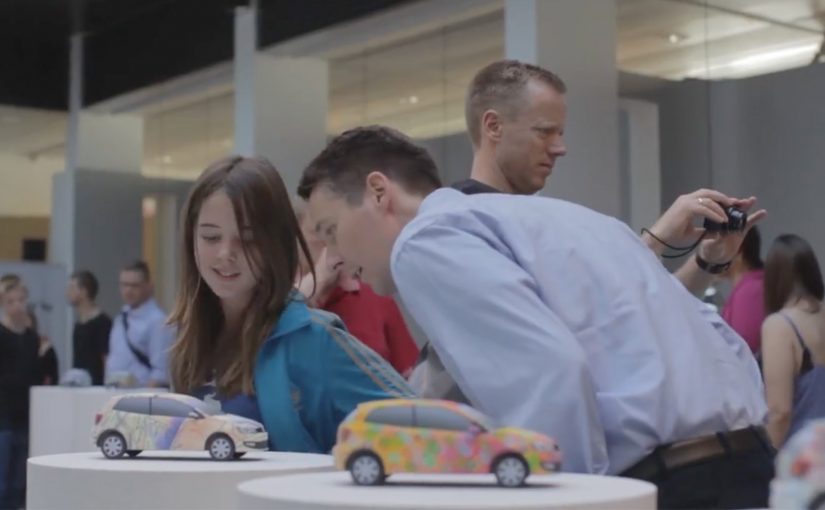
Then, to democratize the innovation process, they allowed people to actually design their very own 3D Volkswagen mock ups. The top 40 designs were chosen by a panel of judges and then put on display in Copenhagen, with the entrants receiving their (mini) 3D printed Volkswagens in the mail.

From innovation message to innovation participation

The mechanism is a neat escalation. The campaign starts with a claim: premium innovation is no longer reserved for premium models. Then it turns that claim into an action: if innovation is being “democratised,” people should be able to shape it. A 3D design tool becomes the interface for participation.

Instead of asking audiences to agree with the brand message, Volkswagen invites them to contribute to it, visually and playfully.

In co-creation campaigns, participation becomes persuasion when people can make something that physically proves the brand promise.

In enterprise marketing teams, co-creation only scales when the participation interface is simple and the payoff is concrete.

Why it lands: ownership beats persuasion

This works because creating something triggers a different level of engagement than watching something. Designing a mock up requires time, intent, and taste. Once you invest that effort, you become emotionally tied to the campaign. And when your design is selected, the brand is no longer a distant manufacturer. It is a platform that amplified you. Co-creation is most persuasive when the act of making produces an object people can keep or show.

Extractable takeaway: When you claim “innovation for everyone,” turn the claim into something people can make, so the audience owns a proof of the promise.

The Copenhagen display adds a public payoff. It moves the work out of the browser and into a real space, which signals seriousness and status.

The intent: make “accessible innovation” feel real

The business intent is to attach innovation to the Polo brand without sounding like advertising. Here, “accessible innovation” means making premium innovation cues feel reachable for everyday Polo drivers, not only for flagship models. The real question is whether your “innovation” story can be experienced, not just believed. User-generated designs create social proof. The 3D printed mini cars make the campaign tangible. “Innovation is available to you” becomes “here is something you made, and here is a physical object that proves it.”

Make co-creation tangible

  • Turn a message into a mechanism. If you claim democracy, build a democratic action people can take.
  • Reward with something physical. A mailed 3D print is a memorable artefact, not a forgettable badge.
  • Curate publicly. Exhibiting the top designs creates status and raises the perceived value of participation.
  • Use judges plus community. A panel can signal craft and quality, not just popularity.
  • Design for shareability. People naturally share what they created, especially when it looks good.

For more examples on brands using 3D printing click here.


A few fast answers before you act

What was the core idea behind the Polo Principle extension?

To move from talking about “innovation for everyone” to letting people participate by designing their own 3D Volkswagen mock ups.

Why add 3D printing to a campaign?

It creates a physical proof point. A printed mini model makes the experience feel real, personal, and worth keeping.

What role did the Copenhagen display play?

It gave public status to the best designs and signalled that the brand took the contributions seriously, beyond a digital stunt.

Is co-creation mainly an awareness play?

It can drive awareness, but its deeper value is emotional ownership. People remember what they helped create.

What is the main takeaway for brands claiming “democratisation”?

If you want the message to stick, build a mechanism that lets people experience the claim directly, and reward participation in a tangible way.