
VGT: Fur iAd that bleeds when you swipe

VGT (an association combating animal factories), working with Austrian agency Demner, Merlicek & Bergmann, created an iAd for the iPad edition of DATUM magazine.

The iAd shows a young woman wearing a fur coat. When the iPad user tries to continue browsing with the familiar finger-wipe movement, each swipe leaves a blood stain on the fur. The more you try, the more blood appears, turning a simple “next page” gesture into the message.

In tablet-first media environments, gesture-based interactivity can turn a standard placement into a moral confrontation.

A navigation gesture that becomes the accusation

The clever part is that nothing “extra” is required from the user. No quiz. No mini game. No new behaviour. The iAd hijacks the most natural behaviour on the device. Swiping to move on. That is why it feels so sticky. The ad does not ask for attention. It punishes avoidance.

Standalone takeaway: The strongest tablet interactions do not add features. They repurpose native gestures so the message is felt in the hand, not just read on the screen.

The mechanism: friction by design

Most advertising tries to reduce friction. This does the opposite. It introduces deliberate friction at the exact moment the audience normally exits. That choice forces a small pause, and that pause is where the ethical point lands.

In coverage and case listings, the execution is framed under the line “Blood sticks to every genuine fur,” with the swipe mechanic visualising “you can’t keep your hands clean.”

Why it lands even if you dislike shock tactics

This is not shock for spectacle. It is shock attached to an action the viewer chooses. You create the stains. That’s what makes the experience uncomfortable in a more personal way than a static image could.

It also matches the medium. The iPad is intimate. It’s held close. When a message uses touch to implicate the user, it feels harder to dismiss than a poster or a pre-roll.

What to steal for your own iPad and tablet units

  • Exploit a native gesture. Swipe, pinch, tap, drag. If the gesture is already habitual, the learning curve disappears.
  • Make the interaction mean something. The response should be the argument, not just a visual flourish.
  • Use friction sparingly and intentionally. Only add resistance when the resistance is the point.
  • Design for instant comprehension. The first swipe should explain the whole idea.
  • Earn the discomfort. If you push people emotionally, the payoff must be clarity, not confusion.

A few fast answers before you act

What is the VGT iAd concept in one sentence?

An iPad iAd that prevents an easy page swipe by leaving blood stains on a fur coat every time you try to move on.

Why use the swipe gesture instead of a video or a static image?

Because swiping is an action the user performs. When the consequence appears immediately, the viewer feels involved rather than merely informed.

Is this an example of “interactive storytelling” or “interactive persuasion”?

Both. The story is minimal, but the persuasion is embodied. The interaction itself carries the moral logic.

When does this kind of tactic backfire?

When the shock feels disconnected from the cause, when the friction blocks people without a clear point, or when the execution reads as manipulation rather than meaning.

What is the simplest way to apply this pattern ethically?

Use a familiar gesture, create an immediate consequence tied to the message, and ensure the user can still exit once the point is delivered.
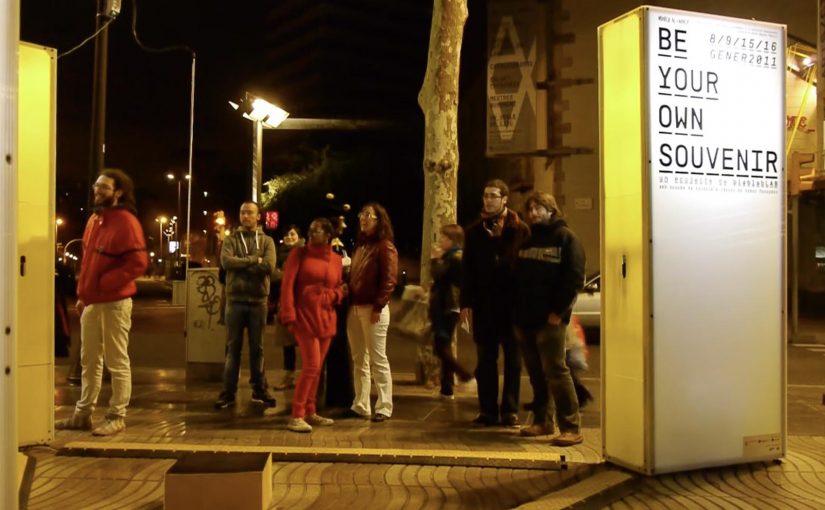
Be Your Own Souvenir: 3D-printed human statue

The crew from blablablab.org creates a unique digital installation in La Rambla, Barcelona, a place made famous by street artists posing as “human sculptures” and the constant flow of tourists who stop to watch them stand still.

This installation reverses the roles and lets the tourist become the producer as well as the consumer. The system invites visitors to perform as a human statue, with a free personal souvenir as the reward: a small figure of themselves, printed three-dimensionally from a volumetric reconstruction generated using three structured-light scanners (Kinect).

In tourist-heavy city streets where people already queue for a photo moment, converting spectators into performers is a reliable way to earn attention without forcing a pitch.

A street ritual, rewritten

La Rambla already has a clear “script”. You stop, you watch, you take a picture, you move on. This project keeps the same script, but switches the hero. Instead of photographing someone else’s performance, you become the performance, and you leave with a physical artifact that proves you did it.

How the scanning becomes the experience

The tech is not framed as “3D scanning”. It is framed as a playful stage. You step into position, hold still like the living statues nearby, and the system quietly captures you. The output is a miniature you can take home, which makes the digital process feel tangible and earned.

Why the reward loop works

A souvenir is usually generic. Here it is personal, location-specific, and instantly story-worthy. The value is not the plastic. The value is the transformation: tourist to performer, data to object, moment to keepsake.

What to steal for public-space interactivity

  • Borrow a behavior people already understand. The “human statue” pose needs no explanation in this location.
  • Make participation the content. The audience is literally the subject.
  • Deliver a physical takeaway. A real object extends the memory past the street corner.
  • Keep the instruction simple. “Stand here and pose” beats any multi-step onboarding.

A few fast answers before you act

What is “Be Your Own Souvenir”?

It is a public installation on La Rambla that invites tourists to pose as human statues, captures them with structured-light scanning, and produces a small 3D-printed figure as a personal souvenir.

How does the system capture the person?

It uses volumetric reconstruction generated from three structured-light scanners (Kinect), producing a digital model that can be sent to a 3D printer.

Why does the “human statue” framing matter?

Because it matches the culture of the street. People already understand the pose-and-watch ritual, so the interaction feels native rather than imported.

What makes this more than a tech demo?

The outcome is personal and physical. The tech disappears behind an experience and a takeaway that visitors actually want.

What is the main lesson for experiential design?

Anchor the interaction in a familiar behavior, then reward participation with an artifact that makes the moment portable.

Nutricia Baby Connection

Young parents all over Belgium rely on Nutricia babyfoods every day. So ad agency Duval Guillaume helped Nutricia find a new unique way to support mums even before their baby is born – with Baby Connection: a unique iPhone app that helps gets the dad more involved in the pregnancy.

Baby Connection works best when you use it as a couple. There’s a mum version and a dad version – and everything each parent adds is automatically synced with their partners’ phone. The app can even transform two iPhones into one big screen.

Have a look at the demo to see how it works:

To launch Baby Connection, Duval Guillaume even came up with a campaign that’s as unique as the app itself. Have a look at what they did: