
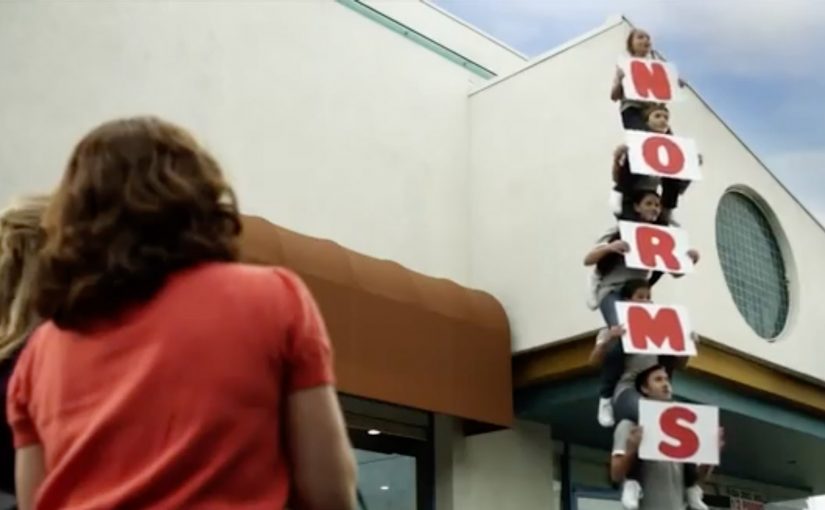
Norms Restaurants: Social Media Above-the-Line

A TV spot that treats social as the main stage

Here is a new TV spot promoting the NORMS Restaurants Facebook page. It does something different. The commercial is grounded in social media rather than simply being an add-on.

How it works: the channel is the creative, not the CTA

The mechanism is straightforward. Instead of telling you to “go to Facebook”, the spot behaves like social. It borrows the language, pacing, and cultural cues of the feed, then uses TV as the amplifier. By “social-native”, I mean it is structured like something you would actually scroll past in a feed. This works because viewers recognize that grammar instantly, so the follow action feels like continuing the same experience.

In US regional restaurant brands, social channels can function as a 24/7 extension of the dining room: service, deals, personality, and community in real time.

The real question is whether your mass media can behave like the channel you want people to adopt, rather than merely pointing at it.

Why it lands: the message and the operating model match

Just as social media never sleeps, NORMS Restaurants also never closes. They are open 24 hours a day. That alignment matters. The spot is not trying to look modern. It is connecting a true operational differentiator to a behaviour that is always on.

Extractable takeaway: When an “always-on” message is backed by something operationally true, the creative reads as utility instead of theatre.

The intent: make “follow us” feel like utility

The point is not only awareness. It is habit formation. If the brand is always open, then the social presence can be positioned as always available too, with updates that feel useful, timely, and worth checking. This is what it looks like to put social “above the line”, treating it as the primary experience and not a supporting channel. Here, “above the line” means the social presence is the main stage, while TV is used mainly to accelerate adoption. If you want social to matter, design mass media as an on-ramp to a repeatable social habit, not as a separate campaign.

Early results the brand shared at the time

This family owned business shared the following success within 10 days of the TV commercials:

  • Gained 1,000 fans on Facebook
  • Gained 150 followers on Twitter

Moves to put social above the line

  • Make the channel the idea. If you lead with social, the creative has to feel native to how social behaves.
  • Anchor the message in something operationally true. “Always on” lands when the business actually is.
  • Give people a reason to follow, not just a reason to notice. Utility beats slogans for repeat behaviour.
  • Measure fast, then iterate. If the goal is followers and engagement, build feedback loops early.

A few fast answers before you act

What is different about this NORMS TV spot?

It is built around social media as the core creative idea, not as a last-second add-on call-to-action.

What is the main mechanism that makes it work?

TV is used as the reach layer, while the creative language is intentionally social-native, so the handoff to Facebook and Twitter feels natural.

Why does the “social never sleeps” line fit NORMS?

Because NORMS is positioned as open 24 hours a day, so the always-on idea matches the operating model instead of feeling like marketing theatre.

What is the business goal behind grounding a TV spot in social?

To turn awareness into ongoing follow behaviour, so the brand gains a direct channel for repeat visits, offers, and relationship building.

What is the most transferable takeaway?

If you want social to sit above the line, treat it as the product experience, then use mass media only to accelerate adoption.

Jameson: Are You Talking To Me?

“Are you talking to me?” becomes a real question when a wall talks back. This month, people in high foot-traffic areas across New York and Los Angeles react to Jameson Irish Whiskey as if the city itself has started a conversation.

The idea defies the downturn mood by shifting from broadcast to banter. The wall does not just show a message. It performs a social moment with whoever walks past.

How the talking wall works

The mechanism is described as a projected interactive ad. A large-scale wall projection delivers conversational prompts and responses that feel directed at individuals in the crowd, turning a static surface into something closer to a street-level character than an ad unit. That works because the projection frames the encounter as a social exchange people instinctively want to resolve.

In urban brand marketing, interactive out-of-home can behave like a social channel when it turns passersby into participants rather than impressions.

Why it lands

It flips the usual power dynamic of outdoor media. Instead of you watching an ad, the environment appears to notice you. That creates a tiny moment of surprise and self-conscious humor, which is exactly what people share with friends standing next to them.

Extractable takeaway: If you want out-of-home to travel beyond the street, give it a social script, meaning a prompt people naturally know how to answer or perform. When the medium feels conversational, people perform it, and performance becomes distribution.

What Jameson is really buying

The business intent is to make the brand feel present in the city’s social fabric, not just visible on its surfaces. A “talking” installation creates memory through interaction, which can outperform pure reach when budgets are tight and attention is scarce.

The real question is whether the interaction makes Jameson feel socially present enough to be retold after the moment ends. Jameson is right to use interactivity here as a behavior engine, not a decorative layer.

What to steal from conversational out-of-home

  • Write for interruption. A short line that sounds like it belongs in real life earns the first glance.
  • Design for group reactions. Outdoor works best when it creates a moment that strangers can share in real time.
  • Make the medium feel alive. Interactivity is not a feature. It is the reason people stop.
  • Keep the proof simple. A single video that shows the reaction is often the most scalable artifact.

A few fast answers before you act

What is the core idea here?

Turn a wall into a conversational brand moment, using a projected interactive execution that feels like it is speaking directly to people on the street.

Why does “talking” out-of-home get attention?

Because it breaks expectation. Outdoor is usually passive. When it behaves like a person, people pause to resolve the surprise.

What makes this more than a stunt?

The interaction itself is the brand experience. The wall creates a repeatable feeling, and that feeling is what people remember, record, and retell.

What should a brand copy from this?

Start with a line that sounds native to the street, then make the interaction readable from a distance. If the setup triggers a shared reaction, the format can extend beyond the physical site.

What is the main pitfall to avoid?

If the interaction is unclear from a distance, people will not stop. The hook must read instantly, even before someone understands the tech behind it.

Esquire’s Augmented Reality Issue

You open a print issue of Esquire and the pages do not stop at ink. You point a webcam or phone at a marked page and the magazine layer expands. Here, “marked” means the page includes a printed visual marker the AR software can recognize. Video clips play, 3D objects appear, and extra content sits directly on top of the printed layout. The issue behaves like a portal, not a publication.

The move. Extending print with augmented reality

Esquire experiments with an augmented reality-enabled issue that connects physical pages to digital experiences. The print product becomes the trigger, and the digital layer becomes the reward for curiosity.

How it works. Markers plus a camera

  • Selected pages include visual markers designed to be recognized by software.
  • The reader opens the AR experience on a computer webcam or mobile device.
  • When the camera recognizes the page, digital content overlays the magazine.
  • The overlays can include video, interactive elements, and 3D objects tied to the editorial content.

In publishing and brand media, augmented reality works best when the page itself becomes the interface rather than a detour to a separate destination. Because the camera locks onto the page itself, the overlay feels anchored to the layout, which makes the payoff arrive without a context switch.

In consumer publishing and brand media, the most repeatable AR pattern is to let the page be the trigger and the camera be the lens.

Why it matters. A magazine that behaves like a medium

This is not a banner ad placed on paper. It is a format shift. The real question is whether you are using AR to deepen the editorial moment or to bolt on a gimmick. The reader keeps control, but the magazine now has depth. Print becomes interface, and “extra content” becomes spatial and contextual rather than hidden behind a URL. If the overlay does not deepen the page you are already reading, it should not ship.

Extractable takeaway: Use AR to deepen the page the reader is already in, with a fast first reveal anchored to the layout, so the extra layer feels earned instead of tacked on.

What to take from it. Designing for the moment of discovery

  • Use print as the entry point. A physical artifact can still be the strongest trigger for attention.
  • Reward curiosity quickly. The first overlay has to land fast to justify the setup.
  • Keep the experience editorial. AR works best when it extends the story, not when it interrupts it.
  • Plan for repeatable templates. Once the pipeline exists, AR pages become a scalable content format.

A few fast answers before you act

What is Esquire’s augmented reality issue?

A print magazine issue that unlocks digital overlays like video, interactive elements, and 3D objects when a camera recognizes marked pages.

What do readers need to experience it?

A webcam or phone camera, plus the AR experience that recognizes the markers in the issue.

What kind of content can appear?

Video clips, interactive elements, and 3D overlays tied to the editorial pages.

Why is this different from typical digital add-ons?

The print page becomes the interface, so the digital layer is contextual and anchored to the physical layout.

What is the transferable lesson?

Treat physical media as an activation surface, then design a fast, editorially relevant reveal that makes the extra layer feel earned.