
Germanwings: Planemob at 30,000 Feet

Germanwings: Planemob at 30,000 Feet

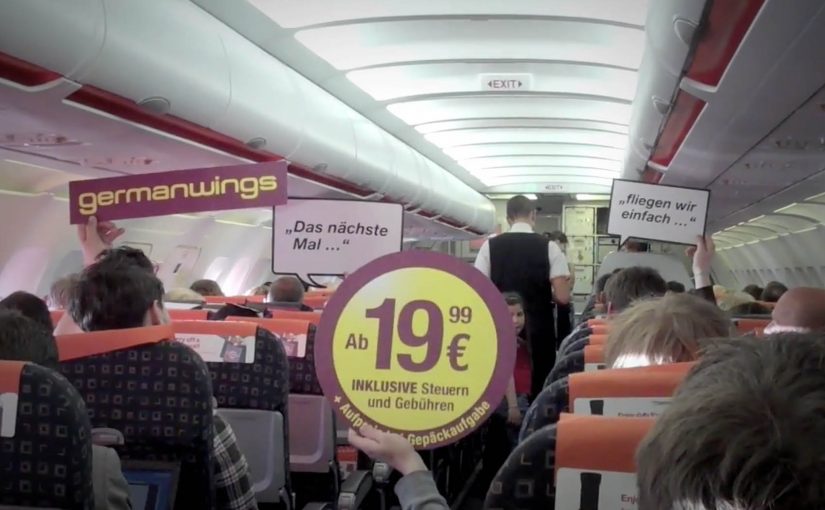
Five creatives board a competitor’s flight with nothing but cardboard signs, a camera, and a plan. At cruising altitude, they run a “planemob” in the aisle. In practice, that means a flashmob-style brand stunt staged on a plane and filmed to travel later as content. The cabin becomes the set, and the passengers become the audience.

A brand comparison staged where the problem happens

The idea is credited to Lukas Lindemann Rosinski in Hamburg. The stunt is described as taking place on a rival low-cost carrier flight, and it uses the rival’s own boarding and seating dynamics as the backdrop for the message.

The execution is deliberately low-tech. A small group reveals a sequence of placards that make a simple point about “quality” versus the small annoyances of no-frills flying, especially the chaos that comes with free seating when groups try to sit together.

The mechanic: hijack the moment, not the media

This is guerrilla advertising in the literal sense. Instead of buying more airtime, the campaign borrows a moment that already has full attention: passengers strapped in, phones out, and nothing else to do.

That works because the stunt captures attention at the exact moment the irritation is most legible, so the comparison feels less like copy and more like proof.

Filming the stunt is not an afterthought. It is the distribution strategy. The onboard moment creates the story, and the video carries it to everyone who was not on the plane.

In European low-cost aviation, brand promises live or die on small frictions that frequent flyers feel immediately.

Why it lands: it turns irritation into proof

Most airline positioning stays abstract because the product is hard to “show” in a single line. Planemob goes the other way. It demonstrates the promise by contrasting it against a situation passengers recognize without explanation. This is smart brand theatre because the proof arrives inside the passenger experience instead of sitting above it as a slogan.

Extractable takeaway: If your differentiator is a reduction of friction, stage the proof inside the friction. Do it in a setting where the audience is already feeling the problem, and keep the message simple enough to travel as a clip.

The business intent: earned attention that outlives the flight

The immediate audience is small. The real audience is everyone who sees the video afterwards. That’s the trade. A short, high-constraint performance buys a longer, shareable narrative, and it tends to get discussed precisely because it happens “in real life” rather than inside a media slot.

The real question is whether a tiny live audience can trigger a much larger story once the moment is filmed and shared.

Award listings also suggest the work gained industry recognition, including a Spotlight Festival Gold in web & mobile categories for “Planemob”.

What to steal for your next guerrilla moment

  • Exploit a captive moment ethically: pick a context where attention is naturally high and interruption is minimal.
  • Use props that read instantly: big typography, one point per beat, no cleverness that needs a caption.
  • Build the distribution into the idea: if it does not work as a video, it does not scale.
  • Anchor the claim in a felt pain point: “quality” lands when it maps to a concrete irritation people already know.
  • Keep the crew small: constraints make it believable, and believability is the fuel for sharing.

A few fast answers before you act

What is a “planemob”?

A planemob is a flashmob-style stunt staged on an aircraft, designed to create an attention-grabbing in-flight moment that can be filmed and shared as a campaign video.

Why does this count as guerrilla marketing?

Because it uses a real-world environment and a minimal set of materials to generate earned attention, rather than relying primarily on paid media placements.

What is the core persuasive trick in this execution?

It connects the brand claim to a situation passengers have experienced. The message feels like evidence because it is delivered inside a recognizable pain point.

What should you watch out for if you copy this approach?

Operational risk and brand risk. You need a concept that is safe, respectful to bystanders, and strong enough to survive without heavy explanation. If it needs a long caption, it will not travel.

How do you measure success for this kind of stunt?

Video reach and completion rates are the baseline. More meaningful signals include press pickup, share-to-view ratio, branded search lift, and whether the stunt strengthens a specific product attribute in brand tracking.

Lacta: Love in Action

Lacta: Love in Action

Following the grand success of Lacta’s interactive film in November 2009, Kraft Foods and OgilvyOne Athens set out to create yet another integrated campaign for Lacta, Greece’s leading chocolate brand. This time, instead of producing another love story themselves, they set out to create one with their audience.

Kraft Foods and OgilvyOne crowdsourced a 27-minute branded-entertainment film, involving the audience in everything from writing to casting and styling the actors. Some even popped up as extras in the finished film. During filming, audiences were kept updated through the campaign blog, Facebook, Twitter, YouTube and Flickr.

Here is a 3 minute video case study on the same.

Then on Valentine’s Day the film was aired on Greece’s top TV channel and online, with great success.

What makes this more than “UGC”

The smart leap is that the audience is not just submitting stories. They are being pulled into the messy, high-signal parts of production. Decisions that normally sit behind closed doors. Casting, styling, and creative direction. That raises commitment, because participation shifts from “I sent something” to “I helped shape what shipped.”

In European FMCG branded entertainment, letting people influence production decisions can turn a single film into a sustained participation loop that runs for weeks, not minutes.

Why this lands

This works because it gives people a credible reason to keep coming back. Not to watch ads, but to follow progress, vote, debate, and see whether their influence makes the final cut. The film becomes the payoff, but the real engine is the journey. A public build, meaning a production process made visible as it develops, turns pre-release into its own entertainment.

Extractable takeaway: If you want long-lived attention, make the audience’s role structural, not decorative. Put participation into decisions that change the output, then publish visible progress so people feel their involvement has weight.

The commercial intent underneath

Lacta gets what a standard Valentine’s spot struggles to buy. Time, conversation, and emotional ownership at scale. The brand also stays relatively in the background, so the entertainment is allowed to carry the attention while the association builds quietly.

The real question is whether the audience is helping shape the asset or merely reacting to it.

What to borrow from participatory production

  • Open up real decisions. Voting on meaningful choices beats asking for comments.
  • Show progress publicly. Updates and behind-the-scenes keep momentum alive.
  • Let contributors appear in the output. Even small “extra” moments create powerful ownership.
  • Build a finale moment. A premiere date gives the whole participation arc a shared finish line.

A few fast answers before you act

What is Lacta “Love in Action”?

It is a crowdsourced branded-entertainment film initiative where audiences contributed to and influenced key parts of the production, from story and casting to styling.

What makes this different from a normal brand film?

The audience is involved before release and in decisions that shape the final output, so the build process becomes part of the entertainment.

Why run it across so many platforms?

Because production is a multi-week narrative. Different channels support different behaviours. Updates, voting, sharing, and behind-the-scenes participation.

Why is Valentine’s Day a strong launch moment?

The theme is culturally aligned with love stories, and the calendar creates a natural deadline and shared viewing moment.

What is the main risk when crowdsourcing content like this?

If participation feels cosmetic, people drop out. The audience needs visible proof that their input changes outcomes, and the process must be curated so quality stays high.

Ogilvy: The World’s Greatest Salesperson

Ogilvy: The World’s Greatest Salesperson

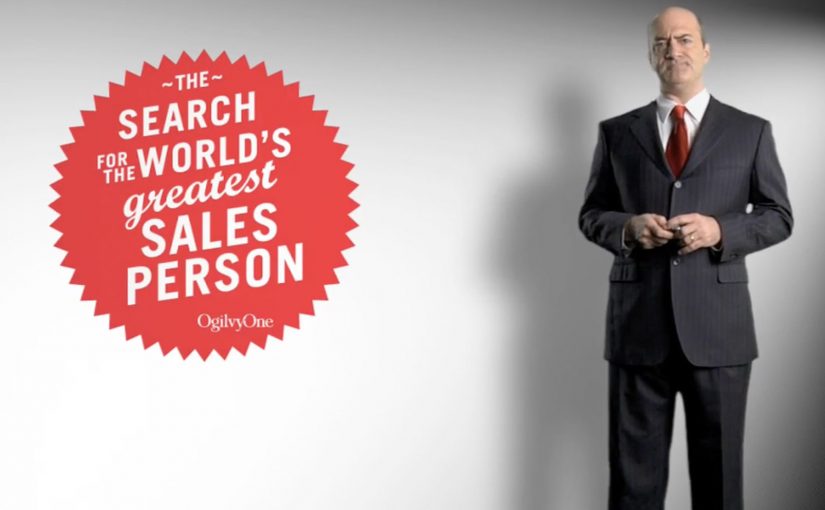
News just out. Ogilvy & Mather Worldwide is looking for “The World’s Greatest Salesperson”.

Ogilvy’s founder, David Ogilvy, went door to door selling stoves before he got into advertising. He was so good at it that the company asked him to write a manual for other salesmen. Now, after decades as one of the best-known agencies in the world, Ogilvy is creating a contest to celebrate the art of selling.

The contest is designed to live where modern pitching lives: on YouTube. Entrants are asked to prove they can sell, not just claim they can sell, by submitting a short video pitch.

A recruiting idea disguised as a sales lesson

The mechanism is simple. Use a public challenge to attract people who can communicate clearly under constraints, then let the internet do the first round of filtering through visibility and voting signals. Because the entry is a short video work sample, the first screen is proof, not claims.

In global agency recruiting and employer branding, open challenges like this turn hiring into content and let capability show up in public rather than on a CV.

This is a stronger recruiting filter than a conventional careers campaign because it forces proof under a shared constraint.

The real question is whether a video-first work sample can replace traditional screening without diluting quality.

Why it lands

It works because the entry format turns “sales ability” into a comparable work sample, so judgment starts with evidence instead of self-description.

Extractable takeaway: The best recruiting campaigns behave like a job preview. A job preview is a small, real slice of the role. They ask candidates to demonstrate the exact skill you care about in a constrained, comparable format, then use curation to turn submissions into a public proof of standards.

It makes “sales ability” observable. The work samples are the application. You can see clarity, empathy, structure, and persuasion in minutes.

It borrows the founder’s origin story without turning it into nostalgia. The David Ogilvy reference sets a standard. Selling is treated as craft, not hype.

It rewards ambition with a real stage. The promised prize, including a Cannes Lions trip and a seminar slot, gives the contest a credible career upside rather than a token reward.

Borrowable moves for video-first recruiting

  • Ask for a work sample, not a statement. Make the entry itself the evidence.
  • Use one consistent prompt. A shared constraint makes submissions comparable and curation easier.
  • Build a reward that signals seriousness. A meaningful stage and exposure attracts serious entrants.

The three winners of this contest will win a trip to the 57th annual Cannes Lions International Advertising Festival. They will also get to make a presentation at the festival seminar on June 21.


A few fast answers before you act

What is Ogilvy actually trying to find with this contest?

Someone who can sell convincingly, on camera, with a clear structure and customer understanding, not just someone with a polished resume.

Why run it on YouTube?

Because sales is performance plus clarity. Video makes both visible, and it scales submissions globally without heavyweight logistics.

What makes this more than a PR stunt?

The entry format is a real work sample, and the prize includes a meaningful industry stage. That combination turns attention into a talent pipeline.

What does David Ogilvy’s backstory add to the idea?

It anchors the contest in a specific belief: selling is foundational craft. The founder story is used to justify why sales ability is being celebrated publicly.

What is the most transferable lesson for leaders hiring for commercial roles?

Design selection as demonstration. Give candidates a single prompt that mirrors the real job, then judge the work, not the claims.