

Coca-Cola: Cheer-O-Meter

Coca-Cola: Cheer-O-Meter

To promote the excitement around Copa America 2011, OgilvyAction worked with Coca-Cola to set up a giant screen in downtown Buenos Aires for fans to watch their favorite teams and provide unconditional cheer to the Argentinean National Team. But there was a catch. Sound sensors were installed to keep the screen on and if the fans stopped cheering, the screen would go blank.

The real question is whether you can make the crowd’s participation the switch that powers the experience.

Why this activation hits

The mechanic is brutally simple. Your cheering is not just encouraged. It is required. Here, an activation is a live brand experience that changes what the crowd can see based on what they do. Because the screen can die, the crowd self-organizes to keep the volume up, which makes “support” feel like a shared responsibility. In sports sponsorship and live-event marketing, conditional access is one of the fastest ways to turn spectators into participants.

Extractable takeaway: If you want participation, make it the required input for a real reward, and show the consequence instantly.

  • Clear rule. Cheer to keep the screen alive.
  • Immediate feedback loop. The crowd sees the consequence in real time.
  • Social amplification built in. People around you become part of the control system.

What marketers can reuse from the idea

This is a strong example of “participation as the power source”. Instead of adding a gimmick on top of the match, the match itself becomes the reward for participation. It also turns a brand message into a behavior, which tends to travel further than a tagline.

  • Make participation the power source. Tie the experience to an audience action instead of adding a side-gimmick.
  • Keep the reward “core”. Use the thing people already want as the payoff, not a separate prize.
  • Show consequences instantly. A visible feedback loop lets the crowd adjust behavior without instructions.

If participation does not change anything in the moment, it will read as decoration, not interactivity.


A few fast answers before you act

What is the Coca-Cola “Cheer-O-Meter”?

It is a live fan-screen activation in Buenos Aires for Copa America 2011 where sound sensors kept the match on screen only while fans kept cheering.

How did the sound-sensor mechanic work?

The cheering volume acted as the trigger. If it dropped too low, the screen went blank, pushing the crowd to keep the energy up.

Why is this effective as a brand experience?

Because it converts brand participation into a simple, memorable rule with instant consequences, and it makes the crowd feel responsible for the outcome.

What is the transferable pattern?

Create one clear rule, attach it to a real reward, then deliver immediate feedback so the audience understands their impact in the moment.

Magnum Pleasure Hunt 2: bigger, bolder sequel

Magnum Pleasure Hunt 2: bigger, bolder sequel

Last year, to launch the all new Magnum Temptation Hazelnut ice-cream, Swedish agencies Lowe Brindfors and B-Reel created an advergame, a branded game built to promote a product, called “Magnum Pleasure Hunt Across The Internet”. In the game, players are taken across 20 well known websites as they collect Bon Bons, the special ingredient of the Magnum Temptation Hazelnut ice-cream.

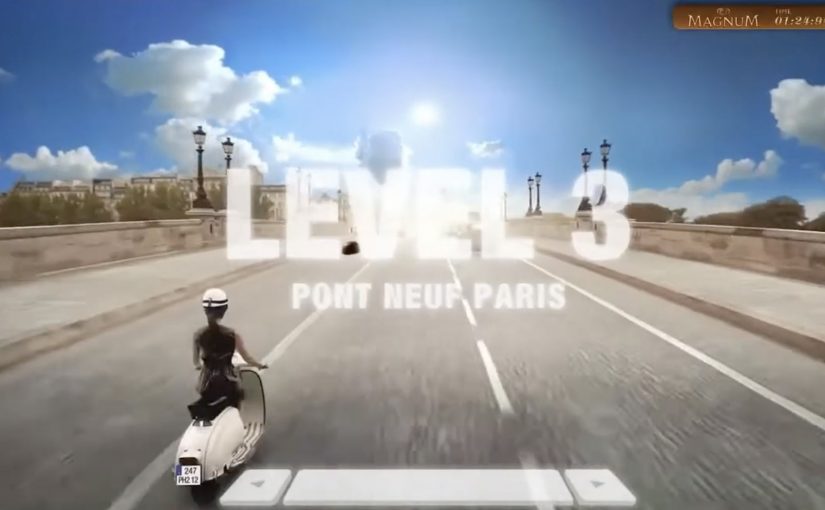
Since the game did exceedingly well, Magnum and team came up with round 2, enhanced with 3D graphics. This time players were taken on a run in New York, made to fly over Paris, and surf the waves in Rio De Janeiro, using a map and street-view style interface as the playground.

What changes from round 1 to round 2

The first game is a browser-bending sprint that treats the wider internet as a set of levels. The sequel shifts the same chase mechanic into city environments, with more depth, more spectacle, and clearer “set pieces” you can remember after one play.

In global FMCG brand launches, advergames like this work when they turn “a product promise” into a simple, replayable challenge people can explain in one sentence.

The real question is whether your sequel escalates the world without changing the one rule people already learned.

  • Round 1: web-hopping levels and Bon Bons as the core collectible.
  • Round 2: city-based runs plus a stronger 3D feel for movement, obstacles, and momentum.

Why it lands: it feels like discovery, not advertising

This is not a microsite you click once and forget. It is designed as a time-and-score loop. You play again to improve your route, your timing, and your collection count, and that repeat play is where the brand association gets built. It also matches Magnum’s “pleasure seeking” positioning with a mechanic that is literally a hunt. Because the loop rewards replay with visible improvement, the hunt association gets reinforced without asking the player to read a product pitch.

Extractable takeaway: When the brand promise is an action verb, make that verb the gameplay loop, and make replay the fastest way to feel the promise again.

The smart brand logic behind the Bon Bons

Bon Bons are a neat choice because they let the product story travel inside the gameplay. You are not only collecting points. You are collecting the “ingredient” that makes the new variant feel specific, even if you never read a product description.

I think it is a great follow up to the first version. Magnum Pleasure Hunt 2 could be experienced at www.pleasurehunt2.mymagnum.com.

Sequel campaign rules worth copying

  • Keep the core rule the same. Sequel energy comes from familiarity, then escalation.
  • Upgrade the world, not the instructions. New environments create novelty without re-teaching the game.
  • Build signature moments. New York, Paris, and Rio act like memorable chapters, not just backgrounds.
  • Make it easy to share a result. If the outcome is a score or time, people instantly understand what “good” looks like.

A few fast answers before you act

What is Magnum Pleasure Hunt?

It is a branded advergame where players chase and collect Magnum Bon Bons, originally by racing across well known websites as game levels.

What is different about Magnum Pleasure Hunt 2?

The sequel moves the action into city environments, adds a more cinematic 3D feel, and turns New York, Paris, and Rio into distinct stages of the chase.

Why does the “hunt” mechanic fit the Magnum brand?

Because it translates the idea of “pleasure seeking” into a simple action loop. Keep moving, keep collecting, keep chasing the next reward.

What makes an advergame replayable enough to matter?

Clear scoring, short rounds, and visible improvement. If players can beat their own time or score, they come back.

What is one practical takeaway for marketers?

If you plan a sequel, keep the rules familiar and escalate the world. That is how you get “new” without losing the audience you already earned.

ETN: The Howling Football

ETN: The Howling Football

The European Football Championship is going to kick off in a few months, and brands are already getting ready with their advertising pitch. However the brands are not the only ones who want to grab people’s attention.

In Ukraine there are street dogs and cats that are reported to be being killed to make the country cleaner and ready to welcome thousands of football tourists. So pan-European animal charity ETN has conceived an attention grabbing ambient campaign in Hamburg to get people involved in its animal protection program.

A football that stops being fun for a second

The execution borrows the most universal gesture around the tournament. A casual kick. Then it interrupts that habit with a jolt that does not belong on a pitch, pulling a distant issue into the middle of the street.

How the mechanism works

The campaign is built around a physical football installation placed in public space. When someone kicks it, the “game” produces an unexpected emotional cue, and the surrounding prompts push you toward a simple next step to support ETN’s protection work. The route to action is designed to be immediate, not research-heavy.

In European cause marketing, the fastest way to mobilize help is to turn a distant issue into a local, physical moment that asks for one simple response.

Why it lands

Football creates permission. People approach without suspicion, because the object feels familiar and playful. The switch from play to discomfort is what makes the message stick. The moment re-frames “preparation for a tournament” as something with consequences, then it uses that heightened attention window to ask for help while the feeling is still fresh.

Extractable takeaway: If you can hijack a familiar public behavior and replace its expected feedback with a values signal, you get instant comprehension and a much higher chance of follow-through than a poster ever delivers.

What ETN is really trying to achieve

This is not awareness for awareness’ sake. The real question is whether a street encounter can convert concern into immediate support before attention fades. It is a conversion play, meaning the point is to turn attention into donations or sign-ups. Make the issue legible in ten seconds, then make support doable in the next ten. The ambient moment is the top of funnel. The donation and sign-up paths are the business end.

What to steal from ETN’s street intervention

  • Use a culturally loaded object. Football already carries meaning during a tournament build-up.
  • Change the feedback, not the instruction. The surprise does the teaching.
  • Design the “next step” to be instant. If action requires effort, the moment evaporates.
  • Keep the story single-threaded. One cause, one emotion, one ask.
  • Place it where the behavior naturally happens. Public space is the medium and the distribution.

A few fast answers before you act

What is “The Howling Football”?

An ambient street installation that uses a football-triggered moment to spotlight a reported animal-welfare issue and direct people to support an animal protection program.

Why tie an animal charity message to a football tournament?

Because the tournament creates attention and shared behavior. The campaign uses that attention to make a neglected topic visible to people who otherwise would not seek it out.

What makes this different from a normal charity poster?

It interrupts a real action in real space. That interruption creates emotional salience, then it immediately offers a next step while attention is still high.

What is the biggest execution risk with shock-based ambient?

If the moment feels gimmicky or unclear, people disengage. The cue has to be instantly interpretable, and the path to help has to be frictionless.

How do you measure success for a campaign like this?

Track conversions first. Donations, sign-ups, and cost per action. Then look at earned reach and press as secondary amplification.