
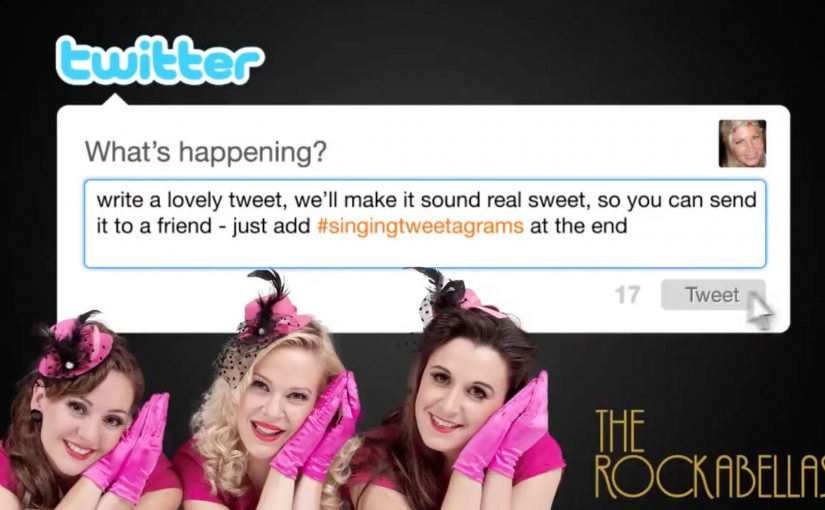
Orange UK: Singing Tweetagrams

When “say it on Twitter” becomes “say it in song”

Got a friend who needs cheering up? Or maybe you just want to tell them that you love them, miss them, or really like their new haircut. Now you can say it with Orange UK’s new singing tweetagram. In this activation, a tweetagram is a short tweet that gets turned into a personalized song you can share.

The mechanic: hashtags in, custom songs out

It works like this. You write the tweetagram message to someone, adding the hashtag #singingtweetagrams. Orange then picks the best ones and has the Rockabellas record the message in song within a few hours. Orange then uploads the song and tweets it to you with a link, so you can send it on to the person.

A tweetagram is a short message written in the native language of Twitter, then converted into a personalized media artifact that feels like it was made for one person.

In consumer social marketing, the strongest hashtag activations reward participation with a tangible output that people can share without extra explanation.

Why it works: the reward is the content

The clever part is that the prize is not a discount or a badge. The prize is the thing you actually want to share. This is a smart activation because it turns participation into a gift-like artifact people actually want to pass on. A custom song is inherently gift-like, and it gives the sender social credit while giving the receiver a genuine moment.

Extractable takeaway: If you can turn a native platform input into a fast, polished, personal artifact, the reward becomes the share, and the experience travels without extra persuasion.

This also reduces the usual user-generated content risk. Users write the raw line, but the brand controls selection, production, and final output quality.

When a brand turns a user’s message into a polished artifact and returns it quickly, it converts “engagement” into a keepsake. That creates higher motivation to participate and higher likelihood of forwarding.

The operational question: can Orange produce at internet speed?

The question will be whether they can keep up the pace set by Wieden + Kennedy in its Old Spice effort, which was described at the time as producing more than 180 videos in a couple days and pumping out responses nearly immediately. The real question is whether Orange can keep the “within hours” turnaround feeling real at scale.

That comparison matters because the magic is not only the idea. It is the turnaround time. If the lag feels slow, the moment passes and the sender stops feeling clever for trying.

Steal this pattern: hashtag-to-song rewards

  • Make the output unmistakably personal. Names, in-jokes, and direct address beat generic templates.
  • Return value fast. “Within hours” is part of the product, not a service detail.
  • Keep creation native. Let people use the platform behavior they already know. Here it is a tweet plus a hashtag.
  • Curate to protect quality. Selection is a feature. It keeps the final artifacts share-worthy and on-brand.

A few fast answers before you act

What is Orange UK’s Singing Tweetagrams campaign?

It is a Twitter-based activation where people post a message with #singingtweetagrams. Orange selects some messages and has the Rockabellas record them as short personalized songs, then sends the result back as a shareable link.

Why is “speed” so important in this format?

Because the sender’s motivation is tied to the moment. Fast turnaround keeps the interaction feeling live, current, and socially relevant.

What role does curation play in making it work?

Curation protects output quality and brand tone. Users provide raw inputs, but the brand controls which messages become finished content.

How is this different from typical user-generated content contests?

The reward is not external. The reward is the finished content itself, which is designed to be shared and kept.

What is the biggest execution risk?

Production bottlenecks. If demand outpaces recording capacity, turnaround slows and the concept loses the real-time feeling that drives participation.
Daffy’s: The Undressing Room

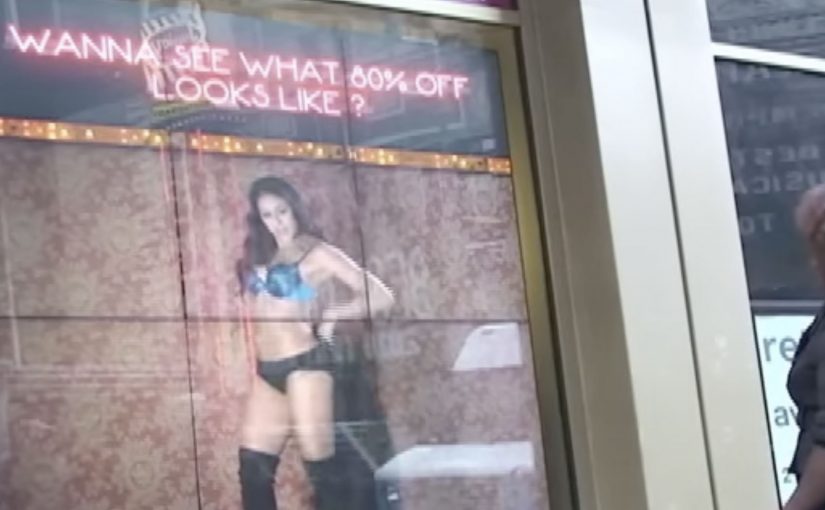
You are walking past a Daffy’s store window in Manhattan and it looks like a fashion show has moved onto the street. Models are inside the display. A crowd is outside. And the public is controlling what happens by text message.

Daffy’s is a fashion retailer from NYC. For their fall fashion launch, they created a street-level event that blended window shopping, a fashion show, and an interactive peep show, meaning passers-by could text outfit requests to models inside while the exchange played out publicly on the glass, to create live interaction from hundreds of passers-by for an entire day and night.

The idea was simple. Put great-looking models in the window with items from the new range. Ask the public at street level to text a special number for each model, requesting specific items to try on and then change out of. Each message was projected onto the store window, letting the crowd follow the conversation, while the models used phones to interact with people on the street.

That shift from window to stage is what turns a shopfront into a live media channel when footfall competes with endless distractions.

Why the mechanism pulls a crowd

The mechanism is a tight loop. You text. Your message appears publicly. The model responds with an immediate, visible action. That creates instant feedback, plus social proof, because everyone can see that participation changes the experience.

Extractable takeaway: When participation is public and the response is immediate, bystanders become an audience because they can see cause and effect in real time.

It also turns fashion into a game with a scoreboard you can read. The projected message stream makes the crowd feel like a single audience, not scattered individuals passing by.

In high-traffic retail corridors, the format works best when the interaction loop is visible to everyone, not just the person who texts.

What Daffy’s is really buying

This is not just “engagement” for its own sake. It is earned attention at street level, then a shareable story that travels beyond the location. The activation is designed to make people stop, watch, talk, and tell others to come over.

The real question is whether you are designing for fast, visible participation that creates social proof, or just staging a spectacle.

This pattern is worth copying only when you can keep the loop tight and keep people safe once the crowd forms.

According to Daffy’s communications, more than 1,500 text messages were received between 6:00 p.m. and 9:30 p.m., and the event was suspended twice by NYC police due to crowd overflow impacting pedestrian and vehicle traffic.

Practical takeaways for interactive storefronts

  • Make the audience the controller. Participation should change something real, not just “send a message”.
  • Project the input publicly. Visibility creates social proof and gives bystanders a reason to join.
  • Design for fast feedback. The shorter the gap between action and response, the bigger the crowd gets.
  • Let the store be the medium. If the window is already the brand’s stage, use it as one.

A few fast answers before you act

What was Daffy’s “Undressing Room”?

A storefront window event where passers-by texted requests to models inside the window, and the messages were displayed publicly so the crowd could follow along in real time.

Why does projecting messages onto the window matter?

It turns private participation into a public feed. People see that the experience is live, and that others are actively shaping it, which increases curiosity and crowd growth.

What’s the core interaction design pattern here?

Public input plus immediate physical response. The text is the trigger. The window action is the payoff.

What makes this more effective than a normal fashion show?

Viewer control. People do not just watch. They influence what happens, and that makes them more likely to stay, share, and bring others.

What’s the biggest operational risk with this kind of activation?

Crowd control. If the moment works, it attracts more people than a normal storefront can safely handle, so permits and on-site management matter.

WWF: Augmented Reality Tiger T-Shirt

A retail AR gut-punch for WWF’s Siberian tiger

This is a great piece of Augmented Reality for WWF aimed at raising awareness around the plight of the Siberian tiger, created by Leo Burnett Moscow.

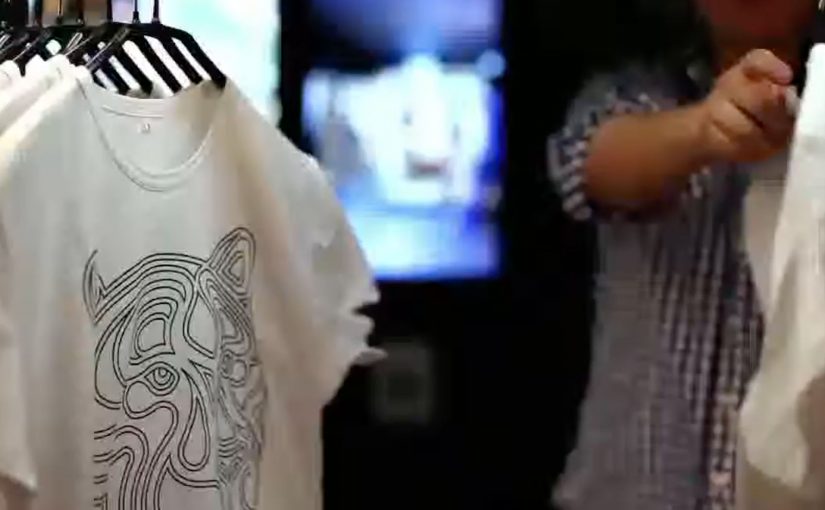
WWF printed thousands of tiger t-shirts and distributed them online and to key stores in Moscow featuring specially placed AR video mirrors that would instantly activate the AR experience the moment a tiger t-shirt was detected. An AR video mirror is a camera plus screen installation that overlays digital effects on your live reflection in real time. And at that moment, the experience became quite graphical to anyone wearing the t-shirt, complete with bullet wounds, huge amounts of blood and sound effects to match it.

How the “video mirror” mechanic does the heavy lifting

The setup is simple. Put the message on the body. Put the trigger in the store. Put the reveal in a mirror people already trust as “truth”.

An AR video mirror is a camera plus screen installation that shows your live reflection while overlaying digital effects in real time. In this case, the mirror detects the tiger shirt and then renders the simulated injuries and audio as if they are happening to you. Because the overlay is pinned to your live reflection, the reveal feels immediate, which is why the message hits before you can distance yourself from it.

In retail environments and public spaces, AR activations work best when the interaction is instant, unmistakable, and socially visible to bystanders.

Why the experience lands so hard

It converts an abstract cause into a first-person moment. You do not just look at an endangered animal. You temporarily “become” the target.

Extractable takeaway: If you want awareness to stick, bind the reveal to a trusted routine and reduce viewer control, so the audience feels the story in their own reflection before they can rationalize it away.

The intent behind making it graphic

The creative choice forces attention and memory. A polite AR overlay would be easy to ignore. A visceral one is harder to dismiss and more likely to be retold, especially when friends are watching from behind you.

The real question is whether the shock serves the story or becomes the story.

Graphic AR is a valid tool only when the cause is unmistakable and the reveal points back to it within seconds.

Design moves to borrow from this AR mirror

  • Use a frictionless trigger. Detection happens automatically. No app download. No QR hunt. No instructions.
  • Choose a culturally “trusted” surface. Mirrors feel like evidence, which makes overlays feel more real than a phone screen effect.
  • Make the message social. The bystander view matters. People react together, and that reaction becomes the spread mechanism.
  • Design the reveal as a single sentence. “This is what it feels like to be hunted.” If the concept cannot be repeated instantly, it will not travel.

A few fast answers before you act

What is the core idea of the WWF tiger t-shirt AR campaign?

It uses an AR video mirror to detect a tiger t-shirt and instantly overlay a graphic “poaching” simulation on the wearer, turning awareness into a first-person experience.

Why use an AR mirror instead of a mobile AR app?

The mirror removes friction and makes the moment public. Everyone nearby sees the same reveal at the same time, which increases impact and sharing.

What makes this activation effective as cause marketing?

It translates a distant problem into a personal reaction. The wearer feels shock and vulnerability, and that emotional spike improves recall and conversation.

What are the key components if you want to replicate the mechanism?

You need a clear trigger (the shirt), a camera plus screen “mirror” setup, real-time overlay rendering, and a reveal that communicates the message in seconds.

What is the main risk with shock-based AR experiences?

If the graphic content overwhelms the cause, people remember only the stunt. The message has to be explicit enough that the emotional reaction points to the intended story.