
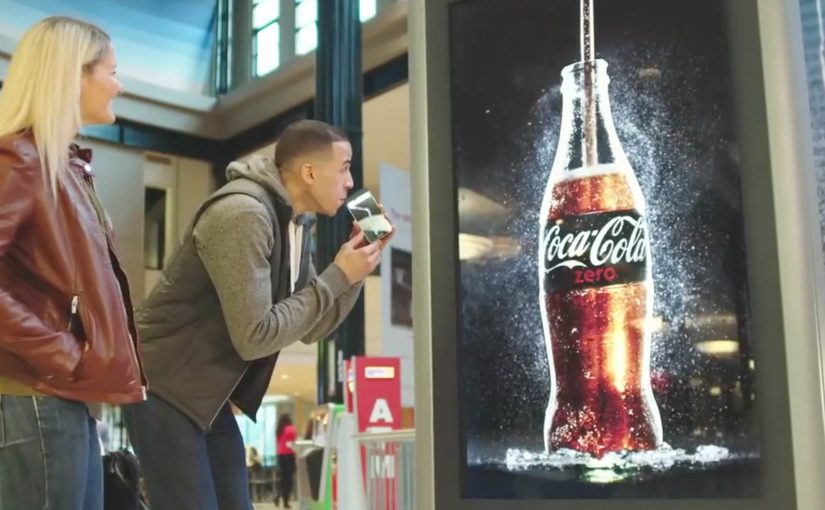
Coca-Cola: First Drinkable Advertising

You are looking at a Coke Zero ad on a billboard, on TV, in print, or even on radio. Instead of just watching it, you Shazam it. On your phone, Coke Zero appears to pour into a glass on-screen, and that moment converts into a free Coke Zero coupon you can redeem at select retail stores across the US.

The premise is blunt and smart. Many people think they know the taste of Coke Zero, but they actually do not. So Ogilvy & Mather creates a campaign where the quickest route from awareness to belief is not another claim. It is immediate trial.

How “drinkable” advertising is engineered

This execution turns Shazam into a universal call-to-action layer across media. Here, “drinkable” means the ad triggers a mobile pour moment that turns into a redeemable coupon for immediate trial.

  • Any channel can trigger the experience. Billboard. TV. Print. Radio.
  • The smartphone becomes the conversion surface. Visual payoff first, then the coupon.
  • The coupon bridges straight into retail. “Try it now” becomes a physical action, not a brand sentiment.

The important part is not the novelty of animation. It is the end-to-end path from message to product-in-hand, because the Shazam trigger and coupon make the next step unambiguous.

Why this works as shopper marketing, not just a stunt

The campaign is designed to reduce the classic friction points that kill trial. In performance-led shopper marketing, the fastest path from awareness to belief is reducing trial friction and making redemption immediate.

Extractable takeaway: If you want trial, design the interaction so it ends in redemption, not in more content.

  • No guessing what to do next. Shazam is the behaviour.
  • No abstract promise. The ad demonstrates “taste” by pushing you to the real thing.
  • No delayed gratification. The reward is immediate and concrete. A redeemable coupon.

It is experiential marketing that does not require a pop-up installation or a live event. The experience travels with the media buy.

This is shopper marketing done right. It treats media as the first step of redemption, not as a detour into “engagement.”

The real question is whether your media can trigger immediate trial without adding steps or new infrastructure.

Steal this: Shazam-to-trial loop

If you are trying to drive trial at scale, this is a reusable model.

  1. One trigger across channels. Create a single interaction that works across channels.
  2. Mobile as the conversion surface. Use mobile to make the experience feel personal and immediate.
  3. Redemption, not delay. Close the loop with a retail mechanic that is simple to redeem.

Do that well, and “engagement” stops being a vanity metric. It becomes a measurable bridge to purchase.


A few fast answers before you act

What makes this advertising “drinkable”?

Shazaming the ad triggers a mobile experience that ends in a free Coke Zero coupon. It is designed to turn exposure into real-world trial.

Why use Shazam in the first place?

It provides a consistent interaction across media formats, including channels where clickable links do not exist.

What business problem is this solving?

Driving immediate trial for a product where many people assume they already know the taste, but have not actually experienced it.

What is the key CX detail that makes it work?

A simple, familiar action. One step to trigger, then a clear reward that can be redeemed in-store.

How do you prove this is more than a stunt?

Measure Shazam activations and coupon redemptions, then compare trial impact against a similar media buy without the redemption mechanic.

100% Real Virtual Reality

A passerby in Tbilisi, Georgia (the country), puts on a VR headset and starts touring Ireland. Irish countryside. The streets of Dublin. A traditional Irish bar. Then the headset comes off, and the “virtual” bar is suddenly real. A pop-up pub has been built around them in seconds, complete with actors performing Irish clichés, and beer in hand. The reveal does not explain the slogan. It makes the slogan unavoidable.

Turn “100% real” into proof

Use virtual reality as misdirection, then land the brand promise by turning the “virtual” experience into a physical surprise.

How the stunt is engineered

Old Irish is a craft beer launch in Georgia (the country). Leavingstone takes a line that could sound like every other beer claim, “100% real,” and makes it literal. Here, “misdirection” means the tech holds attention just long enough for the real-world payoff to be built with zero narration.

  1. Invite the public into VR
    People on the streets of Tbilisi are offered a VR “tour of Ireland,” including nature, Dublin streets, and a typical Irish bar.
  2. Build the punchline in real life
    While they are inside VR, a crew builds a pop-up Irish bar around them. The space is filled with actors performing how locals imagine Ireland.
  3. Reveal the promise as a lived moment
    The moment the headset comes off, the audience is already “in Ireland,” except it is physically there, and the product is part of the scene.

In challenger FMCG launches in mid-sized markets, the fastest way to earn “authentic” is to stage a moment people can witness and retell without explanation.

Why the reveal sticks

Beer marketing often tries to borrow authenticity through language. This one manufactures belief through an experience that collapses the gap between claim and proof. Because VR locks attention and suspends context, the physical build happens unnoticed, which makes the reveal feel like undeniable evidence.

Extractable takeaway: When your promise is “real,” design a before-and-after moment that makes “real” physically undeniable in under five seconds.

The proof is theatrical, but the reaction is real

The campaign bets on ordinary people’s genuine surprise. That reaction becomes the content people want to share.

VR is not the product. VR is the timer

Virtual reality is used as a temporary attention lock so the physical transformation can happen without explanation. The innovation is the transition, not the headset.

The brand promise lands in one repeatable beat

“100% real” is not argued. It is demonstrated when the environment jumps from virtual to physical.

Results Leavingstone reports

Leavingstone reports the stunt video was posted on the Old Irish Facebook page on March 18 with a modest placement budget. They report it engaged more than 50% of internet users in Georgia (the country), reached 1 million views in 72 hours, and was followed by 515,698 liters sold in the first month (described as 2x more sales).

Leavingstone also lists multiple awards for the campaign, including Cannes Lions Bronze and Eurobest Bronze.

What the brand is really buying

The real question is how to turn a generic authenticity claim into proof people can feel and retell. The stance is simple: treat tech as misdirection and timing, then make the product truth the thing people physically experience together.

How to reuse the reveal move

  • Use tech as a timer, not a headline. If the product truth is physical, make the physical payoff the main act.
  • Design the reveal beat. The win is a single, clean “before/after” moment that needs no voiceover.
  • Cast for real reactions. The most credible asset is ordinary people processing surprise in real time.
  • Map the stunt to one promise. If the promise cannot be “felt” in the reveal, the stunt becomes spectacle.

A few fast answers before you act

What is the core mechanic?

A VR tour of Ireland distracts participants while a real pop-up Irish bar is built around them, so the reveal converts “virtual” into physical.

Why use VR at all?

It creates a believable reason to pause someone in public, and it buys time to build the physical environment unnoticed.

What makes it shareable?

The surprise is immediate, visual, and human. Ordinary people’s reactions are the story engine.

What is the transferable pattern?

Use an emerging-tech interface as a controlled setup, then deliver the brand promise through a physical, social payoff people can experience together.

What is the biggest risk?

If the reveal does not map cleanly to the product truth, the stunt becomes spectacle with no belief gain.

The Village Telephone

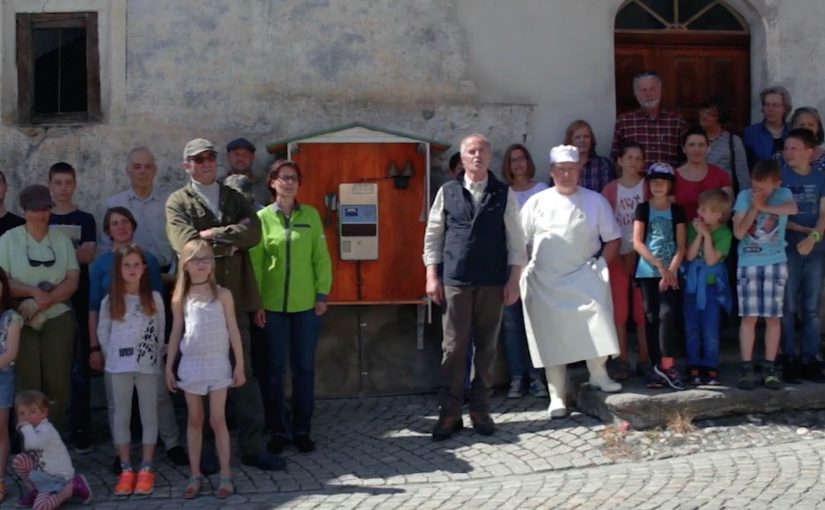
In the mountain village of Tschlin, it is so quiet that when the telephone in the village square rings, you can hear it from every corner of the village. So when that phone starts ringing, people move. The butcher. The innkeeper. The pastor. Whoever is closest. The whole premise is simple: if the phone rings and nobody makes it in time, the caller wins.

The hook

Turn “quietest place in Switzerland” from a claim into a game people can test in real time.

What Graubünden Tourism and Jung von Matt set up

Graubünden Tourism and Jung von Matt/Limmat publish the village phone number online and invite anyone to call it between 10:00 and 20:00. If a resident answers, you get a conversation with a real person from Tschlin. If the call goes unanswered, you win prizes such as free stays, dinner, or merchandise.

To prove that nobody is sitting next to the phone “waiting,” the campaign also runs a live view of the village square, so participants can see what is happening and who is answering. The transparency is part of the promise.

The real question is whether a destination promise can be verified by a stranger in seconds.

When the audience can run the proof themselves, the claim becomes dramatically more credible.

Why the village telephone lands

The mechanic, meaning the simple rule set people can try, creates tourism interest because the proof is experienced in the moment, then shared as a story.

Extractable takeaway: If your benefit is experiential (quiet, fast, safe, simple), build a public test that lets people attempt to disprove it. Then make the proof visible while they try.

It makes the destination benefit testable

Most tourism ads describe tranquility. This one lets you attempt to break it with a phone call.

It turns locals into the medium

No actors are needed. The villagers are the campaign, and that authenticity is visible in every answered call.

It creates a built-in story loop

Call. Ringing. Sprint. Answer. Or silence. Win. The narrative resets every time the phone rings, which is exactly why people keep trying.

In European destination marketing, a public, verifiable test is often what makes a small place feel real to people who have never been there.

The timeframe that makes it feel like an “event”

The action runs from Monday, June 6 to Saturday, June 11, 2016. It is short enough to create urgency, and long enough to become a talking point beyond Switzerland.

Signals that the stunt travels

Reported outcomes for the six-day activation include 30,000 attempted calls, 3,906 conversations, and 1.5 million video views, alongside significant media pickup.

The deeper point

This is a clean example of “proof marketing.” By “proof marketing,” I mean marketing that lets the audience verify the promise with their own action, not a brand assertion. The campaign does not ask you to believe that Tschlin is quiet. It gives you a simple action to attempt, shows you the village while you do it, and lets the locals validate the claim with their own behavior.

Steal the village phone pattern

  • Make the promise testable. Turn the adjective into one action people can try in real time.
  • Show the proof live. Use transparency (like a live view) so the audience trusts the rules.
  • Design a repeatable loop. Reset the story every time the trigger happens so people keep replaying it.
  • Time-box it like an event. A short window creates urgency and makes the stunt easier to talk about.

A few fast answers before you act

What is the core mechanic?

Call the village telephone between 10:00 and 20:00. If a resident answers, you talk. If the call goes unanswered, you win prizes.

Why is the live feed important?

It proves the fairness of the promise. People can see that nobody is waiting next to the phone, and they can see who they are speaking with.

Who is behind the campaign?

Graubünden Tourism (Graubünden Ferien) with Jung von Matt/Limmat.

When does it run?

June 6 to June 11, 2016.

What is the transferable pattern?

If your promise is experiential (quiet, fast, safe, simple), build a public test that lets people attempt to disprove it. Then make the proof visible while they try.