
Coca-Cola: Slurp and Crunch Cinema Spots

Cinema etiquette, packaged as entertainment

Coca-Cola, with the help of Saatchi & Saatchi Denmark and M2Film, created a two-spot public service campaign that highlighted the annoyance of noisy slurps and crunching of refreshments during public viewing at the cinema.

Here, “public service” means a brand-funded reminder about shared cinema etiquette rather than a product offer.

Coca-Cola Gangster

Coca-Cola Stableboy

The move: make the sound the villain

Everyone knows the noise. The spots take that tiny irritation and push it to the foreground, so the whole room shares the same reaction at the same time. By making the sound the villain, the films turn annoyance into an instant, shared norm signal.

In shared public settings like cinemas, etiquette is enforced socially, so in-context cues matter more than abstract rules.

The real question is whether you can correct the behavior in the moment without sounding like you are policing it.

Why it works where it plays

Because it runs in the cinema. The reminder lands in the exact environment where people can immediately correct themselves. It feels like a social cue, not a rule.

Extractable takeaway: When you want voluntary behavior change, put the cue inside the moment of action and make it emotionally legible to everyone in the room.

The behavioral job

Highlight how slurps and crunching can ruin public cinema viewing, and nudge people toward better behavior without preaching.

A short in-context spot like this beats a generic reminder for etiquette nudges because it recruits the audience, not just the offender.

Steal the nudge

  • Micro-irritation: Pick a universal micro-irritation and dramatize it fast.
  • In-context delivery: Deliver the message in-context, where relevance is unavoidable.
  • Watchable change: Use story and character so behavior change stays watchable.

A few fast answers before you act

What was this Coca-Cola cinema campaign?

A two-spot campaign designed to highlight how loud slurping and crunchy snacking can annoy other people during a movie.

Who created the campaign?

The post credits Saatchi & Saatchi Denmark and M2Film alongside Coca-Cola.

How many spots were there and what were they called?

Two spots. “Coca-Cola Gangster” and “Coca-Cola Stableboy.”

Where was this intended to run?

In a cinema context, aimed at audiences during public film viewing.
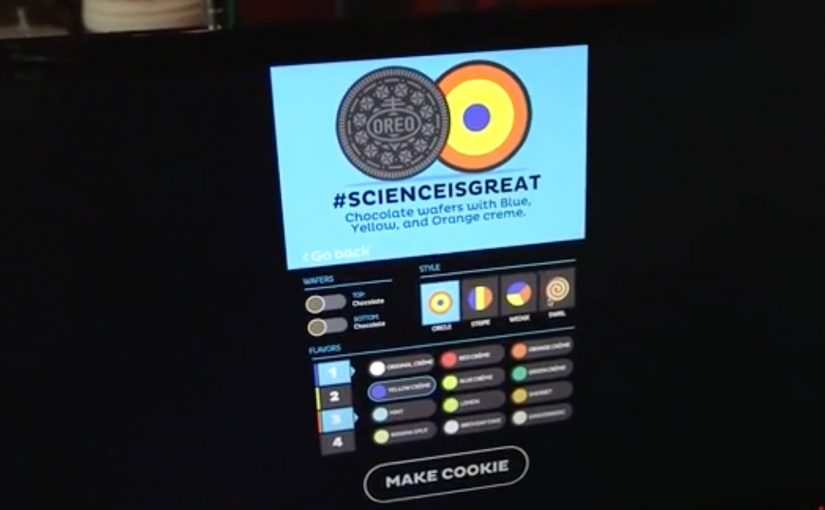
Oreo Twitter Powered Vending Machine

SXSW 2014 has just wrapped up, and Oreo was running a Twitter-powered vending machine that turned what is trending on Twitter into custom Oreo flavours and colours. Here, “Twitter-powered” means live Twitter activity drives the customisation rules the machine applies before dispensing.

How the Twitter-powered machine behaves in the moment

The installation listens to what people are talking about right now, translates that live signal into a tangible product variation, and delivers immediate gratification. It feels less like a branded demo and more like a real-time “trend to treat” pipeline.

In consumer-brand event marketing, the hard part is making a live social signal feel physical fast enough to matter.

Why this works as a live brand experience

The strength is the conversion loop. Social conversation becomes the input. A physical machine becomes the output. The novelty is not just that it is connected. It is that it makes the connection visible and edible in front of a crowd. Because the cause and effect is visible in the cookie itself, people can understand what changed immediately.

Extractable takeaway: Social-to-physical ideas travel when the mapping from input to outcome is obvious and fast. If people cannot explain the cause and effect in one sentence, the activation will not scale beyond the moment.

The real question is whether your activation turns a live signal into a payoff that is legible to bystanders and rewarding to participants.

If the mapping is not instantly clear and the output is not immediate, skip the “social-to-physical” build and invest in a simpler loop.

Steal the ‘trend to treat’ loop

  • Pick one live signal. Use a single, public input people already understand in the moment.
  • Make the mapping obvious. Show exactly what changed and tie it directly to what the person receives.
  • Design for throughput. Keep steps minimal so the line moves and the crowd can watch cause and effect.
  • Instrument the loop. Track usage and wait time so you can compare impact against other event spend.

A few fast answers before you act

What is a Twitter-powered vending machine?

It is a connected vending machine that uses Twitter activity as an input signal. In this case, trending topics influence the Oreo customisation, then the machine dispenses the result.

Why do brands build installations like this at events?

They compress awareness, participation, and sharing into a single experience. People see it, try it, and talk about it in the same moment, which amplifies the reach beyond the venue.

What makes “social-to-physical” activations effective?

The mapping has to be obvious and fast. People should immediately understand what they did, what changed, and what they received. The tighter the loop, the more it feels like magic instead of tech.

How do you keep this from feeling gimmicky?

Anchor the change in something people can see instantly, and make the output desirable enough that bystanders want to try it next. If the “why” is not visible in the product, it reads as a demo.

What should you measure if you run a similar idea?

Measure throughput and dwell time at the installation, social lift during the activation window, content volume and quality created by attendees, and the cost per meaningful interaction compared with other live formats.

Pepsi Max: Unbelievable Bus Shelter

Pepsi Max for its new ‘Unbelievable’ campaign rigged an ordinary bus shelter in London, to perform tricks on unsuspecting travellers.

Using a custom see-through digital display, people waiting at the bus shelter were made to believe that they were actually seeing things like hovering alien ships, a loose tiger, a giant robot with laser beam eyes and so on.

The reactions to these ‘unbelievable’ scenarios were then captured and put in the below viral video.

Why this works. Even before you talk about “tech”

The technology is impressive, but the mechanic is simple. Here, “mechanic” means the repeatable audience interaction pattern, not the underlying tech. It takes an everyday moment. It inserts a believable layer of impossible. Then it lets people do the rest. React, laugh, point, film, share. Because the impossible is framed inside a familiar “window”, disbelief lands fast and reactions become the content. In high-footfall urban out-of-home environments, a brand moment has to work wordlessly, in seconds, for strangers who did not opt in.

Extractable takeaway: If you can turn passive waiting time into a personally witnessed story, you get emotion, proof and distribution before you spend on media.

That is the real move. It transforms passive waiting time into a story that feels personally witnessed.

The bus shelter as a “media product”

This activation treats the bus shelter like a product interface, not just a placement. It has inputs and outputs. Here, “activation” means a physical installation that creates a live brand experience in public space.

  • Input. People arrive with low expectations and spare attention.
  • System. A “window” that looks like reality, then breaks it in a controlled way.
  • Output. Instant emotion, social proof from nearby strangers, and a camera-ready moment.

In other words, it is not only out-of-home. It is an experience designed to be recorded and re-distributed.

The real question is whether your experience turns bystanders into witnesses, and witnesses into voluntary distribution.

What makes it shareable. And why the video is the second product

The live moment is the first product. The viral video is the second product. The second product extends the reach far beyond the street corner.

Tech is optional. If the premise is not instantly legible, it will not travel.

  • High signal in seconds. You understand what is happening instantly.
  • Escalation. Each new “unbelievable” scene raises the stakes and keeps attention.
  • Human faces. The reactions are the content. The brand stays present but not intrusive.
  • Social permission. If others are reacting, you react too. Then you share.

What to take from this if you build brand experiences

  • Design the moment first. The best “viral videos” start as real-world moments people want to show others.
  • Keep the premise instantly legible. If it needs explanation, it loses momentum.
  • Make capture a feature. If people will film it, stage it so the footage works.
  • Build a repeatable format. One idea, multiple scenarios, consistent payoff.
  • Let the audience star. The most believable proof is human reaction, not brand claims.

A few fast answers before you act

What is Pepsi Max “Unbelievable” in one sentence?

It is a London bus shelter activation that used a see-through digital display to create impossible scenes, then turned real public reactions into a viral video.

Is this augmented reality?

It functions like augmented reality for the audience, because it overlays illusions onto what looks like a real street view, even though the experience is delivered through a physical digital screen.

Why do people share this kind of content?

Because it triggers instant emotion and disbelief, and it is easy to explain visually. People share it to pass on the surprise.

What is the key design principle behind the activation?

Make the better story happen in the real world. Then make it easy for the story to travel as video.

What is the practical takeaway for marketers?

When you create a moment that people genuinely want to record, distribution becomes an outcome of the experience, not a separate media plan.