
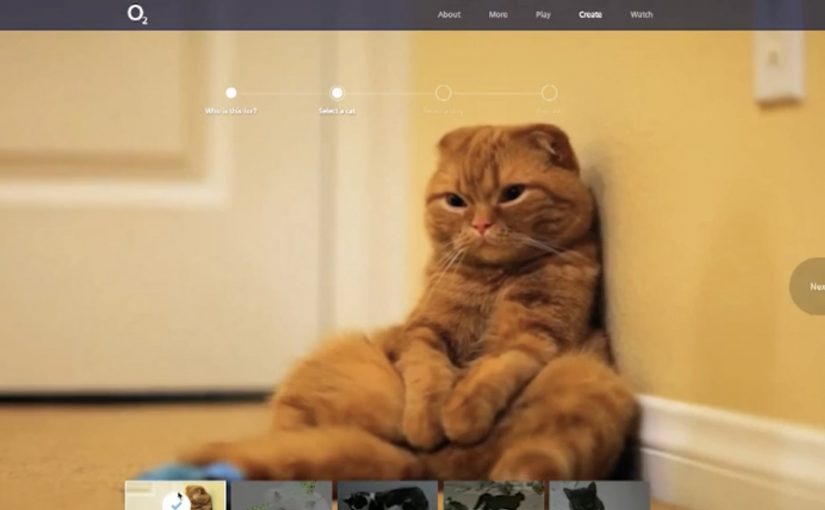
O2: Be More Dog

A cat decides it has had enough of being indifferent. It chases, leaps, splashes, and generally behaves like a dog. O2 UK uses that simple flip to ask people to do the same with technology. Less “meh”. More curious.

With VCCP and the Moving Picture Company, the campaign extends beyond the TV spot into a participation layer. That participation layer means the idea does not stop at the film but gives people something to do and share. On visiting www.bemoredog.com, people are greeted by a cat that acts more like a dog, then pulled into interactive play through a dual-screen HTML5 Frisbee game and a set of customisable cat videos designed for sharing.

How the integration is designed

The mechanism is a clean handoff. TV creates the character and the phrase. Mobile turns into the controller for a dual-screen game. Social carries the customisable video layer so people can pull friends into the same joke and the same attitude shift.

In UK consumer telecoms, where functional claims blur quickly, a memorable behavioural metaphor can do more positioning work than another round of feature talk.

Why it lands

It works because it uses a familiar truth. The cat-to-dog flip works because it turns an abstract behaviour change into a visual joke people understand in seconds. Cats look cool and detached. Dogs look curious and all-in. That contrast is instantly readable, and it translates directly into what O2 wants from people. Try the new thing. Explore. Stop acting like technology is background noise.

Extractable takeaway: If you want people to reframe a category, give them a single, sticky metaphor and one simple interaction that lets them experience the new attitude, not just hear about it.

What O2 is really trying to shift

This is brand positioning dressed as entertainment. The real question is how to make curiosity about new technology feel socially easy and emotionally attractive, not technically demanding. O2 is steering perception toward optimism and exploration, and using connected play to make “embracing the new” feel easy, not technical. In context, the timing also supports a broader push into newer network experiences, including 4G-era behaviour change.

What brand teams can steal from Be More Dog

  • Use one character as the bridge. The cat carries TV, site, game and shareables without needing extra explanation.
  • Make mobile do a job. Second-screen control is more convincing than a generic “download our app” prompt.
  • Build sharing into the format. Customisable videos give people a reason to tag or send, not just watch.
  • Keep the interaction lightweight. Quick play beats complicated onboarding when the goal is broad participation.

A few fast answers before you act

What is “Be More Dog”?

It is an O2 UK brand campaign that uses a cat acting like a dog as a metaphor for being more curious and enthusiastic about new technology, supported by second-screen and shareable digital experiences.

What is the core digital mechanic?

A dual-screen HTML5 Frisbee game that uses a phone as the controller, plus customisable cat videos designed for social sharing.

Why does the cat versus dog metaphor work so well?

It compresses a complex ask into a simple behavioural contrast people instantly understand, then turns that contrast into a repeatable line and a repeatable action.

What makes this an integrated campaign rather than “TV plus a website”?

The channels do different jobs that depend on each other. TV creates meaning. Mobile enables interaction. Social distributes personalised variants that pull others back into the idea.

What is the biggest way this pattern fails?

If the digital layer feels bolted on. The interaction has to express the same promise as the film, otherwise it becomes a novelty that does not move perception.
Carlsberg: Happy Beer Time

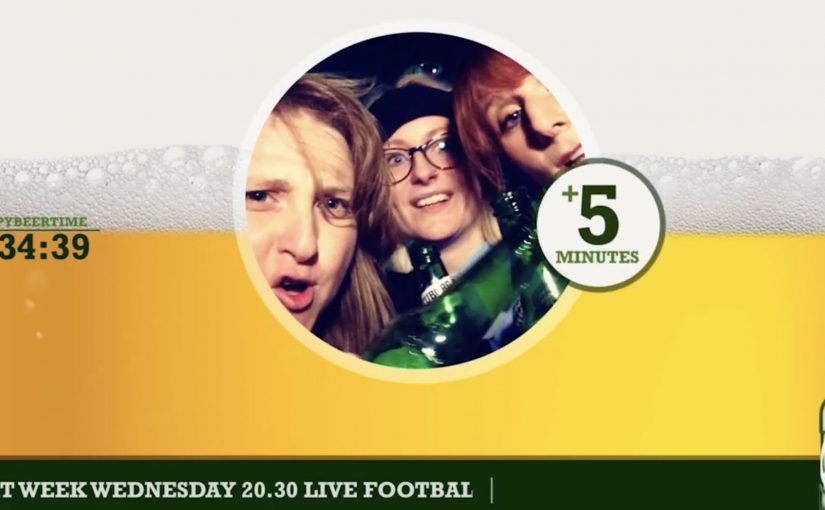
Nowadays people like to go out, take photos, and share them on Instagram. Carlsberg, together with the Danish agency Konstellation, puts a social twist on the well-known concept of happy hour by turning every post into more discounted time for the whole bar.

A happy hour that gets longer when the bar posts together

The mechanic is simple and highly visible. Guests snap an Instagram photo and tag it with the venue name and #HappyBeerTime. Each successfully tagged photo extends a shared countdown on the bar’s screen, which keeps discounted beer available for everyone while the clock keeps moving.

In on-trade environments, meaning bars and restaurants, the strongest promotions convert shared participation into a shared, immediate reward that the whole room can see.

What makes the mechanism work in a real bar

  • One clear lever. Post with the right tags. Add time.
  • Progress is public. A live countdown on a screen turns the promotion into a collective game.
  • Reward is communal. Everyone benefits from every post, so the behaviour spreads naturally.
  • Distribution is built in. The bar gains organic visibility through guests’ own feeds.

The real question is whether your incentive creates a room-level feedback loop fast enough that people feel their action changes the moment.

Why it lands

This activation aligns with what people already do on a night out. Take photos. Share moments. The difference is that the sharing changes the environment in real time. That makes the incentive feel playful rather than purely transactional.

Extractable takeaway: If you want participation at scale inside a venue, use a reward the entire room experiences together, and make the progress visible so the crowd recruits itself.

What the brand is really buying

On the surface, it is discounted beer for longer. Underneath, it is repeat purchase pressure at the point of sale, plus a stream of user-generated content tied to specific venues and nights. The bar gets word-of-mouth promotion. Carlsberg gets social proof linked to a real-world occasion.

A quick note on “Happy Hour 2.0”

“Happy Hour 2.0” is the idea of extending a happy-hour window through a simple trigger, instead of relying on a fixed start and end time. Budweiser was earlier to pioneer this Happy Hour 2.0 concept in August 2012. Carlsberg’s twist is connecting the extension mechanic directly to social posting behaviour.

Proof that the idea travelled beyond a one-off

The concept drew broader industry attention, including recognition in Danish award circuits and international festival shortlists. That matters because it signals the mechanic is legible. It is easy to explain, easy to copy, and easy for people to participate in without training.

Steal the shared countdown loop

  • Keep the action atomic. One photo and two tags beats a multi-step flow.
  • Design the room-level feedback loop. The screen is not decoration. It is the social engine.
  • Set guardrails early. Decide how you handle off-brand or inappropriate posts, and communicate it.
  • Make the reward feel immediate. “Add time now” beats “collect points later”.
  • Measure uplift, not just posts. Treat UGC as a means. The goal is incremental sales and dwell time.

A few fast answers before you act

What is Happy Beer Time in one sentence?

It is a bar promotion where Instagram posts tagged with the venue name and #HappyBeerTime extend a shared happy-hour countdown, keeping discounted beer available for longer.

Why does “time” work as the reward?

Time is instantly understood, visibly shared, and emotionally tied to the night out. Adding minutes feels like progress the whole room experiences together.

What makes this different from a standard hashtag campaign?

The hashtag is not just for awareness. It is a trigger that changes the real-world environment in real time, which makes posting feel consequential.

What can go wrong operationally?

If tagging rules are unclear, people will not participate. If moderation is absent, inappropriate content can surface. If the reward lags, the loop breaks.

What should you measure in a pilot?

Participation rate, post volume per hour, time extended per session, sales uplift during the activation window, and whether dwell time increases without margin loss exceeding targets.

Coca-Cola Interactive Mini Bottles

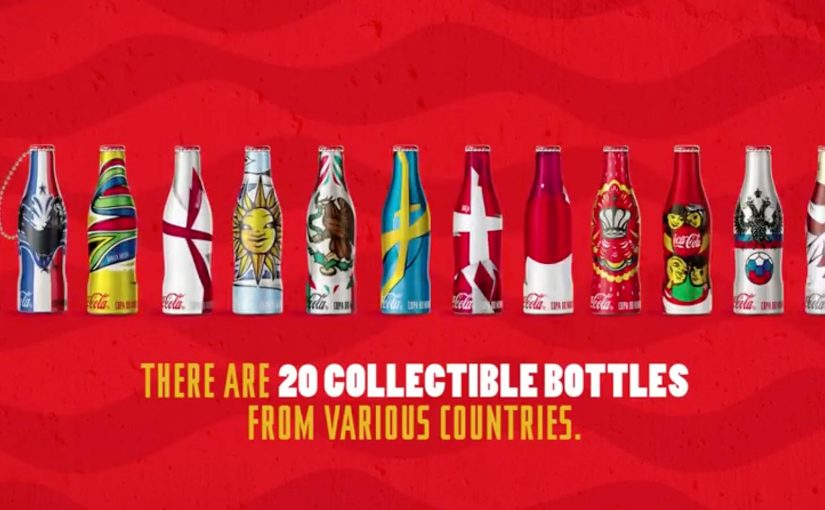
Coca-Cola has launched 20 special edition mini bottles to get fans around the world excited about the upcoming 2014 FIFA World Cup, which will take place in Brazil from June 12th to July 13th.

The bottles come wrapped in flags of countries that have hosted the World Cup previously. Argentina, Chile, Uruguay, Mexico, USA, England, Germany, Spain, France, Italy, Sweden, Switzerland, South Africa, Japan and South Korea. As well as the three upcoming host countries Brazil, Russia and Qatar. Plus two special Coca-Cola editions.

Coca-Cola fans can also create and send special messages and avatars to other bottle owners through Facebook and iPhone or Android apps. In addition, special markers on the bottles activate augmented reality animations when held up to a smartphone camera.

What makes these bottles more than packaging

This is a simple shift with big implications. The bottle is not only a container. It becomes a trigger. A collectible. And a social connector. This is smart brand design because it turns packaging into media without asking people to leave the product in their hand.

The real question is how to make a small physical object behave like media, participation, and social signal at the same time.

The flags do the first job. They make the bottles instantly recognizable and tradable. People have a reason to hunt for specific countries and compare what they found. The digital layer does the second job. By digital layer, this means the messages, avatars, and AR animations unlocked through the bottle. It turns ownership into participation, because the bottle now links to messages, avatars, and AR animations.

Why augmented reality fits this moment

AR works best when the behavior is natural. Here the behavior is already there. You hold the bottle in your hand. You point your phone at it. You get something back instantly. That is what makes the marker idea effective, because it adds a reward to an existing behavior instead of asking people to learn a new one.

Extractable takeaway: When the product already sits in someone’s hand, the strongest digital layer is the one that rewards curiosity in the moment rather than redirecting attention somewhere else.

In global brand portfolios, this matters because packaging that doubles as an activation point can scale engagement and give people a stronger reason to choose the brand at shelf without adding a separate physical touchpoint.

What to borrow from collectible packaging activations

  • Make the physical object the interface. The bottle is the entry point, not a poster, banner, or separate microsite.
  • Give fans something to collect and trade. Flags are a built-in collecting mechanic.
  • Add a social layer that only owners can unlock. Messaging and avatars make participation feel earned, not generic.
  • Use mobile as the bridge. iOS and Android apps turn “I saw it” into “I can activate it” immediately.

A few fast answers before you act

What are Coca-Cola Interactive Mini Bottles?

They are 20 special edition mini bottles designed to build excitement for the 2014 FIFA World Cup, using country-flag designs plus a digital interaction layer.

What is interactive about them?

Owners can send messages and avatars to other bottle owners via Facebook and iOS or Android apps. The bottles also include markers that trigger augmented reality animations through a smartphone camera.

Why use country flags on the bottles?

It creates instant collectability. People can look for specific countries, compare what they found, and feel part of a shared event build-up.

What is the role of augmented reality here?

AR turns the label into an activation point. Point your phone at the bottle, and the design becomes an animation experience rather than static packaging.

What is the main marketing idea worth copying?

Make the product itself the gateway to the experience. When the physical object triggers the digital layer, participation becomes effortless and more memorable.