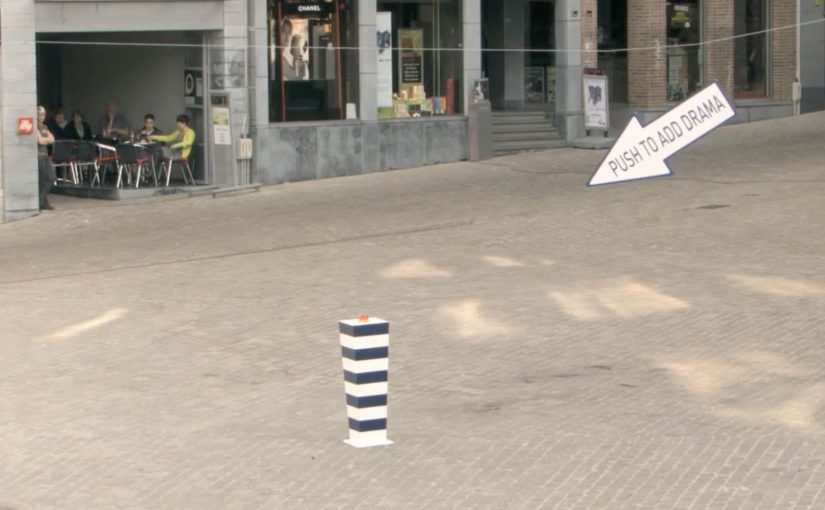
A big red push button sits in a quiet Flemish square. A sign says “Push to add drama”. Someone presses it, and the street turns into a live TV scene.
Flashmob marketing has been quite a fad in the last weeks. If you are unfamiliar with the concept, a flashmob is a large group of people who assemble suddenly in a public place, perform an unusual and pointless act for a brief time and then disperse. The whole act is normally recorded on video and then put on the web to generate more buzz.
In brand marketing built on earned attention, flash mobs are a way to convert physical spectacle into shareable media without buying every impression.
Three street moments worth watching again
Daily dose of drama
To launch their new digital channel in Belgium, TNT placed a big red push button in a quiet Flemish square. A sign with the text “Push to add drama” invited people to use the button. And then the “ordinary day” collapses into staged chaos.
Why it lands: the invitation is frictionless, the payoff is immediate, and the viewer at home gets the same shock that the passer-by gets on the street.
The worst breath in the world
Tic Tac turns a simple “can you help me with directions” moment into social dread. A lost tourist asks for help in a busy square. Then, one person after another reacts as if the breath is so bad it triggers an apocalyptic chain reaction.
Why it lands: it weaponizes a universal fear, then exaggerates it so far that embarrassment becomes comedy. The crowd reaction becomes the story.
The Wouaaah Effect
For its Q10 Plus product, NIVEA in France creates a playful attention ambush on the streets of Paris. An unsuspecting woman tries a cream sample, walks on, and is suddenly met by a sequence of people lavishing her with attention.
Why it lands: it makes a product promise feel physical. The benefit is not “told”. It is acted out as a mini social fantasy.
The pattern behind the fad
The mechanism is simple. Create a one-line invitation, trigger a public spectacle, and film genuine reactions from the “mark” and the bystanders. The distribution is the video, not the street corner. The street corner is just the credibility engine.
What the brands are buying
These are not careful, message-heavy campaigns. They are attention accelerators. The business intent is to earn reach through surprise and shareability, then let the brand borrow the emotional afterglow of the moment.
How to steal the good parts without copying the gimmick
- Start with a legible trigger. One button. One question. One sampling moment.
- Design the escalation curve. The first five seconds decide if people stay for the next thirty.
- Make reactions the hero. The crowd is your proof and your punchline.
- Give the video a clean “retell”. If the concept cannot be explained in one sentence, it will not travel fast.
A few fast answers before you act
What qualifies as a flash mob in marketing terms?
A staged public action that appears spontaneous to bystanders, is filmed for real reactions, and is distributed primarily as a video asset to generate buzz.
Why do flash mob videos spread more than many traditional ads?
They feel like captured reality. The viewer gets surprise, spectacle, and social proof in the same clip, which makes sharing feel like passing on entertainment, not advertising.
What is the biggest creative risk with flash mob marketing?
People can read it as forced or manipulative. If the trigger feels like a trick, the audience turns on it and the brand takes the hit.
How do you keep a flash mob idea brand-relevant?
Make the payoff embody the brand promise. Drama for a drama channel, breath anxiety for mints, and attention for a beauty benefit are all direct translations.
What is the practical “steal” for marketers who cannot stage a street stunt?
Borrow the structure. A simple trigger, a clear escalation, and authentic human reactions, then build it for a format that you can execute safely and repeatedly.