
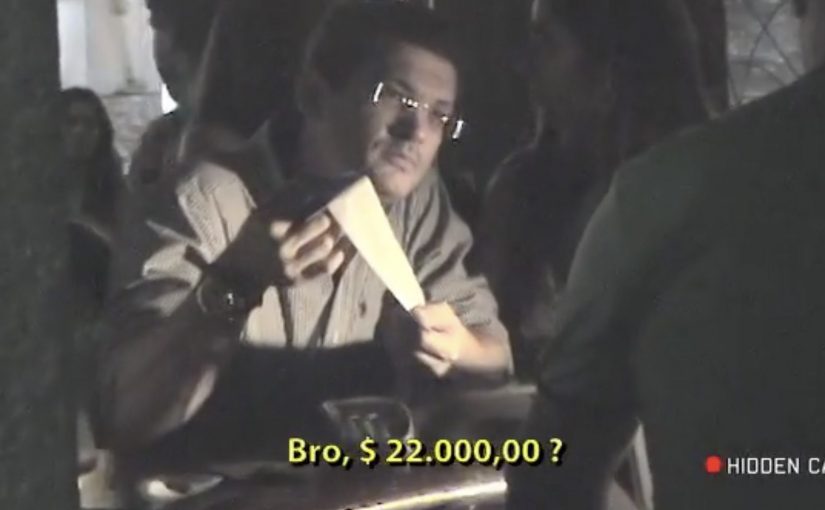
Bar Aurora & Boteco Ferraz: $73,000 Bar Tab

At Bar Aurora and Boteco Ferraz, the bar tab can land like a punch. A normal night out suddenly totals $73,000.

The number is deliberately absurd. Instead of “just” charging for drinks, the receipt is designed to confront patrons with the kinds of costs that a drunk-driving crash can trigger, described as an itemized ledger of consequences rather than a generic warning.

Ogilvy Brasil (São Paulo) ties the message to the moment that matters most. Right after the drinking. Right before the decision to drive.

A receipt that speaks at the exact decision point

The mechanism is simple and brutal. Take a familiar ritual, the bar tab, and turn it into a personalized “cost statement” that patrons cannot ignore because it arrives inside a context they trust and understand. It works because the receipt arrives as a trusted artifact at the exact moment the choice is being made.

That timing does most of the work. The message is not competing with the rest of the day’s noise. It shows up when someone is already weighing options like “I’m fine” versus “I should take a taxi.”

In public-interest and brand-led behavior-change work, point-of-decision interventions outperform broad awareness because they collide with behavior, not intentions.

Here, a point-of-decision intervention is a prompt delivered at the moment someone is deciding what to do next.

The real question is whether you can make the consequence feel immediate enough to change the drive-or-taxi decision.

Why the anger matters more than the poster

People get annoyed because the interruption feels personal. That emotion spike is useful. It snaps the brain out of autopilot, forces a re-check, and reframes the “big deal” as a concrete, financial, immediate-looking problem.

Extractable takeaway: If the risky behavior feels like a small, private choice, make the consequence feel like a concrete, personal ledger entry that appears at the decision point. Reduce abstract harm into a format the audience already treats as “real.”

Done well, this does not need moralizing language. The receipt format does the persuasion quietly. It turns “don’t do this” into “here is what this can cost you, in a language you already understand.”

What the bar gets out of it

This is cause work that also behaves like brand building. It positions the venue as the place that looks after customers beyond the last drink, and it gives staff a socially acceptable reason to start a safer-ride conversation without sounding preachy.

It also travels. The idea is easy to retell, easy to film, and built for word-of-mouth because the “$73,000” moment is inherently shareable.

Patterns to reuse from the $73,000 tab

  • Move the consequence into the present tense. Don’t explain risk. Render it.
  • Use a trusted artifact. Receipts, tickets, confirmations, packaging, dashboards. Anything the audience already believes.
  • Interrupt without humiliating. Aim for friction and reflection, not public shaming.
  • Design for the handoff. The moment should naturally lead to a safer alternative (taxi, ride-share, designated driver) without needing a speech.

A few fast answers before you act

What is the “$73,000 Bar Tab” idea?

It is an anti drink-driving activation where patrons receive a dramatically inflated bar tab that reframes a “small” choice as a high-cost outcome, using the receipt format to make the warning feel concrete.

Why use a bar tab instead of a standard awareness ad?

A bar tab arrives at the point of decision, when a person is actively choosing what to do next. That timing creates immediate relevance and forces the brain out of autopilot in a way a poster rarely can.

What is the key mechanism that makes it persuasive?

Format plus timing. The message is delivered inside a familiar, trusted artifact, at the exact moment the audience is weighing whether they are “okay to drive.”

How can brands adapt this pattern without backlash?

Keep the intervention private, keep the tone factual, and pair it with an obvious safer alternative. The goal is reflection and route change, not punishment.

What should the moment lead to immediately?

Build in an easy handoff to the safer choice, so the “pause” turns into action, like taking a taxi, using ride-share, or calling a designated driver.
3D Holograms: Two Marketing-World Examples

3D holograms are a great way to attract and engage consumers. Here, “3D holograms” refers to hologram-style displays that use animation to create a depth illusion in a physical setting. They can be quite effective if your brand is having trouble getting noticed or if your product’s capabilities can best be described using images and animation.

Though brands find it daunting to venture into this, there are still some brands out there bold enough to try it. Here are some nice examples.

Why holograms can cut through

The strength of a hologram-style display is that it behaves like moving product theater. Because it behaves like moving product theater, it can stop people mid-walk, and it can compress a lot of “show, do not tell” explanation into a few seconds. In retail aisles and brand events, it competes against the surrounding noise, not against other media placements.

Extractable takeaway: Use depth and motion only when they reduce explanation time or make the core action instantly legible. If depth is not doing work, you are paying for novelty.

The real question is whether motion plus depth makes the story easier to grasp than a flat screen or static print. When the answer is yes, the format can earn attention fast.

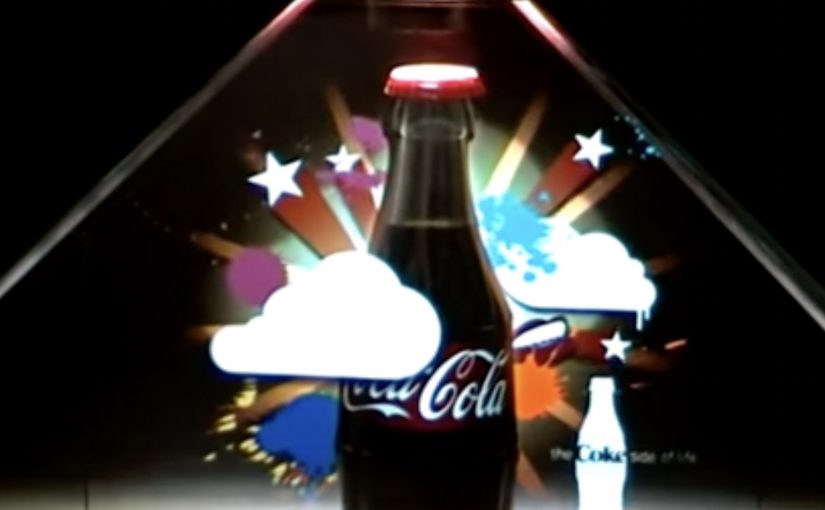
Coca Cola In-Store Display

This example shows how a hologram-style display can work as an in-store attention magnet. The content is pure visual storytelling, which makes it easy to understand at a glance and easy to remember later.

Samsung Jet Launch

At launches, holograms can do a different job. They help dramatize product capability and create a sense of spectacle that standard stage content often struggles to match. That spectacle then becomes a shareable proof that something “big” happened.

What to steal if you are considering holograms

  • Pick one message that benefits from depth. If depth is not doing work, you are paying for novelty.
  • Design for walk-by comprehension. People should get it in under three seconds.
  • Keep the loop tight. Short, repeatable sequences beat long narratives in retail and event contexts.
  • Make the hero action visible. If the product feature is the star, animate that feature, not abstract brand graphics.

A few fast answers before you act

When do 3D hologram displays make sense for marketing?

When you need fast attention in a physical space, or when animation plus perceived depth explains the product better than flat media.

What is the main advantage over a normal screen?

Presence. The illusion of depth makes the content feel more like an object in the space, which can increase stop power and recall.

What is the biggest execution risk?

Paying for the format without a story that needs it. If the creative is not designed around depth and motion, the result feels like expensive wallpaper.

How should success be measured?

Dwell time, footfall impact near the unit, assisted recall, and any downstream action that matters to your context, like store inquiry, trial, or social amplification.

What is a practical way to keep cost under control?

Start with one hero unit and a short content loop, then scale only if you can prove incremental attention and understanding versus simpler formats.

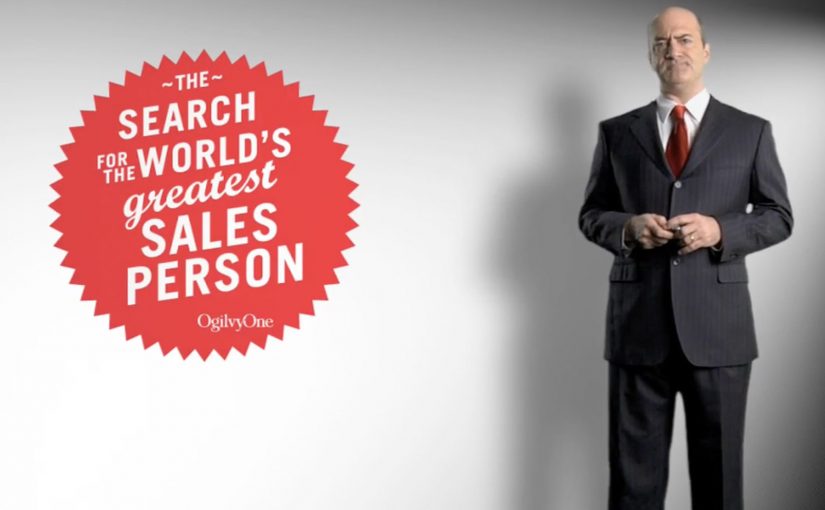
Ogilvy: The World’s Greatest Salesperson

News just out. Ogilvy & Mather Worldwide is looking for “The World’s Greatest Salesperson”.

Ogilvy’s founder, David Ogilvy, went door to door selling stoves before he got into advertising. He was so good at it that the company asked him to write a manual for other salesmen. Now, after decades as one of the best-known agencies in the world, Ogilvy is creating a contest to celebrate the art of selling.

The contest is designed to live where modern pitching lives: on YouTube. Entrants are asked to prove they can sell, not just claim they can sell, by submitting a short video pitch.

A recruiting idea disguised as a sales lesson

The mechanism is simple. Use a public challenge to attract people who can communicate clearly under constraints, then let the internet do the first round of filtering through visibility and voting signals. Because the entry is a short video work sample, the first screen is proof, not claims.

In global agency recruiting and employer branding, open challenges like this turn hiring into content and let capability show up in public rather than on a CV.

This is a stronger recruiting filter than a conventional careers campaign because it forces proof under a shared constraint.

The real question is whether a video-first work sample can replace traditional screening without diluting quality.

Why it lands

It works because the entry format turns “sales ability” into a comparable work sample, so judgment starts with evidence instead of self-description.

Extractable takeaway: The best recruiting campaigns behave like a job preview. A job preview is a small, real slice of the role. They ask candidates to demonstrate the exact skill you care about in a constrained, comparable format, then use curation to turn submissions into a public proof of standards.

It makes “sales ability” observable. The work samples are the application. You can see clarity, empathy, structure, and persuasion in minutes.

It borrows the founder’s origin story without turning it into nostalgia. The David Ogilvy reference sets a standard. Selling is treated as craft, not hype.

It rewards ambition with a real stage. The promised prize, including a Cannes Lions trip and a seminar slot, gives the contest a credible career upside rather than a token reward.

Borrowable moves for video-first recruiting

  • Ask for a work sample, not a statement. Make the entry itself the evidence.
  • Use one consistent prompt. A shared constraint makes submissions comparable and curation easier.
  • Build a reward that signals seriousness. A meaningful stage and exposure attracts serious entrants.

The three winners of this contest will win a trip to the 57th annual Cannes Lions International Advertising Festival. They will also get to make a presentation at the festival seminar on June 21.


A few fast answers before you act

What is Ogilvy actually trying to find with this contest?

Someone who can sell convincingly, on camera, with a clear structure and customer understanding, not just someone with a polished resume.

Why run it on YouTube?

Because sales is performance plus clarity. Video makes both visible, and it scales submissions globally without heavyweight logistics.

What makes this more than a PR stunt?

The entry format is a real work sample, and the prize includes a meaningful industry stage. That combination turns attention into a talent pipeline.

What does David Ogilvy’s backstory add to the idea?

It anchors the contest in a specific belief: selling is foundational craft. The founder story is used to justify why sales ability is being celebrated publicly.

What is the most transferable lesson for leaders hiring for commercial roles?

Design selection as demonstration. Give candidates a single prompt that mirrors the real job, then judge the work, not the claims.