Burger King Truckvertising

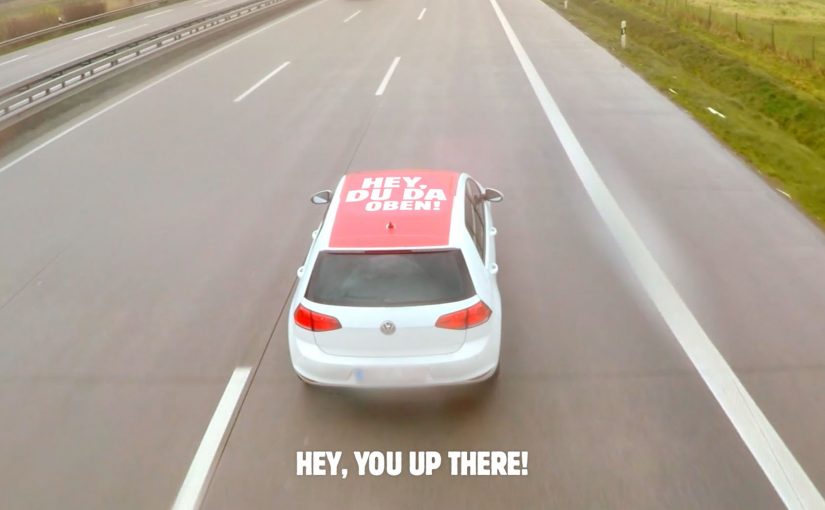
Due to strict laws, reportedly around 13,000km of the German motorway network is ad-free. So to convince truckers in Germany to buy freshly grilled Whoppers, Burger King and agency Grabarz & Partner create ads that only truckers can see. The ads sit on the roof of multiple cars that take turns overtaking trucks.

The cars do not just show an ad. They run a sequence of messages that feels like a conversation from the road:

  • “Hey, you up there!”
  • “You look hungry!”
  • “Why don’t you try out the Whopper?”
  • “Fresh and flame grilled”

Once the first few cars get the truckers’ attention, the remainder guides them to the next Burger King, turning the motorway into a moving funnel:

  • “If yes, then wink”
  • “Follow me to Burger King”

As a result, many truckers give in to temptation and follow the cars to the next XXL Burger King Drive-In.

The constraint that forces the creativity

The starting point is the limitation. Large parts of the German motorway network are ad-free, so the classic roadside billboard play is unavailable at scale.

The execution is “roof media” plus choreography

Burger King turns overtaking cars into a media surface and a delivery system. Roof placements ensure the message is visible from the truck cab. A rotating set of cars keeps the sequence going long enough to land.

The craft is the choreography. It is not one clever line. It is a paced interaction that escalates from attention, to appetite, to direction.

Why this works as shopper marketing in motion

This is direct response built into a live environment. The target is already in a vehicle. The call-to-action is a drive-in. The next best action is physically nearby, and the message literally leads the way.

It also respects context. Truckers are not asked to scan, click, or search. They are asked to notice, react, then follow.

What to steal

  • Start with a hard constraint and treat it as a design brief, not a blocker.
  • Use a format the audience cannot ignore in their context, in this case overhead visibility from a cab.
  • Build a sequence that moves from attention to action, not a single punchline.

A few fast answers before you act

What is “Truckvertising” in one line?

Car-roof ads overtake trucks on ad-free motorways, deliver messages to truckers, then guide them to the next Burger King drive-in.

Why put the ad on the roof?

Because the goal is visibility from the truck cab.

What is the conversion mechanic?

A staged sequence of overtaking cars that gets attention, then provides directions to the next Burger King.

What is the underlying business aim?

To drive immediate, local store visits and Whopper purchase intent from a high-propensity audience in transit.

Pepsi Max – Unbelievable Bus Shelter

Pepsi Max for its new ‘Unbelievable’ campaign rigged an ordinary bus shelter in London, to perform tricks on unsuspecting travellers.

Using a custom see-through digital display, people waiting at the bus shelter were made to believe that they were actually seeing things like hovering alien ships, a loose tiger, a giant robot with laser beam eyes and so on.

The reactions to these ‘unbelievable’ scenarios were then captured and put in the below viral video.

Why this works. Even before you talk about “tech”

The technology is impressive, but the mechanic is simple. It takes an everyday moment. It inserts a believable layer of impossible. Then it lets people do the rest. React, laugh, point, film, share.

That is the real move. It transforms passive waiting time into a story that feels personally witnessed.

The bus shelter as a “media product”

This activation treats the bus shelter like a product interface, not just a placement. It has inputs and outputs.

  • Input. People arrive with low expectations and spare attention.
  • System. A “window” that looks like reality, then breaks it in a controlled way.
  • Output. Instant emotion, social proof from nearby strangers, and a camera-ready moment.

In other words, it is not only out-of-home. It is an experience designed to be recorded and re-distributed.

What makes it shareable. And why the video is the second product

The live moment is the first product. The viral video is the second product. The second product extends the reach far beyond the street corner.

  • High signal in seconds. You understand what is happening instantly.
  • Escalation. Each new “unbelievable” scene raises the stakes and keeps attention.
  • Human faces. The reactions are the content. The brand stays present but not intrusive.
  • Social permission. If others are reacting, you react too. Then you share.

What to take from this if you build brand experiences

  1. Design the moment first. The best “viral videos” start as real-world moments people want to show others.
  2. Keep the premise instantly legible. If it needs explanation, it loses momentum.
  3. Make capture a feature. If people will film it, stage it so the footage works.
  4. Build a repeatable format. One idea, multiple scenarios, consistent payoff.
  5. Let the audience star. The most believable proof is human reaction, not brand claims.

A few fast answers before you act

What is Pepsi Max “Unbelievable” in one sentence?

It is a London bus shelter activation that used a see-through digital display to create impossible scenes, then turned real public reactions into a viral video.

Is this augmented reality?

It functions like augmented reality for the audience, because it overlays illusions onto what looks like a real street view, even though the experience is delivered through a physical digital screen.

Why do people share this kind of content?

Because it triggers instant emotion and disbelief, and it is easy to explain visually. People share it to pass on the surprise.

What is the key design principle behind the activation?

Make the better story happen in the real world. Then make it easy for the story to travel as video.

What is the practical takeaway for marketers?

When you create a moment that people genuinely want to record, distribution becomes an outcome of the experience, not a separate media plan.

Heineken Carol Karaoke

What if you were singing holiday carols to a few friends at a karaoke bar, when suddenly your performance became a concert broadcast before thousands on the Jumbotron at a professional basketball game, in Times Square and on the screens of nearly every New York City taxicab. Would you keep singing?

That is the setup behind Heineken’s Carol Karaoke. It starts as a small, friendly singalong, then flips into a “will you or won’t you” decision in seconds. Keep going and you are suddenly performing for strangers at scale. Stop and you walk away from the moment.

How the stunt works

The mechanism is deliberately clean. Invite people to sing. Reveal the twist. Put a choice in front of them with no time to overthink. The broadcast layer is what raises the stakes, but the real content is the decision itself.

It is also built for the social era without relying on a hashtag to do the work. The reaction is the story. The story becomes the share unit.

In big-city holiday campaigns, the fastest route to earned attention is a simple public challenge that people can imagine themselves facing.

Why it lands

Karaoke is already a controlled embarrassment. The campaign simply stretches that discomfort from “friends in a booth” to “a city watching”. That tension creates instant empathy and instant curiosity, because nearly everyone knows what it feels like to sing badly, and nearly everyone has imagined what it would feel like to be exposed.

Heineken positions itself as the catalyst for crossing that line, not the judge of the performance. The brand role is enabling, and the payoff is human.

Business intent

This is branded entertainment built around social courage. It connects Heineken with celebration behavior, and it manufactures a holiday moment that people will retell, because the premise is easy to repeat and the outcome is emotionally satisfying.

What to steal

  • Use a decision, not a slogan. Put real choice in the frame and you get real reaction.
  • Make the twist explainable in one sentence. If the idea cannot be retold instantly, it will not travel.
  • Raise stakes with environment, not complexity. Big screens and public broadcast do more than extra rules.
  • Cast ordinary people. Relatability is what turns “a stunt” into “I can picture myself there”.

A few fast answers before you act

What is Heineken Carol Karaoke?

It is a surprise karaoke activation where people singing holiday carols are suddenly offered a choice. Keep singing and be broadcast publicly to a much larger audience, or stop and walk away.

Why does the “will you or won’t you” structure work?

Because the content is the decision under pressure. That creates tension, authenticity, and a clear emotional arc that viewers follow in seconds.

What role do out-of-home screens play in the idea?

They turn a private performance into a public moment instantly. The scale shift becomes the stakes, and those stakes are immediately legible to anyone who has ever felt stage fright.

What makes this kind of stunt shareable?

The setup is retellable in one line, and the payoff is emotional and human. People share it to relive the moment of courage, not to explain a complicated mechanic.

How can a brand adapt this idea without a Jumbotron?

You can swap the “big screen” for any sudden jump in visibility that feels real. For example, a live in-venue feed, a public projection, a partner-owned network of screens, or an unexpected “broadcast” to a larger nearby audience.