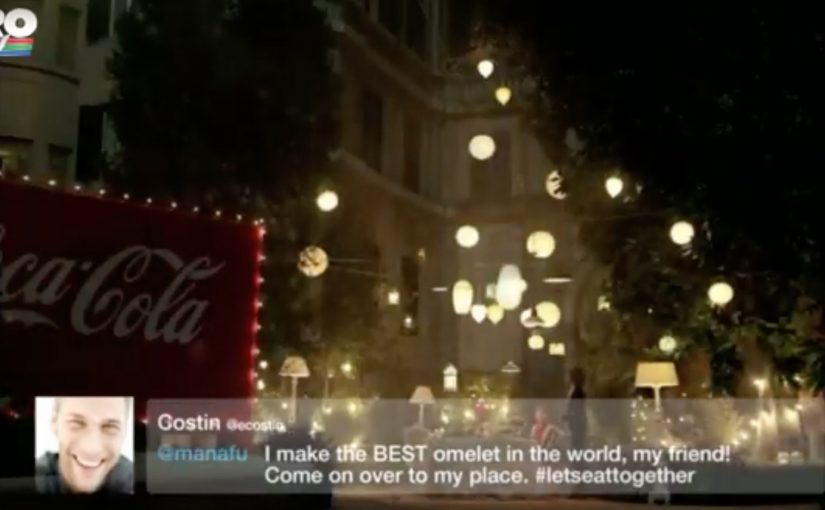
Coca-Cola in Romania seems to have broken new ground in the country with its integration between Twitter and TV, as it included live consumer tweets during its ad.
The insight for the campaign came from the fact that in Romania 60% of people don’t eat meals together, but instead eat them alone while sitting in front of their TV. So Coca-Cola decided to use tweets to create open invitations for people to actually come together and have a meal with a Coke.
As shown in the video below, the TV ad included a subtitle bar that was used to run the tweets that consumers sent using the hashtag #LetsEatTogether. Coca-Cola’s ad agency, MRM Worldwide, then edited the tweets and inserted five to seven of them into each ad placement.
The campaign increased Coke’s Twitter followers in Romania by 15% as hundreds of tweets were aired on TV. The campaign even made it to the evening news as its uniqueness made Romanians wait everyday for the ad.
Why this Twitter plus TV integration worked
The execution is simple. It borrows the visual language of TV subtitles, then uses it for social proof, meaning viewers can see other people already taking part. Viewers see real people inviting others to eat together, in real time, inside the ad break itself. That makes the message feel less like a brand instruction and more like a public invitation.
Extractable takeaway: When you make audience participation visible inside the main media placement, the campaign can feel more social, more immediate, and more worth watching.
It also turns participation into a lightweight ritual. Tweet the hashtag. Watch for your message. Share the moment when it appears. The format gives people a reason to keep an eye out for the ad, which is the opposite of what usually happens during commercials.
The real question is not whether people can respond to a campaign, but whether that response is visible enough to change how the ad itself feels.
In mass-reach brand advertising, this matters because the primary screen can carry participation directly instead of pushing interaction off to a second screen.
What Coca-Cola was really buying here
This is a smart cross-media play because it does more than collect engagement. It upgrades a standard TV placement into something people anticipate, talk about, and actively watch for.
The business intent is clear. Coca-Cola is using participation to make the ad break itself feel more alive, increase repeat viewing, and turn audience response into earned attention for the brand.
What to steal if you design campaigns with live participation
- Use a single, explicit mechanic. One hashtag, one behavior, one clear outcome.
- Make the audience visible inside the media. The tweets are not a second screen. They are on the primary screen.
- Curate without killing authenticity. Editing keeps it brand-safe while still feeling consumer-led.
- Reward repeat viewing. New tweets each placement create a reason to watch again.
A few fast answers before you act
What did Coca-Cola Romania do in this campaign?
They integrated live consumer tweets into a TV ad by running curated hashtag messages in a subtitle bar during the commercial.
What was the insight behind #LetsEatTogether?
That many people in Romania ate alone in front of the TV, so the campaign used tweets as open invitations to share meals together.
How were tweets handled for broadcast?
Tweets using #LetsEatTogether were edited and five to seven were inserted into each ad placement by the agency.
What changed in performance?
Coke’s Twitter followers in Romania increased by 15% and hundreds of tweets were aired on TV.
What is the core lesson for cross-media experiences?
If you bring live participation into the primary screen, you can turn an ad break into an event people actively watch for.