To promote its new high-performance hybrid car, Lexus, together with Saatchi & Saatchi Italy, creates “Trace Your Road”, an experiential event featuring Formula 1 driver Jarno Trulli.
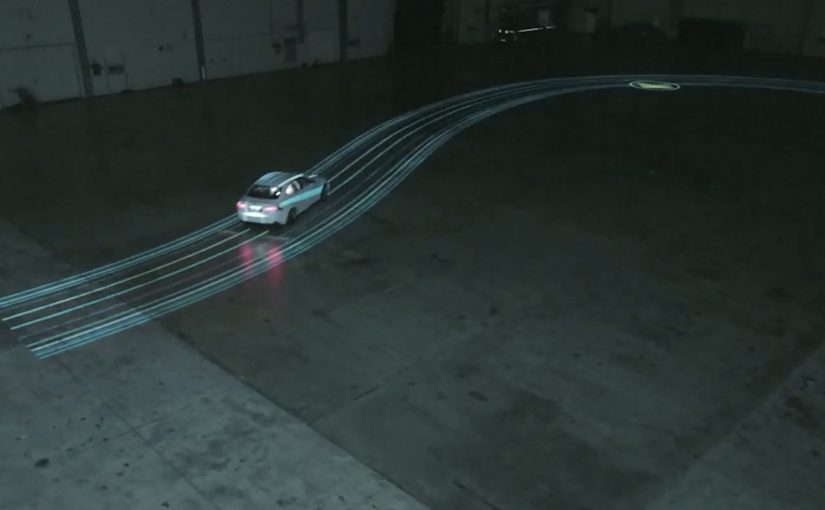
Ten Lexus fans are selected from hundreds of applicants on Lexus’ Facebook page. Each winner rides in the passenger seat of the hybrid while Trulli drives, and the passenger “draws” the course on an iPad. That path is projected onto the floor of an aircraft hangar using special projectors, while a custom high-resolution infrared (IR) camera system tracks the car’s position in real time.
How the experience works
The format is a life-sized driving game with the audience literally designing the track. The event flow is built around three moving parts.
- Live track creation. The passenger traces a route on the iPad, creating spontaneous turns, straights, and corners.
- Real-world projection. The route appears at scale on the hangar floor, so the “racetrack” becomes a physical space.
- Real-time tracking. An IR camera system follows the car so penalties and scoring can be applied accurately.
What makes it competitive, not just cinematic
Trulli’s driving is put to the test as he attempts to follow the improvised paths at speed. Penalty points are given when the car goes outside the projected route or touches the hangar walls. The goal is to hit seven selected touch points in the quickest time, and the fan with the best score wins.
In automotive launches and premium brand marketing, turning a test drive into a participatory game makes performance feel experienced, not explained.
The real question is whether your launch makes the product truth the win condition, not just the headline.
Why it lands: performance becomes legible
Hybrid performance can be hard to dramatize without slipping into numbers. Because the passenger-designed route and visible penalty rules force precision, control and handling become legible without a spec sheet, while the story stays human through the passenger’s real-time choices and Trulli’s visible skill.
Extractable takeaway: When you can turn a product claim into a rule set with visible penalties, the audience understands it instantly and the content becomes inherently shareable.
What Lexus proves with “Trace Your Road”
The brand is not only saying “this car performs”. It is staging a situation where performance is the only way to succeed. This is a stronger way to market performance than listing specs, because it forces the car to prove itself under constraints. The experience also rewards participation: winners influence the outcome, spectators understand the rules instantly, and the filmed content has a clear narrative arc.
Make the claim playable: launch moves worth copying
- Let the audience shape the challenge. When participants create the rules in real time, attention spikes because outcomes are unpredictable.
- Translate product claims into constraints. Handling, control, and precision become visible when the environment punishes mistakes.
- Build a scoring model people can explain. Simple penalties and a clear finish condition make the story travel.
- Use tech as infrastructure, not the headline. Projection and tracking matter most when they disappear into the experience.
A few fast answers before you act
What is Lexus “Trace Your Road”?
It is an experiential event where a passenger draws a racetrack on a tablet and the route is projected onto a hangar floor, while Jarno Trulli drives a Lexus hybrid along that path in real time.
How is the racetrack created and shown?
The passenger traces the course on an iPad, and the design is projected at scale onto the floor using multiple projectors so the track becomes a physical space to drive in.
How does the system know if the car stayed on the route?
A custom high-resolution IR camera tracking system monitors the car’s position against the projected route so penalties can be applied when it leaves the path.
What makes this more than a one-off stunt?
The format produces repeatable rounds, clear scoring, and a strong spectator story, which makes it easy to capture as a campaign film and behind-the-scenes content.
What is the main lesson for experience design?
Make the product truth the win condition. When success requires the product’s strengths, the message feels demonstrated rather than claimed.