Red Stripe Musical Extravaganza

Red Stripe Musical Extravaganza

Red Stripe, a Jamaican lager brand, transforms an ordinary-looking East London corner shop into a singing, dancing musical extravaganza. Products across the shop turn into instruments that burst into a melody when a customer selects a Red Stripe. Noodle pots become maracas. Bottles turn into trumpets. Cans become xylophones.

To capture the surprise, 10 hidden cameras record customer reactions as the shop “comes alive.”

The real question is how you turn a routine purchase into a moment people want to retell and share.

This kind of retail theatre works best when the shopper triggers the show through a product choice, and the documentation is designed to scale the moment beyond the store.

The shop becomes the media

This is not a poster on a wall. It is the environment itself performing. The moment of selection triggers the show. The shelf becomes the stage.

That shift matters because it makes the brand moment inseparable from the act of buying. It is shopper marketing that feels like entertainment, not persuasion. Here, shopper marketing means designing the buying environment so the act of choosing the product creates the brand experience.

The trigger is the product choice

The smartest part is the mechanic. Nothing happens until the customer chooses the product. That makes the experience feel personalised, even though it is engineered. Because the trigger is the shopper’s own choice, the surprise reads as a reward, not a push.

It also makes the story instantly explainable. “When you pick up a Red Stripe, the shop turns into a band.”

If you can explain the trigger in one sentence and show real reactions, the activation comes with built-in distribution.

In retail and FMCG environments, the point-of-sale moment is where intent becomes action, and where a brand can earn attention without interrupting it.

Why hidden cameras make the idea travel

The in-store performance is powerful, but it is local. The video is what scales it. Real reactions signal authenticity, and the format becomes shareable proof that the stunt actually happens.

Extractable takeaway: If you want the idea to travel, design the filmed proof as part of the concept. Authentic reactions do the credibility work that polished edits cannot.

Steal the point-of-sale trigger

  • Trigger at the shelf. Make the point-of-sale moment the trigger, not the end of the journey.
  • Instrument the environment. Convert ordinary objects into a surprising behaviour, so the setting becomes memorable.
  • Film for scale. Capture genuine reactions, then let the video do the distribution work.

A few fast answers before you act

What happens in the Red Stripe Musical Extravaganza?

An East London corner shop turns into a musical performance. Shop items become instruments that play when a customer selects a Red Stripe.

What turns into instruments?

Noodle pots become maracas. Bottles become trumpets. Cans become xylophones.

How is it captured?

Ten hidden cameras record customer reactions.

What is the core mechanic that makes it work?

The product selection triggers the performance, so the “brand moment” happens at the exact point of purchase.

Samsung Live Human Outdoor: Billboard caricature

Samsung Live Human Outdoor: Billboard caricature

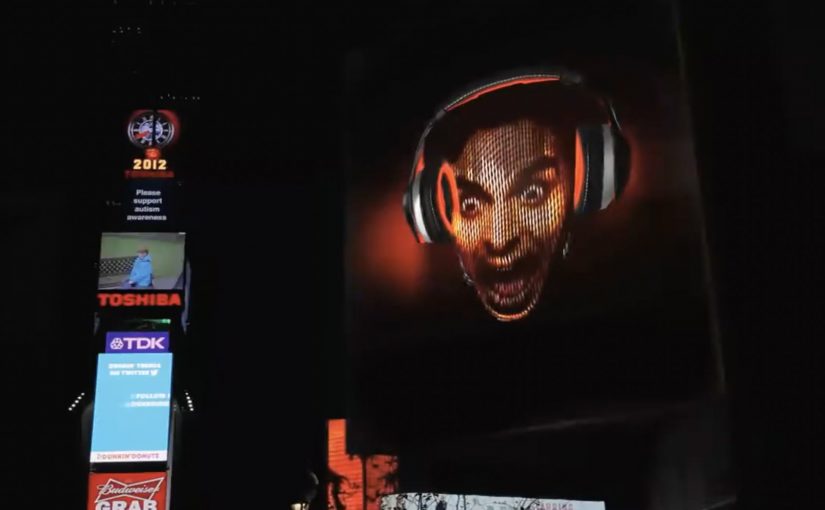
With the new Samsung Note 10.1, caricature artists can now go digital. To highlight this feature and raise awareness about the tablet, Samsung puts a real caricature artist “into” an outdoor billboard experience and has him draw live caricatures of passers-by. The finished drawings are then put on the Samsung Portugal Facebook page.

A live billboard that behaves like a street-portrait stand

The mechanism is simple. People stop. They watch themselves being drawn in real time. The artist works digitally using the Note 10.1, and the billboard becomes a public canvas that makes the device’s creative promise visible from across the street.

In consumer electronics marketing, live demos in public spaces work when the product capability is undeniable without any explanation.

Why it lands: you do not “see a feature,” you experience it

This is not a spec sheet. The real question is whether your launch turns a capability into a moment people actively want, or just a message they tolerate. The device becomes the instrument of a familiar craft, and the outcome is something people actually want. A caricature is personal, fast, and inherently shareable, which makes the crowd effect, the people who stop to watch, do the distribution work.

Extractable takeaway: If your live demo produces a personal artifact on the spot, proof travels further because people share the outcome, not your claims.

What Samsung is really achieving

  • Proof at full scale. A drawing tool is hard to dramatize in a 30-second spot. On a billboard, the proof is the show.
  • A reason to stop. The promise is not “look at our tablet.” The promise is “get drawn.”
  • A built-in content pipeline. The Facebook posting turns a one-off street moment into a browsable gallery.

What to steal for your next live product demonstration

  • Choose an outcome people value. A personal artifact beats a generic demo every time.
  • Make the capability visible from distance. If it only works up close, most of the street never understands it.
  • Close the loop digitally. Give people a clear place to find “their” result after the moment ends.
  • Let the crowd be the media. A live, public performance naturally draws more viewers than static outdoor.

A few fast answers before you act

What is Samsung Live Human Outdoor?

It is an outdoor activation where a caricature artist draws passers-by live using the Samsung Note 10.1, with finished sketches published to Samsung Portugal’s Facebook gallery.

What product feature is being demonstrated?

The ability to create digital drawings naturally and quickly on a tablet, associated with pen-based input and creative apps.

Why use caricatures instead of a standard product demo?

Because the outcome is personal and entertaining, which makes people stop, watch, and share, while the product capability is being demonstrated in plain sight.

What makes this “live communication” rather than outdoor advertising?

The billboard is not only a display. It is a real-time performance and interaction, with the public influencing the content through participation.

What is the main lesson for experiential product launches?

Turn a feature into a moment people want. If the experience creates a valued takeaway, attention becomes voluntary and sustained.

Recruitment: Pirates and Cyber Warriors

Recruitment: Pirates and Cyber Warriors

Since 2010 I have covered how different agencies around the world have been innovating with their recruitment campaigns. Now here are the latest two to join the list.

Two modern filters for hard-to-hire talent

Both ideas avoid broad “we’re hiring” noise. Instead, they place the offer inside the candidate’s real behavior, then use a simple mechanism to separate curiosity from capability.

The better recruitment move is to screen for behavior before you screen for polish.

The real question is not how to attract more applicants, but how to surface people whose behavior already matches the role.

Pirate Recruitment

Young web designers often need expensive application suites to create, and many end up downloading them from illegal pirate websites. Ogilvy Brussels uses that insight by uploading a file that appears to be the “wanted” application suite.

When designers download it, they do not find the software. They find a stronger offer: a job opportunity, delivered right inside the moment of intent.

In competitive digital talent markets, the hardest problem is not reach but signal.

Why this one works

The delivery is the targeting. If you are not the kind of person who looks for pro tools, you never see it. If you are, the offer lands as a wink that proves the agency understands your world. Because the message appears inside a live tool-search moment, it feels relevant instead of interruptive.

Extractable takeaway: Put the offer where the target audience already goes to solve a real problem. The closer your message sits to a “work moment”, the higher the relevance and the lower the waste.

Cyber Warriors Challenge

Wieden+Kennedy wants to recruit community managers for its client Old Spice, so it creates a deliberately crazy set of challenges. Candidates get five days to complete one or more tasks and submit proof of their exploits.

Cyber Warriors Challenge

Why this one works

It forces the right kind of effort. Community management is not just “posting”. It is speed, judgment, creativity, and resilience under ambiguity. A challenge-based entry filters for people who can actually do the work, not just describe it.

A small, time-boxed demonstration of the craft makes the screening signal stronger than a generic application form.

What to steal for your own recruitment

  • Recruit inside real behavior: distribute where the audience already acts, not where recruiters usually post.
  • Make the first step self-selecting: the wrong candidates should bounce naturally.
  • Keep the proof simple: “show me” beats “tell me”, but it has to be feasible in limited time.
  • Respect the audience: clever targeting works when it feels insightful, not exploitative.
  • Optimize for quality, not volume: fewer applicants can be a feature if they are better matched.

A few fast answers before you act

What is “pirate recruitment” in one line?

A job offer is packaged as a fake software download on pirate sites, so the right web designers discover the recruitment message at the moment they search for pro tools.

What is the Cyber Warriors Challenge?

A time-boxed set of tasks used as a screening step to recruit Old Spice community managers by requiring candidates to submit proof of real-world exploits.

Why do these tactics outperform standard job ads?

They target behavior, not demographics. Both approaches reach people in-context and require a small demonstration of motivation or capability.

What is the biggest risk when copying these ideas?

Trust and ethics. If the tactic feels deceptive, unsafe, or disrespectful to the audience, it can damage the employer brand faster than it attracts applicants.

How do you measure success?

Not by raw applicant volume. Track qualified applicants, interview-to-offer ratio, time-to-hire, and early performance or retention of hires sourced through the mechanic.