Coca-Cola: Velcro Posters for Grip Bottle

A bus-shelter poster you can literally grip

Here is another cool innovation at the bus shelters. Coca-Cola has come up with a new Grip Bottle which has a better grip for holding. To let people know they printed posters with Velcro on them and placed them in bus shelters in Paris to make people interact with the grip.

The campaign was a big success as people were literally hooked on to the campaign and there was a 3.8% brand volume growth in France compared to 2007.

The campaign was created by Marcel in Paris, France.

The smartest part: the demo is the media

If the claim is “better grip,” then the fastest proof is to make you grip something. Velcro turns the poster into a hands-on argument.

Why it sticks in your head

Bus shelters give you time. And touch beats talk. You do not just read about the benefit. You feel it while you wait.

The business point

Make the new Grip Bottle noticeable, and make the “better grip” benefit instantly understandable through interaction.

What to take from this

  • When the benefit is tactile, communicate it through touch, not explanation.
  • Use high-dwell environments to earn interaction, not just impressions.
  • Keep the mechanic simple enough to repeat at scale.

A few fast answers before you act

What was the Coca-Cola Grip Bottle campaign?

A bus-shelter activation in Paris promoting Coca-Cola’s Grip Bottle by using Velcro posters that encouraged people to interact with the grip.

Where did the campaign run?

It was placed in bus shelters in Paris, France.

What outcome did the post cite?

The post cited a 3.8% brand volume growth in France compared to 2007.

Who created the campaign?

The post credits Marcel in Paris, France.

Xbox Lips: Jukebox Turns Photos into Videos

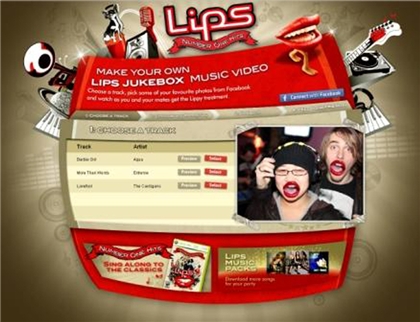
AKQA has taken Xbox Lips digital with the “Lips Jukebox” on Facebook, which enables users to transform their photos into music videos, in a bid to promote the new game “Lips Number One Hits”.

Xbox Lips Digital

The application is hosted at the Xbox website, and uses a combination of facial recognition technology and Facebook Connect functionality to enable people to choose a song and the photos they want to adapt from their profile before adding singing “Lips” to the faces and then creating the animated, personalized music video.

In social experience design, the winning pattern is simple: let people reuse what they already have, then return a share-ready artifact that feels personal without requiring effort.

Why this idea lands

This is a clean example of “personalisation as entertainment”. It takes something people already have, their photos, and turns it into something people want to show, a personalised music video.

  • Low friction input. Your Facebook photos are already there.
  • High novelty output. Seeing faces “sing” creates instant curiosity and share value.
  • Product-fit promotion. A singing video experience naturally aligns with a music game.

Facial recognition as a feature, not a headline

The facial recognition is not presented as “tech for tech’s sake”. It is simply the enabling layer that makes the result feel surprisingly accurate and personal. The user focus stays on selecting a song, picking photos, and getting a finished video worth sharing.

What to take from this if you build social experiences

  1. Turn existing assets into new value. Users are more likely to participate when they can reuse what they already have.
  2. Make the output share-ready. The “end product” should be something people naturally want to post.
  3. Keep creation steps short. Selection, preview, publish. The loop should feel quick.
  4. Align the experience with the product promise. A music game promoted through a music-video maker feels coherent.

A few fast answers before you act

What is the Xbox Lips Jukebox?

It is a Facebook-connected experience that lets users transform their photos into animated, personalised music videos to promote “Lips Number One Hits”.

What technologies does it use?

It combines facial recognition with Facebook Connect so users can select songs and photos, then apply singing “Lips” to faces and generate a video.

Where is the application hosted?

It is hosted on the Xbox website.

Why does this work as game marketing?

It creates a playful, shareable output that matches the core theme of the game. Music and performance.

What is the transferable lesson?

When you can turn user content into entertainment with minimal effort, you can earn both engagement time and social sharing without heavy persuasion.

Esquire’s Augmented Reality Issue

You open a print issue of Esquire and the pages do not stop at ink. You point a webcam or phone at a marked page and the magazine layer expands. Video clips play, 3D objects appear, and extra content sits directly on top of the printed layout. The issue behaves like a portal, not a publication.

The move. Extending print with augmented reality

Esquire experiments with an augmented reality-enabled issue that connects physical pages to digital experiences. The print product becomes the trigger, and the digital layer becomes the reward for curiosity.

How it works. Markers plus a camera

  • Selected pages include visual markers designed to be recognized by software.
  • The reader opens the AR experience on a computer webcam or mobile device.
  • When the camera recognizes the page, digital content overlays the magazine.
  • The overlays can include video, interactive elements, and 3D objects tied to the editorial content.

In publishing and brand media, augmented reality works best when the page itself becomes the interface rather than a detour to a separate destination.

Why it matters. A magazine that behaves like a medium

This is not a banner ad placed on paper. It is a format shift. The reader keeps control, but the magazine now has depth. Print becomes interface, and “extra content” becomes spatial and contextual rather than hidden behind a URL.

What to take from it. Designing for the moment of discovery

  • Use print as the entry point. A physical artifact can still be the strongest trigger for attention.
  • Reward curiosity quickly. The first overlay has to land fast to justify the setup.
  • Keep the experience editorial. AR works best when it extends the story, not when it interrupts it.
  • Plan for repeatable templates. Once the pipeline exists, AR pages become a scalable content format.

A few fast answers before you act

What is Esquire’s augmented reality issue?

A print magazine issue that unlocks digital overlays like video, interactive elements, and 3D objects when a camera recognizes marked pages.

What do readers need to experience it?

A webcam or phone camera, plus the AR experience that recognizes the markers in the issue.

What kind of content can appear?

Video clips, interactive elements, and 3D overlays tied to the editorial pages.

Why is this different from typical digital add-ons?

The print page becomes the interface, so the digital layer is contextual and anchored to the physical layout.

What is the transferable lesson?

Treat physical media as an activation surface, then design a fast, editorially relevant reveal that makes the extra layer feel earned.