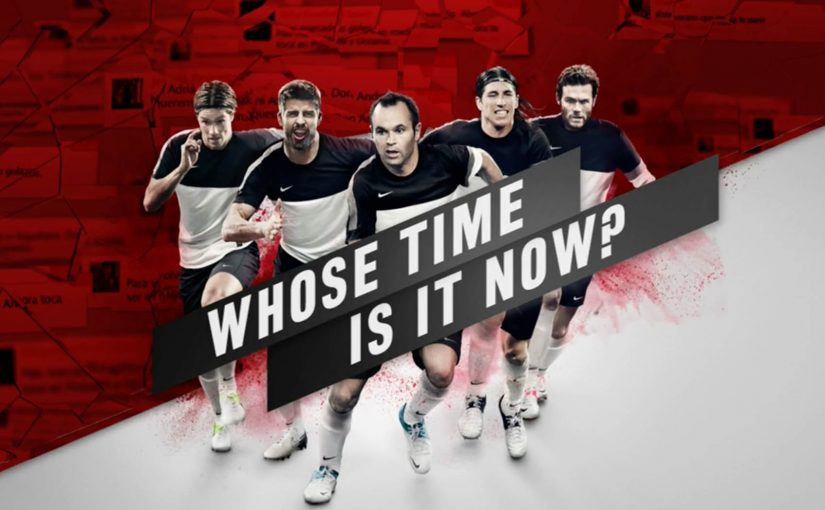
In Puerta del Sol, Madrid’s epicenter, a huge Nike “static” banner behaves like a live scoreboard. As Euro 2012 conversations spike, the face on the banner changes. Each day, the Spanish player who dominates social chatter becomes the protagonist on the canvas. Two fan messages appear alongside him, selected from submissions flowing in through Nike’s Facebook experience.
What the campaign does in public
Turn real-time social conversation into real-world status. Then make “My Time Is Now” visible, in public, every day.
What Nike and DoubleYou build during Euro 2012
Nike works with DoubleYou on a real-time social media monitoring campaign focused on Spanish national-team players. The system tracks mentions and engagement across Facebook and Twitter, then turns that data into a live ranking.
Fans see the leaderboard through a custom Facebook app integrated into Nike Football Spain. The ranking updates continuously, creating a daily “who owns the moment” race that mirrors what is happening on the pitch.
How it works
Step 1. Capture the conversation in real time
The activation monitors references to players across Twitter and Facebook.
Step 2. Translate the conversation into a live ranking
Inside the Facebook experience, the campaign visualizes comments and produces an automatically updated ranking of who is generating the most conversation, refreshed minute by minute.
Step 3. Publish the result into the physical world
Each day, the player who attracts the most social conversation becomes the ambassador of Nike’s message “My Time Is Now” on the large-format placement in Puerta del Sol. A static billboard turns into an interactive billboard because it is connected to the live social pulse.
Step 4. Let fans write onto the execution
From the app, fans also submit messages linked to the player of the day. Nike selects two of those messages and publishes them next to the player on the banner.
In sports sponsorship, the scalable advantage is not just hearing fan momentum, but turning it into a public signal people can rally around.
Why this is more than “social listening”
The real question is how to make live conversation feel consequential while the event is still unfolding. This is not monitoring for reporting. It is monitoring as a publishing engine. Nike turns fan conversation into a daily public decision about who carries the brand line. That mechanism works because it converts abstract buzz into visible status, giving fans a reason to watch, react, and return.
Extractable takeaway: Real-time marketing gets more powerful when the signal changes something public, visible, and easy to argue about, not when it just updates a dashboard.
The business intent is to keep fans returning to Nike’s owned experience during the tournament, while tying that repeat attention back to sponsored players and the brand line.
- The social layer has consequence. The ranking determines who gets featured publicly.
- The physical layer gives the digital behavior weight. People do not just see a number in an app. They see a player crowned in the center of Madrid.
- The loop is fast enough to feel like sport. The leaderboard updates continuously, so fans experience momentum, not a static end-of-day recap.
The line that makes the whole thing sticky
At the end, the leading player is set to bear Nike’s message of “My Time Is Now”.
And the player is…
What to steal from Nike’s live ranking billboard
- Turn chatter into a scoreboard: Convert real-time conversation into points people can instantly understand and debate.
- Reward the behaviour you want repeated: Make fans check back by updating standings during the event, not after it.
- Use sponsorship as a story engine: Anchor the mechanic to the athletes you sponsor so the brand connection stays tight.
- Make the output social by default: Put the ranking in a format that is easy to share and argue about inside the platform.
- End with a single “hero moment”: Let one clear winner carry the slogan so the campaign lands as a climax, not a dashboard.
A few fast answers before you act
What is the campaign in one sentence?
A real-time social monitoring system ranks Spanish players by conversation volume and makes the top player the daily face of a live billboard in Puerta del Sol.
Where do fans see the ranking?
Fans see the ranking in a custom Facebook app integrated into Nike Football Spain.
What makes this different from a normal “second screen” mechanic?
The data output is not just a dashboard. It changes a public, real-world media placement and publishes user messages alongside the hero player.
Why does the billboard matter more than the app alone?
The billboard turns digital attention into visible public status, so the campaign feels culturally present rather than trapped inside a social feed.
What is the repeatable pattern for brands?
If you can connect live signals to live publishing, you turn attention into status. That is how real-time becomes culturally meaningful.