
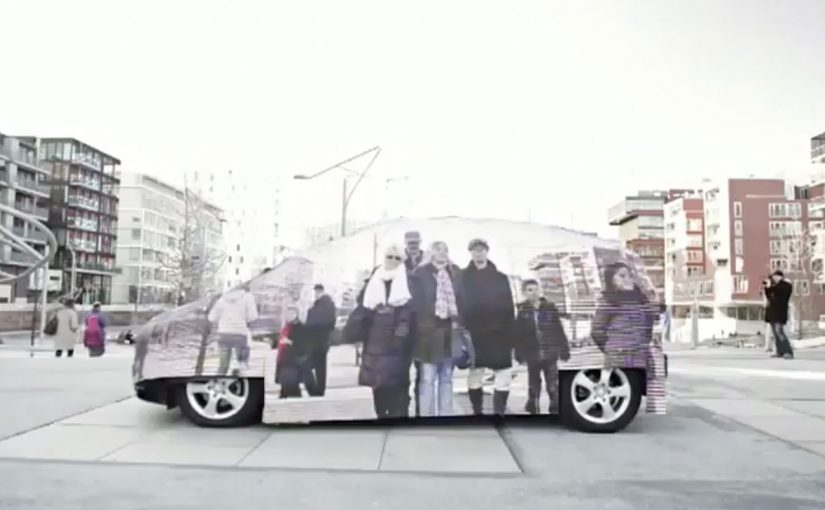
Mercedes-Benz F-CELL: The Invisible Drive

Mercedes-Benz F-CELL: The Invisible Drive

To demonstrate the claimed low impact of its new fuel cell vehicle, Mercedes-Benz has created an “invisible” car that blends into its surroundings.

The trick is a simple, showable hack. One side of the car is covered with LEDs. A camera captures what is on the opposite side, then the LED side displays that live feed so the vehicle appears to disappear from a specific viewpoint.

Stunts like this turn abstract emissions claims into a single, watchable proof-of-idea.

The mechanism that makes the metaphor work

This is not magic and it does not need to be. It is optical camouflage framed as a brand statement. Optical camouflage here means using a camera view and a display surface to mimic the background from a chosen angle. If the vehicle’s impact is close to “nothing,” the car should look like “nothing.” The LED-and-camera setup makes that metaphor instantly legible, even to someone who has never heard the term “fuel cell.” Because the illusion happens live on the car, the metaphor reads as evidence instead of post-production.

In enterprise automotive and mobility marketing, visual proof beats technical proof when the audience is not willing to parse specs.

The real question is whether your claim can be understood and repeated from a single viewpoint without the brochure. This is a strong sustainability communication move when the trick is honest and the metaphor stays tighter than the explanation.

Why it lands

It creates a physical moment people can point at. Sustainability messaging often lives in numbers, claims, and fine print. Here, the message is experiential. You see the effect with your own eyes, and you can describe it in one sentence.

Extractable takeaway: When your product promise is invisible, build a demonstration that makes the promise visible in under five seconds, using a single repeatable rule people can explain to someone else.

Steal the invisibility demo pattern

  • Pick one metaphor and commit to it. The entire execution serves one idea. That focus is why it travels.
  • Use real-world physics, not post-production. Even when the audience knows it is a trick, they trust it more when it is happening live.
  • Design for the shareable angle. Viewpoint-dependent illusions work because they are built for cameras and spectators, not just participants.
  • Make the explanation part of the experience. The best stunts include a built-in “how it works” story that spreads with the clip.

A few fast answers before you act

How does the “invisible car” effect work?

LED panels on one side of the car display a live video feed captured from the opposite side, creating a camouflage illusion from a particular viewpoint.

What is the brand point of using invisibility here?

It turns an environmental claim into a visual metaphor. If the impact is minimal, the car is presented as visually minimal within the scene.

Why do these technology stunts get attention when product specs do not?

They compress the story into a single moment people can see, record, and retell. That makes the promise easier to believe and easier to share.

What is the main risk when copying this approach?

Overcomplicating the trick. If the audience needs a long explanation to understand the effect, the stunt stops being a stunt and becomes a demo.

How do you keep a metaphor stunt from feeling like greenwashing theater?

Keep the claim narrow, make the trick transparent, and ensure the metaphor points to a product attribute you can substantiate elsewhere, even if most people never read the detail.

Volkswagen Canada: The Great Art Heist

Volkswagen Canada: The Great Art Heist

They say that beauty is in the eye of the beholder. But if Volkswagen Canada has their say, beauty will be in the hands of the person who’s stealing it. That is the idea behind this ambient-meets-social campaign for the Volkswagen Jetta GLI.

Since the beginning of October, agency Red Urban has created a series of pop-up art galleries across major cities in Canada that feature “light paintings” made by the movement of the Volkswagen Jetta. These light paintings are long-exposure photographs that turn headlight and taillight trails into abstract artwork.

While the frames in the exhibits have been hung for all to admire, they have not been hung that securely, allowing more daring admirers to claim the artwork for themselves. The “thieves” are then asked to share their stolen items via Tweets and Facebook posts. Volkswagen Canada’s Facebook page starts receiving photos from fans decorating homes and offices with the imagery.

When out-of-home becomes a participation prompt

The mechanism is a deliberate temptation loop. By that, I mean the setup places something desirable in public and makes acting on that impulse part of the idea. Place desirable objects in public. Make them easy to take. Then turn the taking into the call to action, with social sharing as the proof layer. The “gallery” is the stage. The heist is the interaction. The reposted photos are the distribution.

In automotive launch marketing, giving people something physical to claim and display can turn attention into advocacy faster than conventional ads.

The real question is how to turn a static display into an action people want to repeat and publicize.

Why it lands

This works because it flips the normal rules of outdoor advertising. Instead of “look at this and move on”, the frame invites a decision and a story. The act of taking the artwork creates instant ownership, and ownership makes people far more likely to post, discuss, and keep the brand in the room. The strongest move here is not the gallery format but the permission to take the media home.

Extractable takeaway: If you can transform a passive medium into a “take it, show it” mechanic, you convert exposure into participation. Participation creates proof, and proof drives organic reach.

What to steal from this activation

  • Make the object desirable on its own: if the item is genuinely display-worthy, people will do the promotion for you.
  • Use a single rule: “take it and share it” is easy to understand and easy to repeat.
  • Build for accumulation: the more stolen pieces show up online, the more the campaign feels real and alive.
  • Let the audience finish the media buy: the repost is the real multiplier, not the initial placement.
  • Manage the ethics upfront: the line between playful permission and real theft must be unambiguous in execution.

A few fast answers before you act

What is the “Great Art Heist” idea?

It is a pop-up street gallery of framed “light painting” photos tied to the Volkswagen Jetta GLI, where passersby are implicitly encouraged to take a frame and share it socially.

What are “light paintings” in this campaign?

They are long-exposure photographs capturing the car’s headlight and taillight trails, producing abstract, art-like images.

Why does encouraging people to take the artwork work?

Because it creates ownership and a personal story. Once someone has the piece, sharing becomes natural and the brand becomes part of their environment.

Is this more out-of-home or more social?

Both. Out-of-home provides the physical trigger and scarcity. Social sharing provides proof and scale.

What is the biggest risk with a “steal it” mechanic?

Misinterpretation. If permission is not clear, the idea can feel irresponsible. The execution must make the intended rules obvious to avoid negative backlash.

Carlsberg: Bikers in cinema experiment

Carlsberg: Bikers in cinema experiment

In a Belgian cinema, an “easy night out” turns into a small test of nerve. A couple walks in with tickets in hand. The room looks full. The only two empty seats are in the middle. The twist is that the audience is packed with intimidating bikers.

Carlsberg and Duval Guillaume Modem set this up as an experiment to reinforce the brand’s association with making the right choices. Reactions were recorded and edited into a viral film that rewards the people who stay seated rather than turn around.

The mechanism that makes it work

The mechanics are simple and deliberate. Fill the room. Leave two seats. Let unsuspecting pairs make a binary decision in public. Stay or leave. The tension is real because the setting is real, and the social pressure is visible to everyone watching.

Once a couple commits and sits down, the room flips from threat to approval. The bikers applaud, and the moment turns into a reward scene that makes the brand feel like it “saw” the better choice.

In crowded FMCG categories, social experiments work when they dramatize a value claim in a single, easy-to-retell moment.

The real question is whether you can borrow social risk to create attention without breaking participant trust.

Why it lands: social risk, then social proof

The audience experiences the same internal dialogue as the couples. Do I trust my instincts. Do I judge by appearance. Do I avoid discomfort. That tension is the hook. The applause is the release. Here, “social risk” is the fear of being judged in public, and “social proof” is the crowd signalling approval once the choice is made.

Extractable takeaway: When you borrow social pressure as the hook, you must also design visible approval as the proof, so the value claim is retellable in one line.

It also produces a clean moral without preaching. The brave are rewarded. The crowd is not actually hostile. The viewer walks away with a feeling that maps neatly onto the brand’s “good decision” positioning.

What Carlsberg is buying with this stunt

This is not about product attributes. It is about emotional territory. Confidence. Decency under pressure. And the idea that choosing Carlsberg is the grown-up, correct move when there are multiple options. This is a smart brand play because it turns “making the right choice” into observable behaviour, but it only works when the participants are treated carefully.

It is also engineered for sharing. The setup can be explained in one sentence, and the payoff is satisfying even if you only watch the last third of the video.

Design rules for your own brand experiments

  • Make the choice binary. The story works because there is a clear yes or no moment.
  • Stage tension, then earn release. If you create discomfort, you must repay it with warmth or justice.
  • Keep the “why” instantly readable. Viewers should understand what is being tested without narration.
  • Reward the behaviour you want to own. The applause is not decoration. It is the message.
  • Protect trust. If participants feel tricked or harmed, the brand loses the moral high ground.

A few fast answers before you act

What is the Carlsberg “bikers in cinema” experiment?

It is a filmed cinema stunt where unsuspecting couples enter a theatre filled with bikers and find only two seats left among them. Their decision to stay or leave becomes the story, and the people who stay are rewarded.

Why is this more shareable than a typical ad?

Because the premise is instantly understandable and the emotional arc is clean. Tension, decision, payoff. That structure travels well as a short video.

What brand message does the stunt communicate?

That “making the right choice” is a real behaviour under pressure, not a slogan. The brand borrows credibility by rewarding the choice on camera.

What is the biggest risk with social-experiment advertising?

Breaking trust. If the situation feels unsafe, humiliating, or coercive, the audience will side with the participants, not the brand.

How do you adapt this pattern without copying the stunt?

Create a public moment with a clear decision, then design a surprising but positive reward that proves your positioning. Keep the stakes emotional, not harmful.