
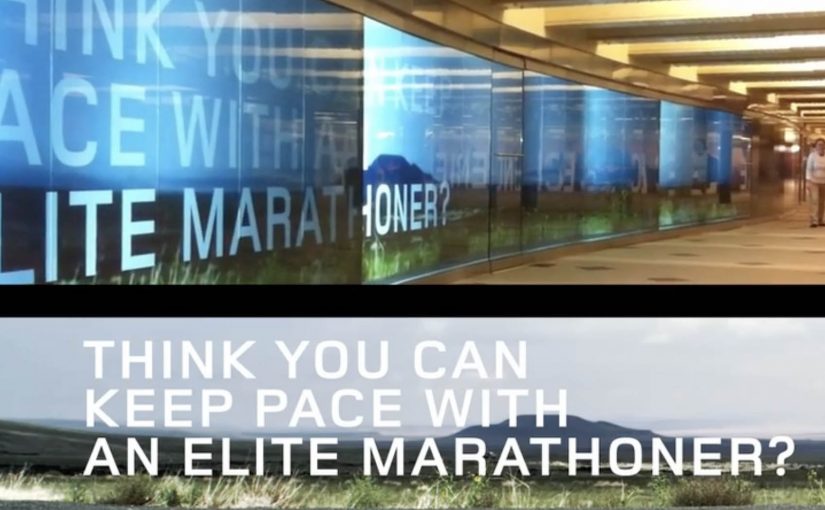
ASICS: Race Ryan Hall at Columbus Circle

ASICS wants to level up physical interaction with their brand. So around this year’s ING New York City Marathon, they built a 60-foot video wall in the Columbus Circle subway station and challenged passersby to race U.S. marathon runner Ryan Hall.

The wall plays life-sized footage of Hall running at marathon pace, turning a commute corridor into a short, sweaty benchmark. You do not “watch” the message. You try to keep up with it.

Why a race works better than a slogan

In high-traffic urban transit environments, the fastest way to make a performance claim believable is to let people feel it with their own body, not just read it. Most sports sponsorship visibility lives on banners and logos. This flips the value. It gives the audience a direct comparison: your pace versus elite pace. Because the wall sets an elite pace as a moving yardstick, that comparison makes the brand message tangible in seconds, and it creates a story people can retell immediately.

Extractable takeaway: If you need credibility fast, turn the claim into a simple physical test that anyone can try without setup.

The craft move: frictionless participation

No sign-up. No app download. No instruction manual. The interaction is instinctive. See runner. Run next to runner. That simplicity matters because subway audiences have short attention windows and low patience for setup.

What ASICS is really doing with this build

On the surface it is a fun stunt. Underneath it is a credibility transfer, meaning the elite standard makes the sponsor’s performance story feel earned when people experience the comparison firsthand. The real question is whether your brand promise holds up when people can compare themselves to an elite benchmark in public. This is a stronger sponsorship play than more logo visibility because it produces felt proof, not just awareness. By letting everyday runners test themselves against a real benchmark, ASICS positions itself closer to serious performance culture, not just event sponsorship.

Big-event activation moves to copy

  • Turn a claim into a test. If the audience can try it, they will believe it.
  • Make participation obvious. The interaction should be understood without reading instructions.
  • Place it where behavior already fits. A corridor invites motion. Use spaces that support the action.
  • Design for one-sentence retell. “I raced Ryan Hall in the subway” is the whole message.

A few fast answers before you act

What is the core mechanic of this activation?

A long-form video wall shows Ryan Hall running at marathon pace, inviting passersby to physically race alongside the footage.

Why does transit placement matter here?

Transit corridors create natural “run lanes” and constant foot traffic, so the activation gets high exposure and the behavior feels socially plausible.

What makes this more effective than a normal video billboard?

It turns viewers into participants. The message is experienced as effort and pace, not as information.

What is the biggest execution risk?

If the wall is hard to notice, the corridor is too crowded to move, or the interaction cues are unclear, people default back to walking and the idea collapses.

How would you measure success?

Dwell time, participation rate, repeat attempts, social sharing volume, and any lift in event-area brand consideration versus baseline sponsorship exposure.
Prigat: Smile Stations

Publicis Israel and e-dologic are back with a new campaign for Prigat, a leading company in the Israeli fruit juice market.

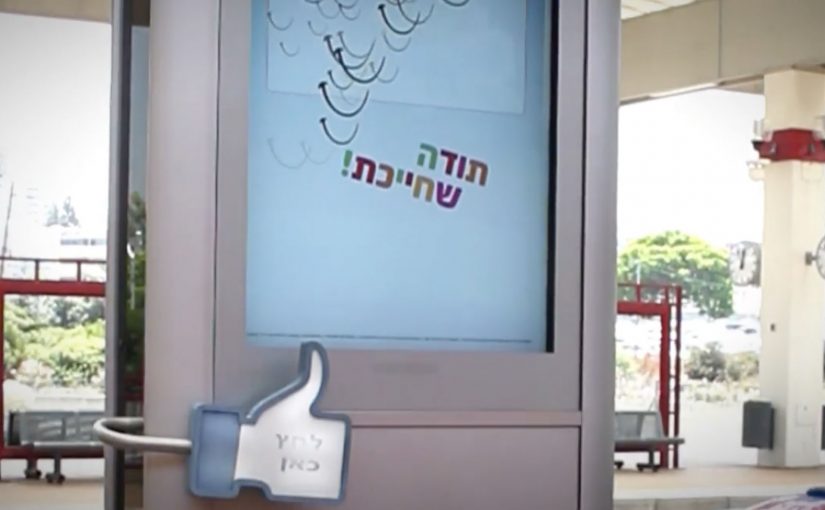
This time they use innovative digital billboards called “Smile Stations” to send real-time messages at various train stations. The aim is to get passers-by to smile, and “like” the moment.

The mechanic: turn a Facebook message into a station moment

It starts on the Prigat Facebook Page. People send messages that are pushed to screens at train stations. Commuters walking by can approach the screen and press a physical “Like” button.

That button press triggers a simple payoff. The billboard captures the moment, then broadcasts the video back to the person who sent the message. Users who generate the most smiles win a prize.

In busy public transit environments, interactive out-of-home works best when the action is obvious, the feedback is immediate, and the reward is shareable.

Why it lands: it makes public emotion measurable

Most out-of-home asks for attention. Smile Stations asks for a reaction, then turns that reaction into proof you can send back to the originator.

Extractable takeaway: If you want participation at scale, close the loop. Let a remote user trigger a real-world moment, let a passer-by respond with one physical action, then send that response back as a personal artifact the originator can keep and share.

Reported figures put this at over 10,000 messages sent to station screens, with thousands of people responding by hitting the Like button.

What the brand gets from this

The real question is whether a public display can turn a remote social prompt into a personal moment worth sharing.

This is stronger than passive digital out-of-home because the physical Like button reduces effort and the returned video turns a fleeting reaction into a personal memory both sides can own.

The campaign does not just generate impressions. It creates a two-sided interaction where both parties feel like they caused something to happen. That is a stronger memory structure than “I saw an ad”, especially in a context as repetitive as commuting.

What to steal for your own social-plus-out-of-home activation

  • Design a one-step physical interaction: one big button beats a complicated interface in public space.
  • Make the response visible: the passer-by should understand instantly that their action “counts”.
  • Return a personal artifact: sending the video back is what turns participation into sharing.
  • Gamify without friction: “most smiles wins” is a clean mechanic with no explanation overhead.
  • Pick locations with dwell time: stations work because people pause, look up, and wait.

A few fast answers before you act

What is a “Smile Station”?

It is an interactive digital billboard at a train station that displays user-submitted messages and invites passers-by to respond by smiling and pressing a physical Like button.

What makes this different from a normal digital billboard?

It is two-way. Remote users trigger messages, commuters respond physically, and the response is captured and sent back as video, creating a closed feedback loop.

Why include a physical Like button?

Because it removes friction. A single, tangible action is faster and more intuitive than asking people to pull out a phone, scan, or type.

How do you measure success for an activation like this?

Message volume, unique senders, Like-button presses, response rate per message, video shares by originators, and dwell time around the screen locations.

What is the main execution risk?

Latency and unclear feedback. If the system feels slow or people are unsure what their button press did, participation drops quickly in a commuter setting.

Ariel Actilift: Facebook-Controlled Shoot

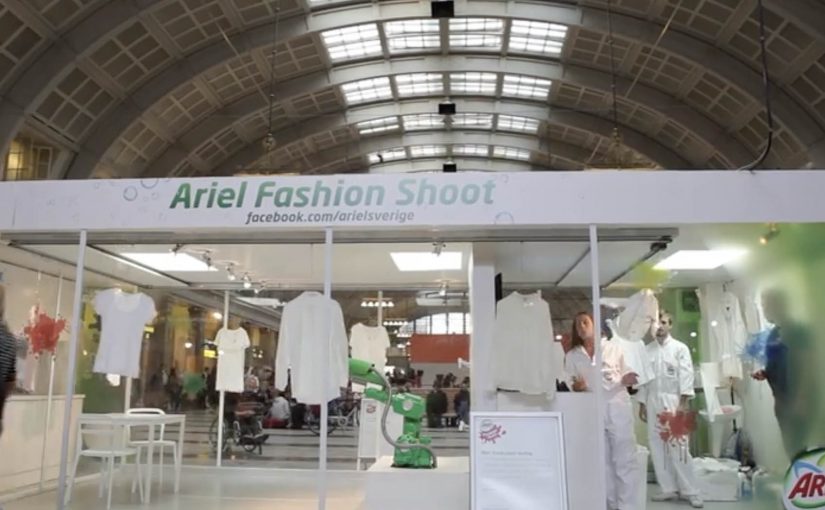
Procter & Gamble Nordics, in collaboration with Saatchi & Saatchi Stockholm, B-Reel and Atomgruppen, creates an interactive campaign centered on a specially built glass installation in Stockholm Central Station, Sweden.

For one week, passers-by at Stockholm Central Station can watch designer clothes hung on a washing line being soiled by ketchup, drinking chocolate and lingonberry jam via fans on the Ariel Sweden Facebook page (or Denmark, Norway, Finland equivalents).

The mechanic: stain it from Facebook, then win it back clean

In order to win the designer clothes, Ariel fans use a Facebook-controlled industrial robot cannon to soil them. The stained clothes are then sent in the post after being washed on-site with regular Ariel Actilift.

In high-traffic European transit hubs, the strongest “social media” ideas are the ones that visibly change the physical world in front of everyone, not just the feed.

Why it lands: it makes participation feel consequential

This is a neat reversal of how most product demos work. Instead of the brand creating a controlled “before and after”, it invites the audience to create the mess themselves, then proves the wash result under public scrutiny.

Extractable takeaway: If you want participation that people remember, make the audience’s input irreversible in the moment, then let your product do the recovery. The contrast between “I caused this” and “it still comes out” is stronger than any claim line.

The glass box is doing strategic work. It turns a Facebook click into a visible event for commuters, which makes the campaign feel bigger than the people who are actually playing.

What the campaign is really selling

At a surface level it is a stunt to win clothes. At a deeper level it is reassurance. The mess is extreme and deliberately unglamorous, so the cleanliness result reads as confidence, not a carefully staged demo.

The real question is whether a Facebook click creates enough public consequence to make the cleaning proof feel worth watching.

What to steal for your next social-plus-physical idea

  • Let the audience create the proof: user-generated “inputs” that change the outcome are more persuasive than brand-controlled setups.
  • Use a public stage: a transparent environment creates trust because the product has nowhere to hide.
  • Keep the control surface simple: one clear action. One obvious effect. No complicated UI.
  • Design a real reward path: the prize should be operationally credible, not a vague “chance to win”.
  • Make the brand step undeniable: show the product moment on-site so the claim is witnessed, not narrated.

A few fast answers before you act

What is the core idea of this Ariel activation?

A Facebook interface controls a robot cannon that stains designer clothes in a glass installation. Ariel then washes the clothes on-site, and participants can win the cleaned items.

Why combine Facebook with a physical installation?

Because it turns digital participation into a public spectacle. The online action has a visible consequence in the real world, which makes it more engaging and more shareable.

What product truth is being demonstrated?

That Ariel can handle tough, visible stains. The audience creates the stains, and the brand shows the wash outcome under observation.

What makes this different from a normal product demo?

The brand gives up control of the “mess creation” to the public. That makes the demonstration feel less scripted and more credible.

What should you measure if you run something like this?

Participation rate, dwell time at the installation, social engagement tied to the control interface, earned media pickup, and any lift in product consideration during the activation window.