
Track My Macca’s: Supply Chain Transparency

McDonald’s in Australia decided to use technology to tackle one of its biggest problems, the disbelief that its ingredients are fresh, locally sourced and of decent quality. So with image recognition, GPS, augmented reality and some serious integration with its supply chain, they put together a full story behind every ingredient people came across while buying food at McDonald’s.

The real challenge: trust, not awareness

This is not a campaign built to shout louder. It is built to answer the skeptical question that sits in the customer’s head at the moment of choice: “Is this actually fresh, and where did it come from”.

Instead of responding with claims, it responds with traceable context. Ingredient by ingredient.

Why the tech stack matters only if it is integrated

Image recognition, GPS, and augmented reality are the attention layer. The credibility layer is the supply chain integration. Without that, the experience would be a glossy story. With it, the experience becomes proof.

  • Image recognition. Identify what the customer is looking at or buying.
  • GPS. Connect the experience to location and local sourcing claims.
  • Augmented reality. Make information feel immediate and tangible in the buying moment.
  • Supply chain integration. Ensure the “story” maps to real sourcing and logistics data.

What makes this a strong model for brand transparency

Transparency only works when it is easy. People will not dig through PDFs or corporate sustainability pages while they are ordering lunch.

This approach brings the information to the moment and to the object. It reduces friction and increases believability.

What to take from this if you run CX, MarTech, or operations

  1. Start with the objection. The customer’s doubt defines the experience.
  2. Proof beats promise. If you want trust, show traceability, not slogans.
  3. Integrate the system of record. Experiences that depend on trust must connect to operational data.
  4. Design for the moment of choice. The best transparency is delivered exactly when people need it.

A few fast answers before you act

What is “Track My Macca’s”?

It is a McDonald’s Australia initiative that uses mobile technology to show a story behind ingredients, aiming to build trust in freshness, local sourcing, and quality.

Which technologies were used?

Image recognition, GPS, augmented reality, and strong integration with McDonald’s supply chain to connect the experience to real sourcing and logistics.

Why is supply chain integration the critical piece?

Because the experience depends on credibility. Without operational data behind it, the story would feel like marketing. With it, it can function as proof.

What customer problem does this solve?

It addresses disbelief about ingredient freshness and quality by making provenance and context visible at the point of purchase.

What is the transferable lesson for other brands?

If trust is your barrier, design transparency into the customer journey and connect it to your systems of record, so the experience can stand up to scrutiny.
Mercedes-Benz: Tweet Fleet Parking on Twitter

The “Active Parking Assist” from Mercedes-Benz recognizes empty parking spaces by simply passing them. That brought ad agency Jung von Matt/Neckar to the idea that if the car knows where the empty parking spaces are, then everybody could also be informed.

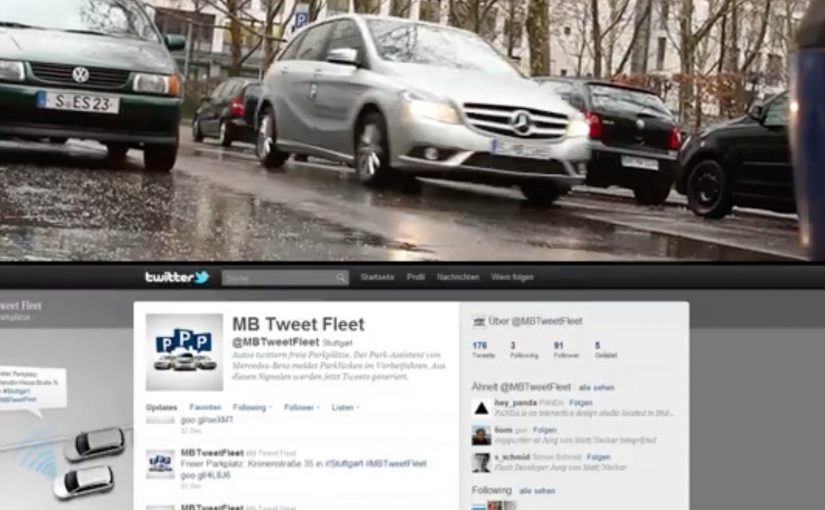
So just before Christmas when parking spaces were hard to find, they launched the Mercedes-Benz Tweet Fleet with its Active Parking Assist that tweeted empty parking spaces in downtown Stuttgart.

The MBTweetFleet cars automatically generated the tweets with GPS data via Arduino an onboard electronic and a PHP Relay. People could then follow @MBTweetFleet to find empty parking spaces near them on Twitter and be navigated there by the linked Google map.

Why this idea is stronger than it looks

The cleverness is not “tweeting”. The cleverness is turning a capability that already exists inside the car into a public utility. That flips a product feature into a service people can use immediately, without buying anything first.

  • Signal becomes service. The car detects something useful. The system shares it.
  • Real-time context. Parking availability is only valuable when it is current.
  • Distribution is native. Twitter is a lightweight channel for fast, location-based updates.

The technical stack is simple, but the integration is the point

GPS plus an onboard controller plus a relay layer is not the story. The story is that data moves from sensing to publishing with minimal friction. That is what makes it feel “live”.

  1. Detect. Active Parking Assist identifies an empty space while driving.
  2. Locate. GPS attaches coordinates.
  3. Publish. An automated tweet shares the spot publicly.
  4. Act. People navigate using the linked map.

In urban mobility and smart-city moments, public utility beats brand messaging when the value is immediate, local, and easy to act on.

What to take from this if you build connected experiences

  1. Start with a real pain point. Holiday parking pressure is a perfect use case.
  2. Make the feature externally visible. Utility grows when it helps non-owners too.
  3. Choose a low-friction channel. Where people already are beats “download our app”.
  4. Design for immediacy. Real-time value requires real-time delivery.

A few fast answers before you act

What is Mercedes-Benz Tweet Fleet?

It is a campaign in Stuttgart where Mercedes-Benz used Active Parking Assist to detect empty parking spaces and automatically tweet their locations so people could find and navigate to them.

Why does Active Parking Assist enable this?

Because it can recognize empty parking spaces as the car passes them, creating a reliable signal that can be shared.

How were the tweets generated?

The cars generated tweets automatically using GPS data, an Arduino-based onboard electronic component, and a PHP relay.

How did people use the service?

They followed @MBTweetFleet on Twitter and used the linked map in tweets to navigate to nearby empty spaces.

What is the transferable lesson?

If a product can sense something valuable in the real world, you can turn that sensing into a public utility by publishing it in a channel people already use.

Dentsu: iButterfly Location-Based Coupons

Coupons with wings: iButterfly turns deals into a mobile hunt

Here is a great example of Online, Mobile and Shopper Marketing converging with Augmented Reality (AR). Integrated Marketing literally put into the hands of the people.

Japanese ad agency Dentsu has started this experimental coupon download platform called iButterfly on the iPhone. The free iPhone app transforms the habit of collecting coupons into a fun little game using AR and the device’s GPS.

The mechanic: catch a butterfly, unlock a coupon

The app tasks its users with catching virtual butterflies that are flying around, each representing one or more coupons. You can even share “butterflies” with your friends via Bluetooth.

Augmented reality in this context means the phone camera view becomes the backdrop, while digital objects. Here, butterflies. are overlaid and tied to location signals like GPS.

In retail and FMCG shopper marketing, the value of this approach is that promotions become a location-linked experience, not a passive download.

Why this format works for targeted promotions

The key shift is motivation. People are not “clipping” coupons. They are playing a simple collecting game, and the reward is a deal that feels earned.

Because butterflies can be placed around specific areas, the mechanic supports targeting by place and moment. That makes the coupon feel context-aware rather than generic.

What Dentsu is really prototyping here

This is less about novelty AR and more about a new distribution behavior. Turning offers into collectible objects changes how often users open the app, how long they stay in it, and how naturally they talk about it with friends.

It is also a rare example where “share with a friend” is not a marketing CTA. It is a gameplay action that carries the promotion with it.

What to steal for your own shopper activation

  • Make the reward immediate. Catch. Unlock. Redeem. Long funnels kill the game loop.
  • Use location as a story, not a filter. Place rewards where people already go, so the map feels meaningful.
  • Let sharing be part of the mechanic. A tradable object beats a generic “share this” button.
  • Keep the collection simple. If users need a manual, they will not hunt.

A few fast answers before you act

What is iButterfly?

iButterfly is a mobile coupon platform that turns deal collection into a location-based AR game. Users catch virtual butterflies on their phone and unlock coupons as rewards.

How does the AR coupon mechanic work?

Users view the real world through the phone camera. Virtual butterflies appear and can be “caught”. Each butterfly contains one or more offers, which unlock after capture.

Why is this relevant for shopper marketing?

It shifts promotions from passive browsing to active discovery. Location and gameplay increase attention, repeat usage, and the likelihood of in-the-moment redemption.

What makes it feel targeted rather than random?

Butterflies can be tied to locations and contexts via GPS. That links the offer to where the shopper is, not just who they are.

What is the biggest execution risk?

If redemption is hard or the rewards feel weak, the novelty wears off fast. The game loop only survives when the payoff is clear and friction stays low.