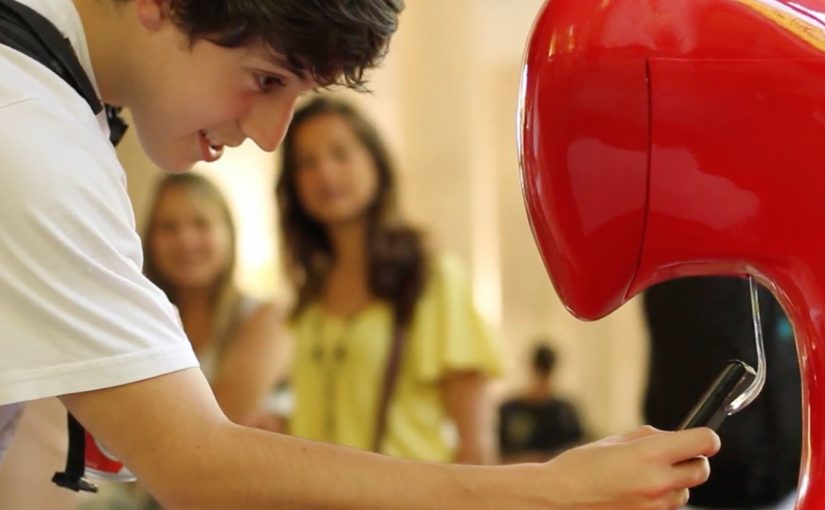
Coca-Cola: Happiness Refill

Connection as currency on Copacabana

For teens, happiness often means one thing: staying connected.

Coca-Cola in Brazil acted on this insight by creating a beachfront store on Copacabana Beach in Rio de Janeiro and installing a soda machine that delivered something more valuable than a drink.

The real question is whether your brand can trade something people have for something they cannot easily get in the moment.

Instead of only dispensing Coca-Cola, the machine rewarded users with free mobile internet credits. For young, emerging middle-class consumers who loved their mobile phones but could not afford generous data plans, the exchange was instantly clear and immediately useful.

How the Happiness Refill machine worked

The interaction was deliberately simple. Users accessed the machine through an exclusive Coca-Cola mobile browser. Completing the interaction unlocked internet credits directly on their phones.

No long registration. No delayed reward. Just a physical interface connected to a digital payoff.

The machine functioned as a bridge between the physical and mobile worlds, using hardware as a trigger and mobile connectivity as the reward.

By turning a quick physical action into instant connectivity, the mechanism created a visible payoff people could copy on the spot.

In mobile-first markets where data is a noticeable constraint, connectivity behaves like a form of currency.

Why free data landed harder than free soda

On a public beach, attention is fleeting. People move quickly, and distractions are constant.

Extractable takeaway: If you reward people with something scarce in their environment, the crowd becomes your distribution channel.

Free data solved a real, present problem. Connectivity was scarce, valuable, and socially visible. Watching someone gain internet access in front of you created instant social proof.

The machine became a gathering point. Not because it was novel technology, but because the value exchange was obvious and human.

The business intent behind Happiness Refill

Coca-Cola’s intent was not short-term sampling.

Utility beats messaging when attention is scarce and the payoff is immediate.

The goal was to make the brand’s long-standing “happiness” positioning tangible for a mobile-first audience by attaching it to everyday utility. Instead of asking teens to emotionally connect with a message, Coca-Cola embedded itself into a moment of real need.

This activation reframed the brand from advertiser to enabler.

What brands can steal from this activation

Here, an activation is a public, in-person brand moment designed to trigger a digital behavior.

  • Translate emotion into utility. Abstract values become powerful when expressed as something people actually need.
  • Design for instant payoff. Immediate rewards outperform persuasion in high-noise environments.
  • Create a public interaction. Physical touchpoints generate social visibility that digital ads cannot buy.
  • Respect economic reality. Value feels bigger when it acknowledges real constraints.

This machine also fits into a broader Coca-Cola pattern. It joins the growing number of Happiness Machines the brand has deployed globally since 2009.


A few fast answers before you act

What insight powered Coca-Cola’s Happiness Refill?

That for teens, happiness is often defined by connectivity. Free data mattered more than another free product.

What made the mechanism effective?

A simple physical interaction with an immediate digital reward. No delay, no complexity.

Why was Copacabana the right context?

The beach favors fast, visible experiences. The activation turned utility into a social moment.

What was the core business goal?

To reinforce Coca-Cola’s happiness positioning by delivering real-world value aligned with mobile behavior.

What is the transferable lesson?

When you make your brand genuinely useful in the moment, people do the distribution for you.
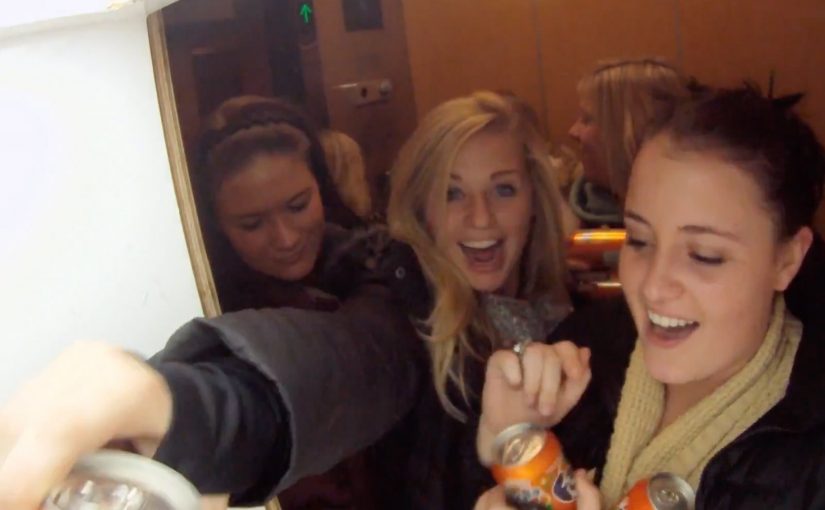
Fanta: Lift & Laugh

A school elevator that refuses to stay boring

Ogilvy Brazil sought to reinforce Fanta’s brand image of “joy” in the USA. So they came up with an elevator prank called “Lift & Laugh”.

An elevator in a school in Atlanta was chosen to arouse students curiosity and laughter. In the elevator they installed a device that responded to the movements and comments from the students.

The mechanic: a responsive space that reacts back

This works by turning a routine moment. waiting for an elevator ride. into an interaction loop. The environment listens, then answers in real time, so the people inside start experimenting to see what triggers the next reaction.

An ambient ad is a brand experience placed in an everyday setting, where the setting itself becomes the medium and the message is delivered through participation.

In youth and soft drink marketing, “joy” only sticks when it is felt in-the-moment, not just claimed in a tagline.

The real question is whether your experience design can make play discoverable without instructions.

Why the prank lands with students

It creates instant permission to play. The elevator is a confined stage, the reactions are immediate, and the group dynamic amplifies everything. If one person laughs, everyone joins, and the experience escalates without needing instruction.

Extractable takeaway: When the audience’s own movement or words trigger an immediate response, the fun feels earned and becomes more likely to be retold.

The business intent: make joy a repeatable brand behavior

This is not just a one-off gag. It is a proof point for a positioning idea. Fanta turns dull places into fun places. If the experience is good enough, the brand gets earned attention plus social retell value without needing to push product features.

In the end many students did not want to get off the elevator and asked for a repeat trip.

What to steal if you want an experience people replay

  • Make the interaction discoverable. People should learn the rules by trying, not by reading.
  • Reward experimentation fast. Short feedback loops create momentum.
  • Design for groups, not individuals. Laughter spreads socially. Build for that amplification.
  • Anchor the behavior to your brand. The “why” should map cleanly to what you stand for.

A few fast answers before you act

What is Fanta’s Lift & Laugh?

It is an elevator prank experience where the elevator reacts to students’ movements and comments, turning a normal ride into a playful, responsive brand moment for Fanta.

Where did the activation take place?

It was staged in a school in Atlanta, using a real elevator as the experience space.

How does the elevator prank create engagement?

It uses immediate cause and effect. People try something, the elevator responds, and the group starts experimenting together to trigger more reactions.

Why does this work especially well with students?

The elevator becomes a contained stage and laughter spreads socially. One reaction gives others permission to play, which escalates the experience quickly.

What makes this “ambient advertising” rather than a standard ad?

The everyday environment becomes the medium. The message is delivered through participation in a real situation, not through a screen or a slogan.

What should brands learn from this format?

If you want “fun” as a brand attribute, build it into a situation people already live. Then make participation the delivery mechanism, not a message about participation.

Coca-Cola: Santa’s Forgotten Letters

When childhood letters get answered years later

The city of Santa Claus is situated in the state of Indiana, USA. The museum in the city brings together different objects related to Santa Claus and has long received letters from people around the world, described as doing so for more than 70 years.

Coca-Cola with its ad agency Ogilvy Brazil selected 75 forgotten letters, meaning letters written to Santa as children that sat unanswered for years, and set out on an impossible task to find the writers and give them exactly what they asked for. The result was a touching movie that reinforces the magic of Christmas.

The impossible brief behind the film

The mechanism is straightforward and brutal in effort. Find a place where old letters to Santa were kept. Read through decades of messages that never got a reply. Select a small set of letters. Then track down the original writers and recreate the exact gifts they once requested.

In global FMCG holiday marketing, the fastest route to belief is to make generosity observable in the real world, not just promised in a tagline.

Santa’s Forgotten Letters is a Coca-Cola Christmas campaign by Ogilvy Brazil that turns archival letters into real deliveries, using the act of fulfilment as the proof of the story.

Why it lands: belief becomes physical

This works because it reverses the usual Christmas-ad formula. Instead of asking the audience to feel something while watching a film, it shows a real-world action first. The emotion is earned by the logistics.

Extractable takeaway: If you want “magic” to read as real, put the proof in the world first, then let the film simply document the effort.

The letters also do the writing for the brand. Each request is specific, personal, and time-stamped by childhood. That specificity makes the surprise feel less like marketing and more like closure.

The business intent hiding inside the sentiment

Coca-Cola is reinforcing a familiar role in the season. It wants to be the brand that protects the “magic” adults quietly miss, and it does that by staging a story people retell without needing to mention product features.

The real question is whether you can prove the sentiment with a concrete act, not just narrate it.

Done well, this is the right kind of sentiment-led brand work because it earns emotion through effort the audience can verify.

This is brand meaning built through a single, high-signal act that generates a long tail of earned conversation.

Steal this structure for earned emotion

  • Start with an artifact, not an insight. Real letters, real handwriting, real specificity.
  • Make the work visible. Show the searching, the tracking, the making, the delivery.
  • Let the recipients carry the truth. The reactions are the credibility layer.
  • Limit the scope to protect authenticity. A small number of deliveries can feel more believable than a mass stunt.

A few fast answers before you act

What is Coca-Cola’s Santa’s Forgotten Letters campaign?

It is a Christmas film built around a real-world fulfilment stunt. Coca-Cola and Ogilvy Brazil selected 75 old letters to Santa from Santa Claus, Indiana, tracked down the writers, and delivered the gifts they once asked for.

Where did the letters come from?

The letters were kept in Santa Claus, Indiana, where a local Santa-related museum had reportedly received letters for decades.

What is the mechanism, step by step?

Locate an archive of unanswered letters. Select a small set. Identify the original writers years later. Recreate the exact requested gifts. Deliver them, and film the search and the moment of fulfilment.

Why does the “old letters” device work so well?

Because it carries built-in specificity and credibility. A handwritten childhood request feels personal and time-stamped, so the fulfilment reads as earned rather than manufactured.

What should brands learn from this execution?

If you want belief, let the action do the persuading. Make the work visible. Keep the claim simple. Let real reactions carry the credibility.

What is the main risk with this kind of sentiment-led work?

If the fulfilment feels staged, scaled too broadly, or too polished, it can lose authenticity. Limiting scope and showing real effort helps protect trust.