
Volkswagen Canada: The Great Art Heist

Volkswagen Canada: The Great Art Heist

They say that beauty is in the eye of the beholder. But if Volkswagen Canada has their say, beauty will be in the hands of the person who’s stealing it. That is the idea behind this ambient-meets-social campaign for the Volkswagen Jetta GLI.

Since the beginning of October, agency Red Urban has created a series of pop-up art galleries across major cities in Canada that feature “light paintings” made by the movement of the Volkswagen Jetta. These light paintings are long-exposure photographs that turn headlight and taillight trails into abstract artwork.

While the frames in the exhibits have been hung for all to admire, they have not been hung that securely, allowing more daring admirers to claim the artwork for themselves. The “thieves” are then asked to share their stolen items via Tweets and Facebook posts. Volkswagen Canada’s Facebook page starts receiving photos from fans decorating homes and offices with the imagery.

When out-of-home becomes a participation prompt

The mechanism is a deliberate temptation loop. By that, I mean the setup places something desirable in public and makes acting on that impulse part of the idea. Place desirable objects in public. Make them easy to take. Then turn the taking into the call to action, with social sharing as the proof layer. The “gallery” is the stage. The heist is the interaction. The reposted photos are the distribution.

In automotive launch marketing, giving people something physical to claim and display can turn attention into advocacy faster than conventional ads.

The real question is how to turn a static display into an action people want to repeat and publicize.

Why it lands

This works because it flips the normal rules of outdoor advertising. Instead of “look at this and move on”, the frame invites a decision and a story. The act of taking the artwork creates instant ownership, and ownership makes people far more likely to post, discuss, and keep the brand in the room. The strongest move here is not the gallery format but the permission to take the media home.

Extractable takeaway: If you can transform a passive medium into a “take it, show it” mechanic, you convert exposure into participation. Participation creates proof, and proof drives organic reach.

What to steal from this activation

  • Make the object desirable on its own: if the item is genuinely display-worthy, people will do the promotion for you.
  • Use a single rule: “take it and share it” is easy to understand and easy to repeat.
  • Build for accumulation: the more stolen pieces show up online, the more the campaign feels real and alive.
  • Let the audience finish the media buy: the repost is the real multiplier, not the initial placement.
  • Manage the ethics upfront: the line between playful permission and real theft must be unambiguous in execution.

A few fast answers before you act

What is the “Great Art Heist” idea?

It is a pop-up street gallery of framed “light painting” photos tied to the Volkswagen Jetta GLI, where passersby are implicitly encouraged to take a frame and share it socially.

What are “light paintings” in this campaign?

They are long-exposure photographs capturing the car’s headlight and taillight trails, producing abstract, art-like images.

Why does encouraging people to take the artwork work?

Because it creates ownership and a personal story. Once someone has the piece, sharing becomes natural and the brand becomes part of their environment.

Is this more out-of-home or more social?

Both. Out-of-home provides the physical trigger and scarcity. Social sharing provides proof and scale.

What is the biggest risk with a “steal it” mechanic?

Misinterpretation. If permission is not clear, the idea can feel irresponsible. The execution must make the intended rules obvious to avoid negative backlash.
Norte: The Best Excuse Ever

Norte: The Best Excuse Ever

A night out with the boys usually needs an excuse, at least as the joke goes. Norte, a beer brand associated with northern Argentina, decides to turn that familiar line into a socially useful premise.

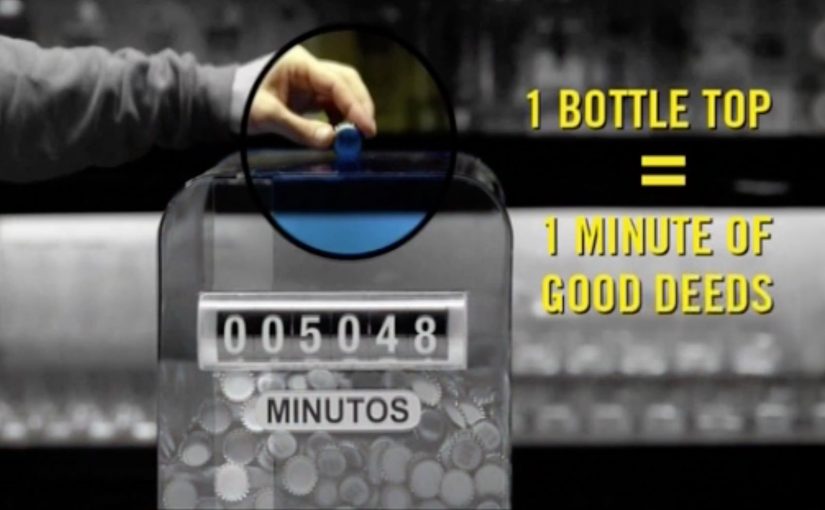
The idea is deliberately simple. For every Norte beer consumed at a bar, the brand donates one minute of time to practical community work, including fixing houses, maintaining parks, and repairing schools. Followers can monitor the donated minutes and the progress made through a dedicated website, which turns “we went for a beer” into a measurable counter of good deeds.

How the “minutes” mechanic works

The mechanic converts consumption into a visible unit of contribution. One beer equals one minute, then the brand performs the work and publishes progress so the audience can see the tally move. The counter is the proof, and the proof is the story people repeat.

In FMCG marketing, especially in categories tied to social rituals, converting a purchase into a transparent, trackable unit of public benefit can reframe indulgence as participation.

Why it lands

It removes the defensiveness from the behavior by giving it a credible upside. The campaign is not asking people to stop going out. It is redirecting the narrative from “pointless drinking” to “we contributed minutes.” The tracking layer matters because it reduces cynicism, since the audience can follow a concrete output rather than a vague promise.

Extractable takeaway: If your category has a guilt narrative, turn the core behavior into a quantifiable unit of visible impact, then publish progress often enough that people can use it as social proof.

What the brand is really trying to win

This is reputation as much as reach. Norte is positioning itself as the beer you can choose without needing to defend the choice later. The community work is the legitimacy, and the “best excuse” line is the social wrapper that helps the story travel.

The real question is whether a beer brand can turn a familiar excuse into a credible, repeatable proof of usefulness.

What to borrow from Norte’s minute logic

  • Make the unit understandable. A minute is easier to grasp than a donation percentage.
  • Design the proof before the film. A public counter and visible work outputs keep the idea credible.
  • Let the audience retell it in one sentence. “Every beer adds a minute” is built for word-of-mouth.
  • Guard the integrity. Transparency and follow-through matter more here than polish.

A few fast answers before you act

What is “The Best Excuse Ever” in one line?

A beer campaign where each Norte beer consumed converts into one minute of real community work, tracked publicly so people can see progress.

Why does the minute-based unit help?

It is concrete and easy to visualize. It also makes progress feel additive, so participation scales naturally with social occasions.

What makes this more credible than typical cause marketing?

The proof mechanism. A visible counter plus documented work outputs reduces the “donation fog” that often makes audiences skeptical.

What is the biggest risk with this approach?

If the brand cannot consistently deliver the promised work, the counter becomes a liability and the campaign reads as opportunism.

When does this model work best?

When consumption is already social and habitual, and the brand can operationally execute real-world outputs at the pace the campaign generates demand.

Mercedes-Benz: Tweet-Fueled Road Trip Race

Mercedes-Benz: Tweet-Fueled Road Trip Race

In February this year four two-person teams left four cities, Chicago, Los Angeles, New York City, and Tampa Bay, to goto Dallas, Texas in a custom-designed Mercedes-Benz car that was fuelled by Twitter.

Of course the cars were not physically running on tweets, but virtually they were. The reason for Mercedes-Benz saying that the race was “Tweet-Fueled” was because each of the four teams had to get the support of their home cities to drum up enough support on Twitter to get them to the finish line in Dallas.

In the end the campaign had almost 30,000 active participants with over 72,000 Facebook Fans and 77,000 Twitter Followers who generated over 150,000+ tweets to power the cars. The campaign videos generated about 2 million views, while the twitter reach pushed over the 25 million mark.

Why “tweet-fueled” is more than a gimmick

The smart move is that social support is not commentary. It is the engine of progress. That turns spectators into participants, because every tweet has a clear meaning. It helps your team move. In large consumer brands, this kind of real-time mechanic works best when the audience action maps to a visible outcome.

Extractable takeaway: When the audience can see their social action move a scoreboard, participation scales beyond one-off commenting.

  • Clear cause and effect. Tweets translate into distance and momentum.
  • City pride as a driver. Chicago vs LA vs NYC vs Tampa gives the story a natural rivalry.
  • Built-in recruiting. Teams need their cities, so they recruit friends to contribute.

How the campaign design created scale

The structure is simple. Four teams. One destination. A visible race. But it is the social mechanics that create the volume.

The real question is whether your campaign turns audience action into trackable progress that people can influence in real time.

  1. Teams need advocates. Supporters feel like they are part of the outcome.
  2. Progress is trackable. People return when they can see movement and standings.
  3. Video extends the narrative. Moments from the road give the audience something to share beyond the scoreboard.

In real-time social entertainment, participation scales when the audience can visibly change the outcome, not just comment on it.

What to take from this if you build real-time social campaigns

  1. Make participation meaningful. If the social action changes the outcome, people care more.
  2. Create teams and identity. Groups recruit. Individuals browse.
  3. Design a visible progress loop. Standings and milestones keep engagement alive.
  4. Use content to refresh attention. Videos give people new reasons to re-share and re-engage.

A few fast answers before you act

What was the Mercedes-Benz Tweet-Fueled race?

It was a social-powered race where four teams drove from Chicago, Los Angeles, New York City, and Tampa Bay to Dallas, and their progress was powered virtually by Twitter support from their home cities.

Why were the cars called “tweet-fueled”?

Not because tweets powered engines physically, but because tweets served as the mechanism that enabled teams to accumulate the support needed to reach the finish line.

What were the reported results?

Almost 30,000 active participants, over 72,000 Facebook fans, 77,000 Twitter followers, more than 150,000 tweets, about 2 million video views, and Twitter reach exceeding 25 million.

Why does the city-based structure matter?

It creates rivalry and pride, which motivates supporters to participate and recruit others to help their team advance.

What is the transferable lesson?

If you can turn social activity into measurable progress toward a clear goal, you can convert audience attention into sustained participation.