
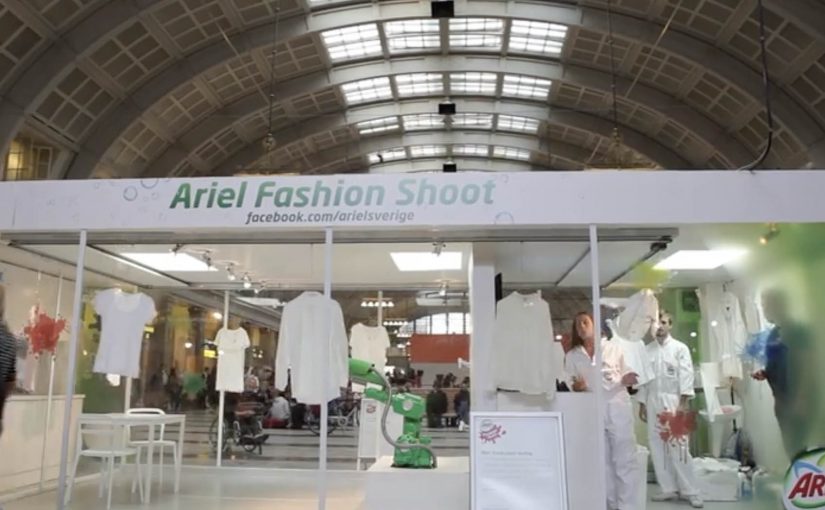
Ariel Actilift: Facebook-Controlled Shoot

Ariel Actilift: Facebook-Controlled Shoot

Procter & Gamble Nordics, in collaboration with Saatchi & Saatchi Stockholm, B-Reel and Atomgruppen, creates an interactive campaign centered on a specially built glass installation in Stockholm Central Station, Sweden.

For one week, passers-by at Stockholm Central Station can watch designer clothes hung on a washing line being soiled by ketchup, drinking chocolate and lingonberry jam via fans on the Ariel Sweden Facebook page (or Denmark, Norway, Finland equivalents).

The mechanic: stain it from Facebook, then win it back clean

In order to win the designer clothes, Ariel fans use a Facebook-controlled industrial robot cannon to soil them. The stained clothes are then sent in the post after being washed on-site with regular Ariel Actilift.

In high-traffic European transit hubs, the strongest “social media” ideas are the ones that visibly change the physical world in front of everyone, not just the feed.

Why it lands: it makes participation feel consequential

This is a neat reversal of how most product demos work. Instead of the brand creating a controlled “before and after”, it invites the audience to create the mess themselves, then proves the wash result under public scrutiny.

Extractable takeaway: If you want participation that people remember, make the audience’s input irreversible in the moment, then let your product do the recovery. The contrast between “I caused this” and “it still comes out” is stronger than any claim line.

The glass box is doing strategic work. It turns a Facebook click into a visible event for commuters, which makes the campaign feel bigger than the people who are actually playing.

What the campaign is really selling

At a surface level it is a stunt to win clothes. At a deeper level it is reassurance. The mess is extreme and deliberately unglamorous, so the cleanliness result reads as confidence, not a carefully staged demo.

The real question is whether a Facebook click creates enough public consequence to make the cleaning proof feel worth watching.

What to steal for your next social-plus-physical idea

  • Let the audience create the proof: user-generated “inputs” that change the outcome are more persuasive than brand-controlled setups.
  • Use a public stage: a transparent environment creates trust because the product has nowhere to hide.
  • Keep the control surface simple: one clear action. One obvious effect. No complicated UI.
  • Design a real reward path: the prize should be operationally credible, not a vague “chance to win”.
  • Make the brand step undeniable: show the product moment on-site so the claim is witnessed, not narrated.

A few fast answers before you act

What is the core idea of this Ariel activation?

A Facebook interface controls a robot cannon that stains designer clothes in a glass installation. Ariel then washes the clothes on-site, and participants can win the cleaned items.

Why combine Facebook with a physical installation?

Because it turns digital participation into a public spectacle. The online action has a visible consequence in the real world, which makes it more engaging and more shareable.

What product truth is being demonstrated?

That Ariel can handle tough, visible stains. The audience creates the stains, and the brand shows the wash outcome under observation.

What makes this different from a normal product demo?

The brand gives up control of the “mess creation” to the public. That makes the demonstration feel less scripted and more credible.

What should you measure if you run something like this?

Participation rate, dwell time at the installation, social engagement tied to the control interface, earned media pickup, and any lift in product consideration during the activation window.
ERAN: When Facing Distress, Dial 1201

ERAN: When Facing Distress, Dial 1201

Here is a campaign from ERAN, the National Crisis Intervention Hotline in Israel.

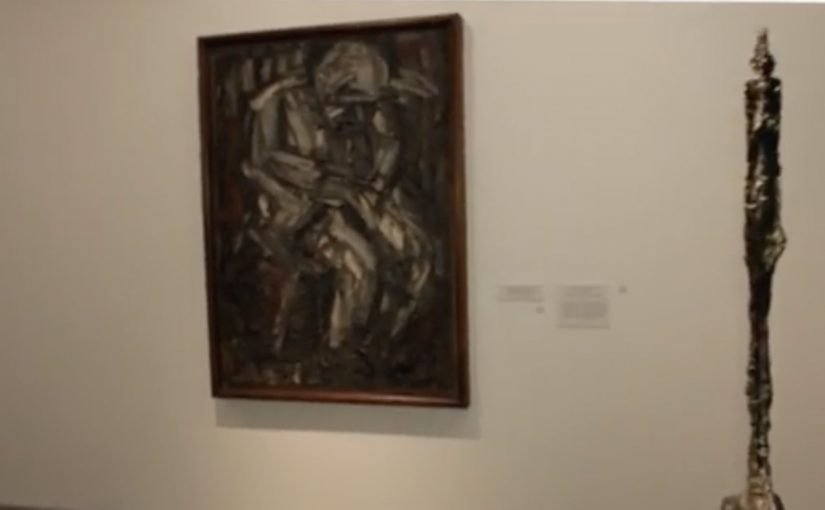
To make people aware of the 1201 hotline, McCann Erickson worked with the Israel Museum in Jerusalem. They identified paintings that express distress, then changed each artwork’s audio guide number to 1201. Dialing that number on the guide gives visitors a customized message that mirrors the emotion of what they are looking at, while quietly pointing to the same number outside the museum.

A hotline reminder that hides in plain sight

The trick is that nothing feels like advertising at first. You are already in “audio guide mode”. You are already entering numbers. The campaign simply reroutes a familiar behavior into a moment of recognition, then uses the artwork’s emotional weight to make the number stick.

How the mechanism earns attention without shouting

This is ambient marketing built from context rather than volume. The museum provides the emotional frame. The audio guide provides the interface. The number provides the bridge between cultural experience and real-world help. It is a one-step interaction, and the message arrives when the viewer is already primed to feel.

Because the visitor is already using the guide as intended, the intervention feels credible rather than intrusive, which makes the number easier to absorb and remember.

In public service communication, the most effective prompts often appear inside routines people already trust, so the call-to-action feels like guidance rather than persuasion.

Why it lands

It lands because it changes the meaning of a number. “1201” stops being a hotline you may never need, and becomes a small, memorable experience tied to a specific feeling and a specific place. The museum setting also lowers defensiveness. People expect reflection, not selling, so they are more open to receiving a supportive message.

Extractable takeaway: If you can place a helpline inside an existing, legitimate interface, and align it with an emotionally resonant context, you turn awareness into recall without relying on fear or shock.

What ERAN is really doing here

This is recall engineering. That means designing a vivid cue so a critical number is easier to remember when it matters.

The real question is how to make a crisis number memorable before someone actually needs it.

ERAN is right to optimize for respectful recall over louder awareness. The value is not the interaction itself. The value is that a visitor leaves with a number that now has emotional meaning.

What to borrow from this hotline recall design

  • Borrow an interface people already use. Audio guides, ticketing kiosks, vending machines, any trusted routine.
  • Let context do the targeting. The environment pre-qualifies the emotional state and attention level.
  • Keep the action to one step. The smaller the action, the higher the completion.
  • Design for respectful tone. Supportive beats sensational when the topic is distress.
  • Make the recall object simple. A short number, a clear phrase, one job.

A few fast answers before you act

What is the core idea of “When Facing Distress, Dial 1201”?

Turn museum audio guide numbers into a hotline reminder by assigning “1201” to distress-themed artworks and delivering supportive messages through the guide.

Why use a museum as the medium?

Because visitors expect emotion and reflection. That context makes the message feel natural, and it helps the number attach to a real feeling rather than a generic PSA.

What makes this more memorable than a poster?

The viewer performs an action. They dial the number. That small act creates muscle memory and meaning, which improves recall later.

What is the biggest execution risk?

If the experience feels like it interrupts the museum visit or trivializes the artworks, it can trigger backlash. The tone has to stay respectful and restrained.

How can other causes apply this approach?

Find a trusted public interface, align the message with the environment’s emotional purpose, and make the action so simple it can happen without instruction.