
Carlsberg: Happy Beer Time

Carlsberg: Happy Beer Time

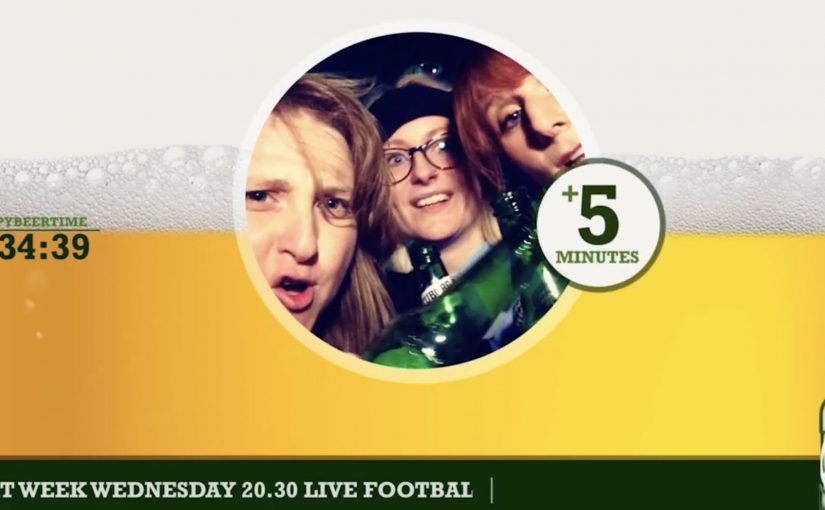
Nowadays people like to go out, take photos, and share them on Instagram. Carlsberg, together with the Danish agency Konstellation, puts a social twist on the well-known concept of happy hour by turning every post into more discounted time for the whole bar.

A happy hour that gets longer when the bar posts together

The mechanic is simple and highly visible. Guests snap an Instagram photo and tag it with the venue name and #HappyBeerTime. Each successfully tagged photo extends a shared countdown on the bar’s screen, which keeps discounted beer available for everyone while the clock keeps moving.

In on-trade environments, meaning bars and restaurants, the strongest promotions convert shared participation into a shared, immediate reward that the whole room can see.

What makes the mechanism work in a real bar

  • One clear lever. Post with the right tags. Add time.
  • Progress is public. A live countdown on a screen turns the promotion into a collective game.
  • Reward is communal. Everyone benefits from every post, so the behaviour spreads naturally.
  • Distribution is built in. The bar gains organic visibility through guests’ own feeds.

The real question is whether your incentive creates a room-level feedback loop fast enough that people feel their action changes the moment.

Why it lands

This activation aligns with what people already do on a night out. Take photos. Share moments. The difference is that the sharing changes the environment in real time. That makes the incentive feel playful rather than purely transactional.

Extractable takeaway: If you want participation at scale inside a venue, use a reward the entire room experiences together, and make the progress visible so the crowd recruits itself.

What the brand is really buying

On the surface, it is discounted beer for longer. Underneath, it is repeat purchase pressure at the point of sale, plus a stream of user-generated content tied to specific venues and nights. The bar gets word-of-mouth promotion. Carlsberg gets social proof linked to a real-world occasion.

A quick note on “Happy Hour 2.0”

“Happy Hour 2.0” is the idea of extending a happy-hour window through a simple trigger, instead of relying on a fixed start and end time. Budweiser was earlier to pioneer this Happy Hour 2.0 concept in August 2012. Carlsberg’s twist is connecting the extension mechanic directly to social posting behaviour.

Proof that the idea travelled beyond a one-off

The concept drew broader industry attention, including recognition in Danish award circuits and international festival shortlists. That matters because it signals the mechanic is legible. It is easy to explain, easy to copy, and easy for people to participate in without training.

Steal the shared countdown loop

  • Keep the action atomic. One photo and two tags beats a multi-step flow.
  • Design the room-level feedback loop. The screen is not decoration. It is the social engine.
  • Set guardrails early. Decide how you handle off-brand or inappropriate posts, and communicate it.
  • Make the reward feel immediate. “Add time now” beats “collect points later”.
  • Measure uplift, not just posts. Treat UGC as a means. The goal is incremental sales and dwell time.

A few fast answers before you act

What is Happy Beer Time in one sentence?

It is a bar promotion where Instagram posts tagged with the venue name and #HappyBeerTime extend a shared happy-hour countdown, keeping discounted beer available for longer.

Why does “time” work as the reward?

Time is instantly understood, visibly shared, and emotionally tied to the night out. Adding minutes feels like progress the whole room experiences together.

What makes this different from a standard hashtag campaign?

The hashtag is not just for awareness. It is a trigger that changes the real-world environment in real time, which makes posting feel consequential.

What can go wrong operationally?

If tagging rules are unclear, people will not participate. If moderation is absent, inappropriate content can surface. If the reward lags, the loop breaks.

What should you measure in a pilot?

Participation rate, post volume per hour, time extended per session, sales uplift during the activation window, and whether dwell time increases without margin loss exceeding targets.
Coca-Cola Interactive Mini Bottles

Coca-Cola Interactive Mini Bottles

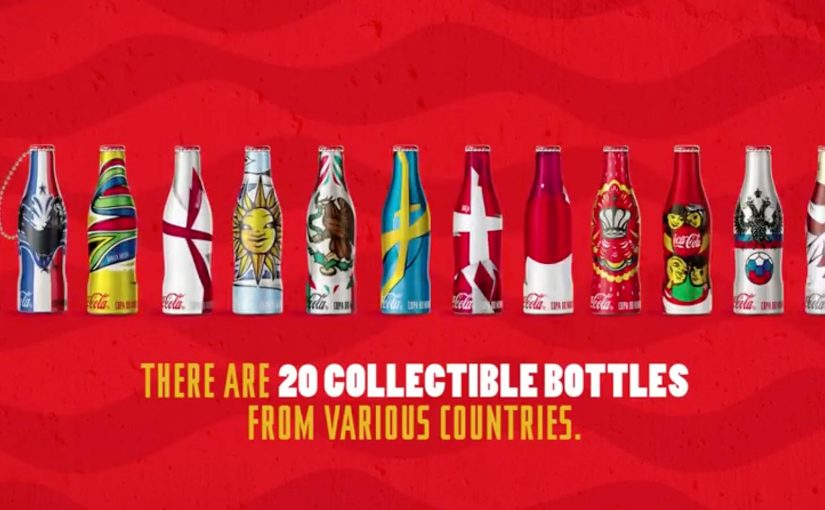
Coca-Cola has launched 20 special edition mini bottles to get fans around the world excited about the upcoming 2014 FIFA World Cup, which will take place in Brazil from June 12th to July 13th.

The bottles come wrapped in flags of countries that have hosted the World Cup previously. Argentina, Chile, Uruguay, Mexico, USA, England, Germany, Spain, France, Italy, Sweden, Switzerland, South Africa, Japan and South Korea. As well as the three upcoming host countries Brazil, Russia and Qatar. Plus two special Coca-Cola editions.

Coca-Cola fans can also create and send special messages and avatars to other bottle owners through Facebook and iPhone or Android apps. In addition, special markers on the bottles activate augmented reality animations when held up to a smartphone camera.

What makes these bottles more than packaging

This is a simple shift with big implications. The bottle is not only a container. It becomes a trigger. A collectible. And a social connector. This is smart brand design because it turns packaging into media without asking people to leave the product in their hand.

The real question is how to make a small physical object behave like media, participation, and social signal at the same time.

The flags do the first job. They make the bottles instantly recognizable and tradable. People have a reason to hunt for specific countries and compare what they found. The digital layer does the second job. By digital layer, this means the messages, avatars, and AR animations unlocked through the bottle. It turns ownership into participation, because the bottle now links to messages, avatars, and AR animations.

Why augmented reality fits this moment

AR works best when the behavior is natural. Here the behavior is already there. You hold the bottle in your hand. You point your phone at it. You get something back instantly. That is what makes the marker idea effective, because it adds a reward to an existing behavior instead of asking people to learn a new one.

Extractable takeaway: When the product already sits in someone’s hand, the strongest digital layer is the one that rewards curiosity in the moment rather than redirecting attention somewhere else.

In global brand portfolios, this matters because packaging that doubles as an activation point can scale engagement and give people a stronger reason to choose the brand at shelf without adding a separate physical touchpoint.

What to borrow from collectible packaging activations

  • Make the physical object the interface. The bottle is the entry point, not a poster, banner, or separate microsite.
  • Give fans something to collect and trade. Flags are a built-in collecting mechanic.
  • Add a social layer that only owners can unlock. Messaging and avatars make participation feel earned, not generic.
  • Use mobile as the bridge. iOS and Android apps turn “I saw it” into “I can activate it” immediately.

A few fast answers before you act

What are Coca-Cola Interactive Mini Bottles?

They are 20 special edition mini bottles designed to build excitement for the 2014 FIFA World Cup, using country-flag designs plus a digital interaction layer.

What is interactive about them?

Owners can send messages and avatars to other bottle owners via Facebook and iOS or Android apps. The bottles also include markers that trigger augmented reality animations through a smartphone camera.

Why use country flags on the bottles?

It creates instant collectability. People can look for specific countries, compare what they found, and feel part of a shared event build-up.

What is the role of augmented reality here?

AR turns the label into an activation point. Point your phone at the bottle, and the design becomes an animation experience rather than static packaging.

What is the main marketing idea worth copying?

Make the product itself the gateway to the experience. When the physical object triggers the digital layer, participation becomes effortless and more memorable.

Pepsi Max: Test Drive

Pepsi Max: Test Drive

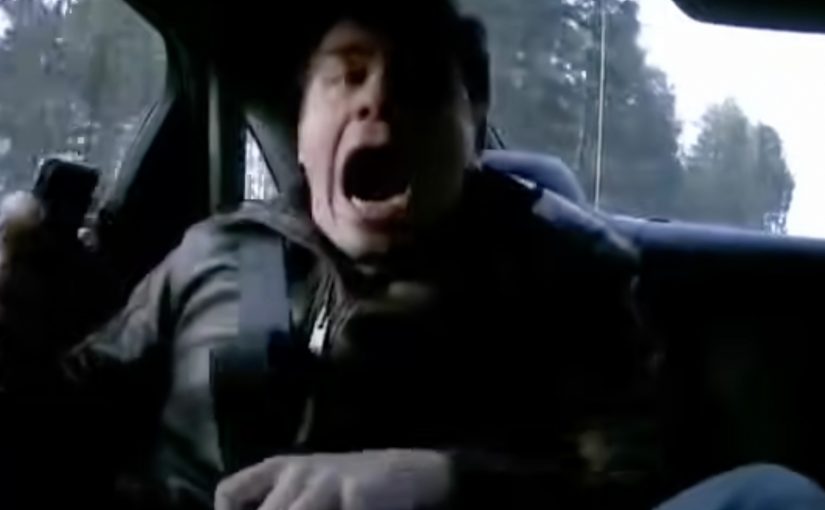
Last year in March, Pepsi Max along with professional stock car racing driver Jeff Gordon performed a prank on an unsuspecting car salesman by taking him on a test drive of his life. Here, a “prank” is a designed real-world setup filmed to capture reactions, not a fully scripted spot.

The video since then got over 41 Million views on YouTube. Despite its viral success, automotive journalist Travis Okulski was not impressed and was pretty vocal in pointing out inconsistencies in the viral ad and calling it a fake.

So Jeff Gordon teamed up again with Pepsi Max to pull a similar prank on unsuspecting Travis Okulski, just to prove the authenticity of the original test drive video…

But even after all of that Travis Okulski is still not convinced and the video since its release last week has already gotten over 13 Million views on YouTube.

The real question is what you do when a viral stunt becomes a public authenticity debate.

Why this became a two-part story

The first video worked because the premise is simple, the escalation feels real, and the payoff is pure reaction. But the moment it went viral, it also invited scrutiny. Because the setup looks “too good to be true”, it triggers a verification instinct, which is why people rewatch, share, and interrogate the details. That is what makes the follow-up so interesting. The brand turned criticism into content by making the skeptic part of the narrative.

Extractable takeaway: When your entertainment idea can be framed as “real or staged”, plan a proof-driven sequel path up front, so the debate extends the platform instead of draining trust.

  • Viral hook. A familiar setting, then a sudden reveal of unexpected capability.
  • Credibility challenge. A public critique that reframed the conversation as “real or staged”.
  • Response as sequel. A second execution aimed at the critic to re-earn belief.

In mass-reach consumer campaigns, “real or staged” scrutiny is part of distribution, so the sequel has to protect credibility without changing the core promise.

What to learn from the backlash

If doubt becomes the headline, leaning in with credible proof beats going quiet. When stunts travel, authenticity becomes part of the product. If the audience starts debating “is it real”, the brand can either go silent or lean in. Pepsi Max leaned in and used the debate as fuel, which extended the lifecycle and kept attention anchored to the same brand platform.

  • Design for verification. Build in moments that can withstand frame-by-frame scrutiny.
  • Turn skeptics into structure. If a credible critic challenges you, make the response the next chapter, not a defensive footnote.
  • Keep the platform constant. Address doubts without drifting into a different promise or tone.

A few fast answers before you act

What is Pepsi Max “Test Drive” with Jeff Gordon?

It is a prank-style stunt video where Jeff Gordon takes an unsuspecting car salesman on an extreme test drive, created as part of Pepsi Max’s viral entertainment approach.

Why was there controversy around the first video?

An automotive journalist publicly pointed out inconsistencies and argued it was staged, which sparked debate about authenticity.

Why did Pepsi Max do a second video?

To address the credibility debate directly by repeating a similar stunt and making the outspoken critic part of the execution.

What is the transferable pattern for viral campaigns?

Expect scrutiny, especially when the content looks “too good”. If doubt becomes the story, design a credible sequel that engages the criticism rather than ignoring it.