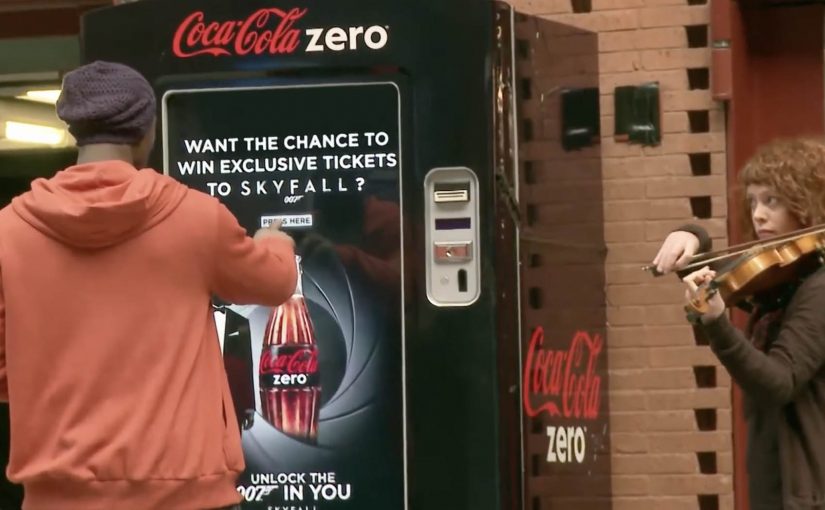
At Antwerp Central Station, Coke Zero challenges unsuspecting passengers to unlock the 007 in them for a chance to win exclusive tickets for the new James Bond movie Skyfall.
The catch is simple. The tickets aren’t free. You have to earn them by going the extra mile and completing the challenge in under 70 seconds.
A station takeover that turns waiting time into play
The setup is built for instant comprehension. A public space. A clear prize. A visible timer. A single instruction: move fast and stay cool.
That clarity matters. In a busy station, you do not have time to explain a brand story. You need a trigger that people understand in one glance and a mechanic that draws a crowd.
The mechanic: a timed “prove you’re 007” sprint
The experience is a countdown challenge. You step in, the clock starts, and you run a sequence of quick tasks designed to test speed, coordination, and composure. Finish within 70 seconds and you win.
This works because the timer turns a movie fantasy into visible stakes that both participants and bystanders can understand instantly.
In high-traffic transit hubs, timed challenges can turn waiting time into a shareable brand moment.
Why it lands: it makes the fantasy feel physical
Bond is not just a character. It is a posture: calm under pressure. The campaign translates that posture into something you can demonstrate with your body, in public, with a deadline.
Extractable takeaway: If your brand borrows meaning from a cultural icon, make the audience perform the meaning in a simple, timed ritual. A clock plus a visible finish line converts “cool story” into “I can do this”.
The station setting also does the work. People already have a reason to be there. The activation adds a burst of purpose to an otherwise idle moment, and the crowd reaction becomes part of the reward.
The business intent: earn attention that travels beyond the station
This is not a subtle idea. It is designed to be watched. Spectators gather, phones come out, and the experience becomes content. Even for people who do not play, the brand still wins a memorable association: Coke Zero equals fast, bold, and game-for-a-challenge.
The real question is whether you can turn borrowed cultural meaning into a public ritual people want to attempt and others want to watch.
What to steal from this timed station challenge
- Start with a single rule: one sentence that explains how to win.
- Use an obvious constraint: a countdown is the fastest way to create stakes.
- Make it watchable: design for a crowd, not just the participant.
- Reward participation, not perfection: the attempt should feel fun even if people fail.
- Keep the prize culturally aligned: the reward should match the fantasy you are selling.
A few fast answers before you act
Why do timed challenges work so well in public spaces?
A timer creates instant stakes and makes the outcome easy to understand for both players and spectators. That clarity is what pulls a crowd in seconds.
What’s the core psychological hook in this activation?
It turns identity into action. You are not told to “feel like 007”. You are invited to prove it under pressure.
What should you measure for a stunt like this?
Footfall around the installation, participation rate, completion rate, average watch time for spectators, social shares per participant, and earned media pickup.
What’s the biggest execution risk?
Friction. If onboarding takes too long or rules are unclear, people will not step in. In transit environments, attention is short and drop-off is ruthless.
How do you adapt this idea without a movie tie-in?
Anchor the challenge to any role people want to inhabit: “be the expert”, “be the fastest”, “be the calm one”. Then translate that role into a simple timed sequence with a visible finish line.