Coca-Cola: Give a Coke, Be Santa

A vending machine that asked you to choose who you are

In global FMCG holiday marketing, the strongest ideas often turn seasonal sentiment into a simple action people can take in public. Coca-Cola’s holiday vending machine is a clean example of that move.

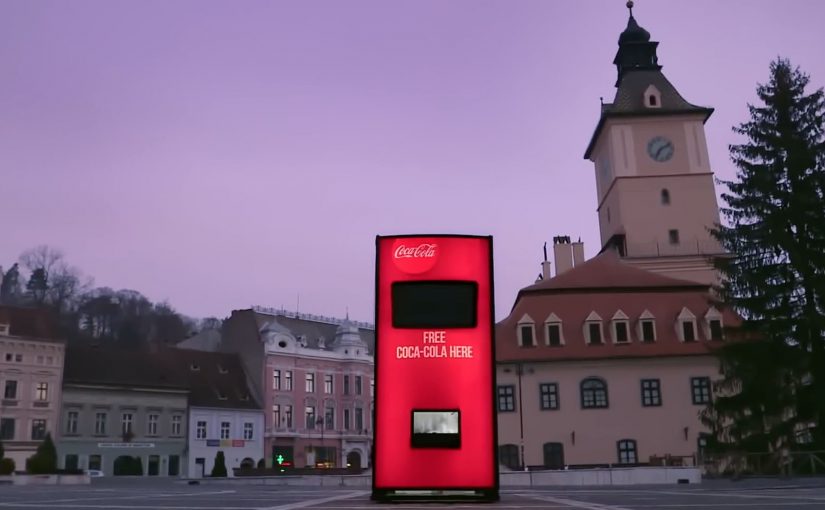
Coca-Cola wanted to bring out the Santa in everyone. So for the 2013 holiday season, they created a special vending machine that prompted users to either get a free Coke or give a free Coke.

The two-button mechanic that made sharing the story

If the user chose a free Coke, the machine quickly dispensed the drink for the user to enjoy.

However, if the user decided to share, then the machine did something a little more special. Watch the video below to find out.

Why “give” feels better than “get” in December

The psychology here is straightforward. A free product is nice, but it is forgettable. A choice that reflects identity is sticky.

By putting “give” and “get” side by side, the machine turns a small decision into a moment of self-image and social proof. In a holiday setting, people want to see themselves as generous, and they want to be seen that way by others.

The business intent behind bringing out the Santa

The intent is not simply distribution.

Coca-Cola uses the vending machine to translate a brand promise into behavior. The brand is associated with warmth and sharing because the consumer enacts it, not because the brand claims it.

What to steal from this give-or-get design

  • Turn values into a choice. Make the brand idea something people can do, not just hear.
  • Reward the “better” behavior. If sharing is the story, make sharing the more memorable path.
  • Keep the interaction instantly legible. Two clear options beat complex instructions in public spaces.
  • Design for a public moment. When others can witness the decision, the story travels faster.

A few fast answers before you act

What did Coca-Cola build for the 2013 holiday season?

A special vending machine that offered users a choice: take a free Coke or give a free Coke.

What was the core mechanism?

A simple two-option prompt. Choosing “get” dispensed a Coke immediately. Choosing “give” triggered a more special outcome.

Why does the “give” option matter so much?

Because it turns a freebie into an identity moment. People remember what they chose, and others can witness it.

What business goal did this support?

Making Coca-Cola’s holiday positioning feel real by linking the brand to a visible act of sharing, not just a message about sharing.

What is the main takeaway for brands?

If you want to own a value like generosity, design an interaction where people can demonstrate that value in the moment.

Coca-Cola: Slurp and Crunch Cinema Spots

Cinema etiquette, packaged as entertainment

Coca-Cola, with the help of Saatchi & Saatchi Denmark and M2Film, created a two-spot public service campaign that highlighted the annoyance of noisy slurps and crunching of refreshments during public viewing at the cinema.

Coca-Cola Gangster

Coca-Cola Stableboy

The move: make the sound the villain

Everyone knows the noise. The spots take that tiny irritation and push it to the foreground, so the whole room shares the same reaction at the same time.

Why it works where it plays

Because it runs in the cinema. The reminder lands in the exact environment where people can immediately correct themselves. It feels like a social cue, not a rule.

The behavioral job

Highlight how slurps and crunching can ruin public cinema viewing, and nudge people toward better behavior without preaching.

Steal the nudge

  • Pick a universal micro-irritation and dramatize it fast.
  • Deliver the message in-context, where relevance is unavoidable.
  • Use story and character so behavior change stays watchable.

A few fast answers before you act

What was this Coca-Cola cinema campaign?

A two-spot campaign designed to highlight how loud slurping and crunchy snacking can annoy other people during a movie.

Who created the campaign?

The post credits Saatchi & Saatchi Denmark and M2Film alongside Coca-Cola.

How many spots were there and what were they called?

Two spots. “Coca-Cola Gangster” and “Coca-Cola Stableboy.”

Where was this intended to run?

In a cinema context, aimed at audiences during public film viewing.

Coca-Cola Interactive Mini Bottles

Coca-Cola has launched 20 special edition mini bottles to get fans around the world excited about the upcoming 2014 FIFA World Cup, which will take place in Brazil from June 12th to July 13th.

The bottles come wrapped in flags of countries that have hosted the World Cup previously. Argentina, Chile, Uruguay, Mexico, USA, England, Germany, Spain, France, Italy, Sweden, Switzerland, South Africa, Japan and South Korea. As well as the three upcoming host countries Brazil, Russia and Qatar. Plus two special Coca-Cola editions.

Coca-Cola fans can also create and send special messages and avatars to other bottle owners through Facebook and iPhone or Android apps. In addition, special markers on the bottles activate augmented reality animations when held up to a smartphone camera.

What makes these bottles more than packaging

This is a simple shift with big implications. The bottle is not only a container. It becomes a trigger. A collectible. And a social connector.

The flags do the first job. They make the bottles instantly recognizable and tradable. People have a reason to hunt for specific countries and compare what they found. The digital layer does the second job. It turns ownership into participation, because the bottle now links to messages, avatars, and AR animations.

Why augmented reality fits this moment

AR works best when the behavior is natural. Here the behavior is already there. You hold the bottle in your hand. You point your phone at it. You get something back instantly.

That is what makes the marker idea effective. It does not ask people to do something unfamiliar. It simply adds a reward to something they already do when they are curious about a special edition design.

What to borrow if you build brand experiences

  • Make the physical object the interface. The bottle is the entry point, not a poster, banner, or separate microsite.
  • Give fans something to collect and trade. Flags are a built-in collecting mechanic.
  • Add a social layer that only owners can unlock. Messaging and avatars make participation feel earned, not generic.
  • Use mobile as the bridge. iOS and Android apps turn “I saw it” into “I can activate it” immediately.

A few fast answers before you act

What are Coca-Cola Interactive Mini Bottles?
They are 20 special edition mini bottles designed to build excitement for the 2014 FIFA World Cup, using country-flag designs plus a digital interaction layer.

What is interactive about them?
Owners can send messages and avatars to other bottle owners via Facebook and iOS or Android apps. The bottles also include markers that trigger augmented reality animations through a smartphone camera.

Why use country flags on the bottles?
It creates instant collectability. People can look for specific countries, compare what they found, and feel part of a shared event build-up.

What is the role of augmented reality here?
AR turns the label into an activation point. Point your phone at the bottle, and the design becomes an animation experience rather than static packaging.

What is the main marketing idea worth copying?
Make the product itself the gateway to the experience. When the physical object triggers the digital layer, participation becomes effortless and more memorable.