
Ariel Actilift: Facebook-Controlled Shoot

Ariel Actilift: Facebook-Controlled Shoot

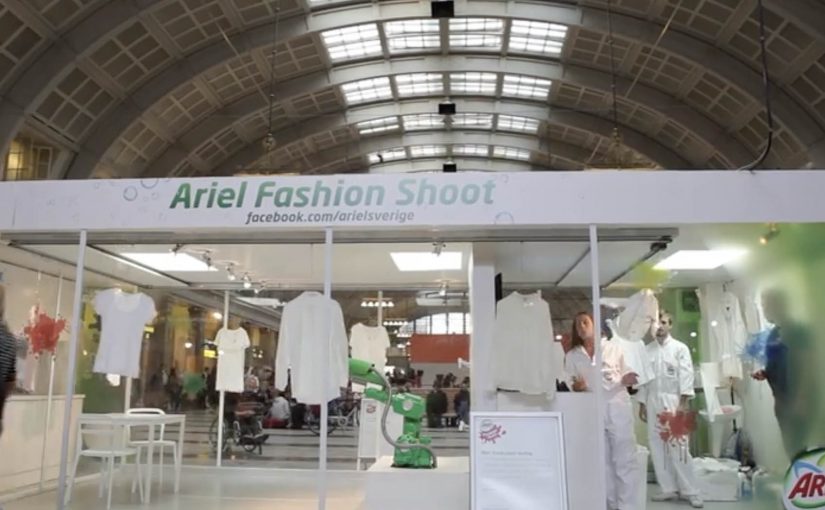
Procter & Gamble Nordics, in collaboration with Saatchi & Saatchi Stockholm, B-Reel and Atomgruppen, creates an interactive campaign centered on a specially built glass installation in Stockholm Central Station, Sweden.

For one week, passers-by at Stockholm Central Station can watch designer clothes hung on a washing line being soiled by ketchup, drinking chocolate and lingonberry jam via fans on the Ariel Sweden Facebook page (or Denmark, Norway, Finland equivalents).

The mechanic: stain it from Facebook, then win it back clean

In order to win the designer clothes, Ariel fans use a Facebook-controlled industrial robot cannon to soil them. The stained clothes are then sent in the post after being washed on-site with regular Ariel Actilift.

In high-traffic European transit hubs, the strongest “social media” ideas are the ones that visibly change the physical world in front of everyone, not just the feed.

Why it lands: it makes participation feel consequential

This is a neat reversal of how most product demos work. Instead of the brand creating a controlled “before and after”, it invites the audience to create the mess themselves, then proves the wash result under public scrutiny.

Extractable takeaway: If you want participation that people remember, make the audience’s input irreversible in the moment, then let your product do the recovery. The contrast between “I caused this” and “it still comes out” is stronger than any claim line.

The glass box is doing strategic work. It turns a Facebook click into a visible event for commuters, which makes the campaign feel bigger than the people who are actually playing.

What the campaign is really selling

At a surface level it is a stunt to win clothes. At a deeper level it is reassurance. The mess is extreme and deliberately unglamorous, so the cleanliness result reads as confidence, not a carefully staged demo.

The real question is whether a Facebook click creates enough public consequence to make the cleaning proof feel worth watching.

What to steal for your next social-plus-physical idea

  • Let the audience create the proof: user-generated “inputs” that change the outcome are more persuasive than brand-controlled setups.
  • Use a public stage: a transparent environment creates trust because the product has nowhere to hide.
  • Keep the control surface simple: one clear action. One obvious effect. No complicated UI.
  • Design a real reward path: the prize should be operationally credible, not a vague “chance to win”.
  • Make the brand step undeniable: show the product moment on-site so the claim is witnessed, not narrated.

A few fast answers before you act

What is the core idea of this Ariel activation?

A Facebook interface controls a robot cannon that stains designer clothes in a glass installation. Ariel then washes the clothes on-site, and participants can win the cleaned items.

Why combine Facebook with a physical installation?

Because it turns digital participation into a public spectacle. The online action has a visible consequence in the real world, which makes it more engaging and more shareable.

What product truth is being demonstrated?

That Ariel can handle tough, visible stains. The audience creates the stains, and the brand shows the wash outcome under observation.

What makes this different from a normal product demo?

The brand gives up control of the “mess creation” to the public. That makes the demonstration feel less scripted and more credible.

What should you measure if you run something like this?

Participation rate, dwell time at the installation, social engagement tied to the control interface, earned media pickup, and any lift in product consideration during the activation window.
LivingSocial: Roll the Dice Taxi

LivingSocial: Roll the Dice Taxi

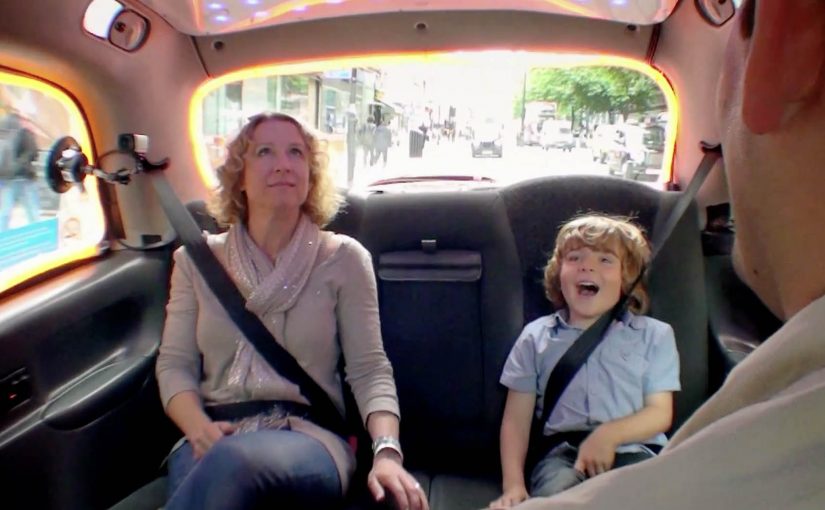
Taxis are becoming a great media for unexpected advertising. In London, LivingSocial takes over an everyday cab and turns it into a surprising, delightful experience.

The objective is simple. Create buzz around the LivingSocial website and showcase the variety of discounts in a way that feels like a story, not a sales pitch.

A taxi ride with a fork in the road

When unsuspecting passengers hail this special taxi and get inside, they are offered a choice. Carry on to their original destination, or “roll the dice” and go for an experience instead.

The decision is the hook. The passenger stays in control, but the brand turns that control into a game, and the game turns a normal ride into a memorable narrative.

In urban commuter cities, a taxi ride is one of the few time-boxed moments where a brand can own the environment end-to-end.

Why the gamble is more persuasive than the pitch

This works because it reframes discount discovery as adventure. The “roll the dice” option creates a moment of suspense, and suspense buys attention better than any list of offers ever will.

Extractable takeaway: If you sell a broad catalogue of offers, do not lead with the catalogue. Lead with a simple, voluntary choice that creates emotional momentum, then let the catalogue appear as the natural payoff for choosing to play.

While the ride plays out, the experience is described as feeding contestants a long stream of sales information. The trick is that the information arrives while the passenger is already invested in what happens next, so it feels like part of the ride rather than an interruption.

The real business intent behind the stunt

At the surface, this is “surprise and delight.” The real question is whether you can turn an everyday ride into a voluntary choice people want to retell. Underneath, it is a conversion engine. It demonstrates the breadth of deals, pushes people into trying something they would not normally consider, and gives them a story they want to retell.

Steal this pattern for city-scale activations

  • Offer two paths. A safe default and a bold option. The contrast makes the bold option irresistible.
  • Make the choice voluntary. Consent turns skepticism into curiosity.
  • Let the content ride shotgun. Teach benefits during the experience, not before it.
  • Design for retellability. Make the twist easy to repeat in one sentence, like “a taxi that lets you roll the dice for a surprise destination.”

A few fast answers before you act

What is the LivingSocial Taxi Experiment?

It is a branded taxi experience where passengers can either continue to their original destination or roll the dice and be taken to a surprise experience that showcases LivingSocial deals.

Why does the “roll the dice” mechanic work?

It creates suspense and a sense of ownership. The passenger chooses the gamble, which makes the experience feel like their story, not the brand’s stunt.

What is the key mechanism that makes this shareable?

A clear, explainable twist on a familiar behavior. Taking a taxi becomes a game with a surprising payoff, which people naturally want to describe to friends.

How do you adapt this pattern without a taxi fleet?

Find a time-boxed environment you can fully control, introduce a simple forked choice, and make the “bold” path deliver a visible, memorable payoff that naturally carries your product story.

What is the simplest way to judge if it worked?

If people can retell the twist in one sentence and explain why they chose the bold path, you built something that travels beyond the ride.

World’s Biggest Hug: Christ the Redeemer PSA

World’s Biggest Hug: Christ the Redeemer PSA

A monument-sized gesture

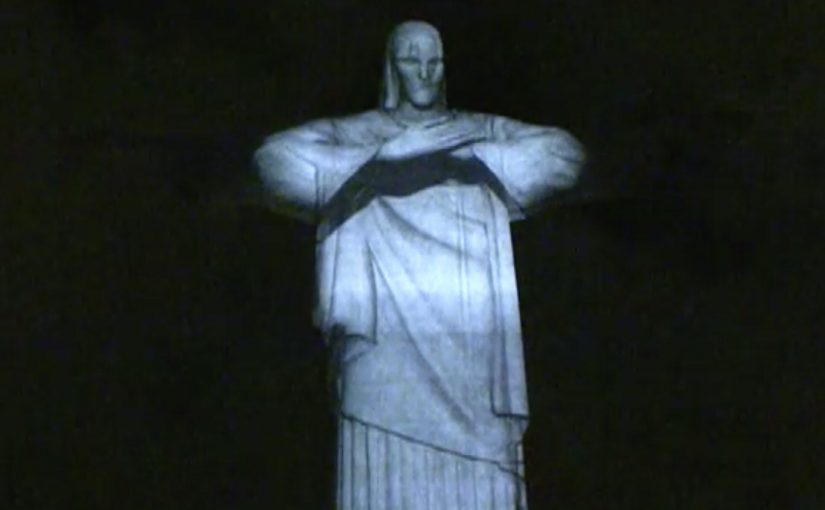
In October 2010, Conselho Nacional do SESI ran a campaign described as the “world’s biggest hug” by using the Christ the Redeemer statue in Rio de Janeiro as the canvas.

Across two nights, the statue’s spotlights were switched off and replaced with projections and 3D imagery that made it look like Christ was closing his arms around the city. The moment linked back to the Carinho de Verdade (“True Affection”) campaign, built to raise awareness of sexual abuse affecting children and teenagers and to promote healthier relationships of trust.

Visualfarm Brazil created the projection using Coolux Germany’s Pandoras Box technology. Below is the recorded footage of the projection itself.

How the illusion works. A quick mechanics recap

The execution combines three things: a landmark people already read as a symbol of protection, a temporary “blackout” that resets attention, and projection mapping that makes a static surface feel alive.

Projection mapping is the practice of aligning video to the exact geometry of a 3D surface so the object appears to change shape, gain depth, or move, even though nothing physical moves.

In global public-awareness communications, landmark-scale stunts work best when the symbolism is instantly legible and the path from emotion to action is frictionless.

Why it lands when it could have been “just a stunt”

The hug is a universal gesture with a clear meaning. It does not need translation, and it carries warmth without feeling like a lecture. Using the Christ the Redeemer silhouette makes that meaning immediate at city scale, then the darkness-to-light reveal gives it a shared “you had to be there” quality that naturally travels by word of mouth and video.

Extractable takeaway: If your message is difficult, start with a human gesture everyone understands, then let the medium amplify it, and only then introduce the cause and the action you want people to take.

The intent behind the hug

This is cause communication that uses emotional clarity as a bridge into a harder conversation. The strongest public-awareness work starts with an emotionally legible act before it asks people to absorb the harder message. The real question is how to turn a monument-scale emotional moment into a cause message people can approach instead of avoid. The job is not only awareness. It is to make the topic speakable, reduce avoidance, and give the public a simple next step that feels aligned with the warmth of the symbol.

What to steal from this for your next public-facing campaign

  • Pick one unmistakable symbol. Use a form people recognize in under a second, then change it in a way that supports the message.
  • Engineer a “collective moment.” Limited time windows create urgency and social proof, especially when the result is visibly shareable.
  • Design for cameras, not just crowds. If it does not read clearly on a phone video, it will not scale beyond the live audience.
  • Keep the CTA emotionally consistent. If you lead with care, the action should feel like care too, not like a hard switch to bureaucracy.

A few fast answers before you act

What was “The World’s Biggest Hug” campaign?

It was a Carinho de Verdade campaign moment in Rio where projections on Christ the Redeemer created the illusion of the statue hugging the city, used to draw attention to child and teen sexual abuse and encourage healthier trust-based relationships.

How did the projection create a “hug” effect?

The statue’s normal lighting was turned off, then mapped visuals were precisely aligned to the statue’s 3D surface so the arms and body appeared to move and close around the city.

Why use a monument instead of a standard ad placement?

A monument compresses meaning. People already attach emotion and identity to it, so the message is understood faster and shared more willingly than a conventional placement.

What role did the campaign site play?

It provided the action path. The public moment created attention and emotion, and the site anchored the message, participation, and follow-through.

What is “projection mapping” in one sentence?

Projection mapping is video projected onto a real-world object with the visuals warped and timed to the object’s geometry so it appears to transform or move.

What is the main transferable principle?

Use a simple, human symbol to earn attention, then make the next step feel effortless and consistent with the emotion you created.