
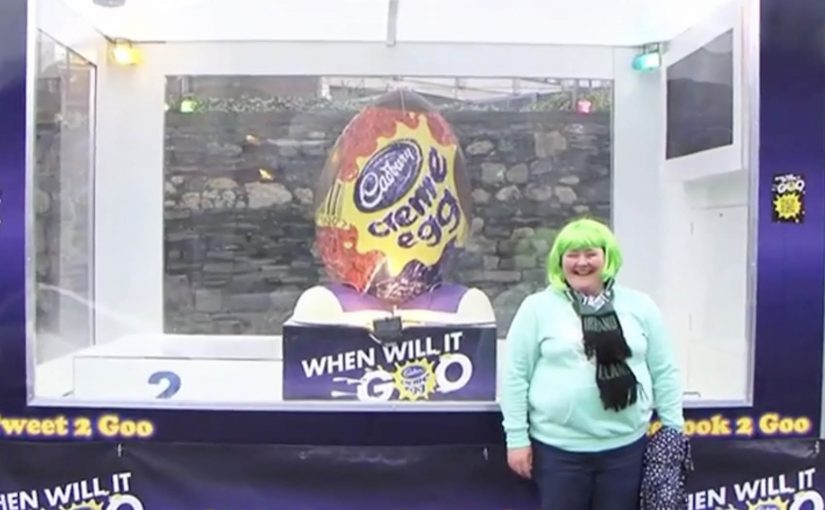
Cadbury Creme Egg: When Will It Goo

Cadbury, along with agency MCsquared Dublin, created an integrated campaign that enlisted the Irish public to help their giant Creme Egg release its Goo. Here, “Goo” is the campaign’s shorthand for the public release moment.

Eight rocking giant eggs, each protected in a transparent case, were placed around Dublin. Fans were asked to tweet “Goo” using #tweet2goo or enter via the campaign Facebook app. Every tweet and Facebook post made the egg get more “egg-cited” until it “egg-sploded”.

The entire Goo event was broadcast live on the Cadbury Ireland Facebook page, and participants were automatically entered into a draw to win tickets to the London 2012 Olympic Games.

From social input to physical payoff

The mechanic is a simple loop with a strong public proof moment. People post. The installation reacts. The reaction builds suspense. Then the payoff happens in public, with a clear “we did that” feeling for anyone who participated.

In Irish FMCG launches where seasonal products rely on impulse and talk value, turning participation into a shared street spectacle can earn attention that paid media cannot easily buy.

Why it lands

This works because it turns a familiar product truth, the goo, into a shared mission. Because people can see progress building toward a public release, each post feels consequential rather than disposable. The spectacle turns remote social actions into something you can physically witness, and the ticking progress effect gives people a reason to keep posting and to pull friends in. The live broadcast also gives the event a second stage, so even people not in Dublin can follow along and contribute.

Extractable takeaway: If you want social participation at scale, design a public system where every small action visibly moves a shared object toward an inevitable moment. The promise of that moment does the acquisition work.

What the campaign is really buying

It is not just awareness. It is repeat behavior during a short seasonal window. The real question is how to turn a short seasonal sales window into repeat participation instead of one-off attention. The hashtag and the Facebook entry mechanic reward persistence, and the prize draw adds a practical reason to participate even if you are not nearby.

What to steal for seasonal participation campaigns

  • Make the participation rule obvious. One hashtag, one word, one job.
  • Translate digital actions into physical feedback. That is what creates credibility and excitement.
  • Build suspense, not just a reveal. Progress is a stronger engine than surprise.
  • Give it two stages. Street spectacle plus a live stream extends the audience.
  • Add a lightweight incentive. A draw works best when the core experience is already fun.

A few fast answers before you act

What is “When Will It Goo”?

A Cadbury Creme Egg activation where tweets and Facebook entries drive giant public eggs toward a live “goo-splosion” moment.

Why does the physical installation matter?

It turns online participation into something visible and real, which increases belief, excitement, and sharing.

What is the role of the hashtag?

It is the simplest participation interface. It makes the action easy to repeat and easy to recruit others into.

What is the biggest execution risk?

If the installation feedback is slow, unclear, or unreliable, people stop participating because they cannot see impact.

How can a smaller brand replicate the pattern?

Use one shared object, one simple input, and one visible progress signal. The object can be smaller, but the loop must stay legible.
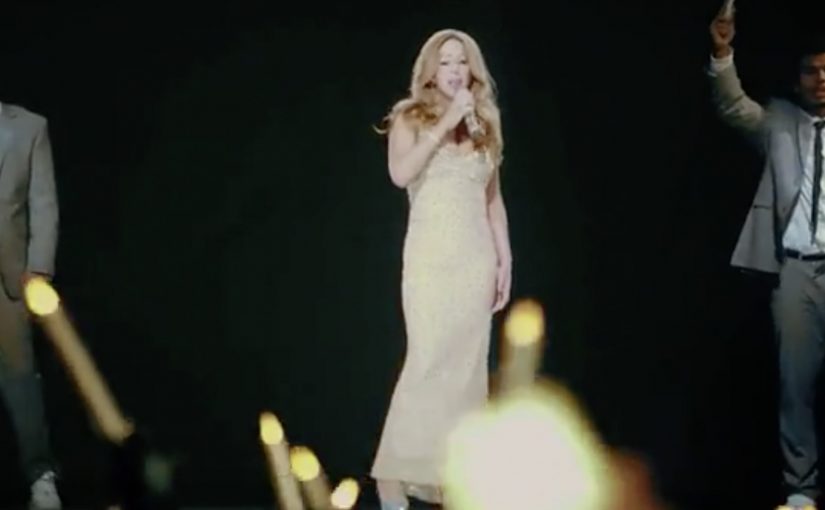
Deutsche Telekom: Hologram Christmas Surprise

Deutsche Telekom stages a multi-city, multi-media Christmas surprise where people across five countries believe they are seeing Mariah Carey perform live, right in their city square.

The event is described as unfolding simultaneously in Germany, Croatia, Macedonia, Montenegro, and Poland. After roughly 10 minutes, the hologram “breaks” into the sky to reveal the surprise, then reforms to lead the connected crowds through “Silent Night”, finishing with “All I Want for Christmas Is You”.

How the spectacle is engineered

Mechanically, each city is linked live to the others, enabling interaction across locations while the performance plays out on large-scale public screens. Attendees are also given a QR code that takes them to a smartphone experience featuring a candle flame, turning the crowd into a coordinated visual.

In European telecom brand marketing, making the network feel like a shared human experience is a reliable way to give an invisible service a visible emotional payoff.

Why it lands as more than “a stunt”

This works because the surprise is collective, not individual. People do not just watch content. They witness their city being connected to other cities in real time, and that connection is the product truth Deutsche Telekom wants remembered. Because the cities are live-linked, the audience experiences “connection” as something happening to them, which makes the brand promise feel credible. The real question is whether your experience lets people feel the benefit in the moment, not just understand it in hindsight. If your brand sells connectivity, a shared public ritual beats a standalone content drop.

Extractable takeaway: When the benefit is intangible, engineer a shared moment that makes the benefit felt, then let the crowd carry the story.

What the numbers are really doing

The piece is framed with scale metrics. Attendance is described as 12,000 people in total, with an additional 27,000 watching via a live internet stream on lifeisforsharing.tv. Treated as reported figures, the strategic point is clear: the “in person” crowd creates authenticity, and the stream extends reach without losing the feeling of simultaneity.

Stealable patterns for cross-market surprise

  • Build one shared ritual. A carol everyone recognises becomes the simplest multi-language participation layer.
  • Make the reveal part of the story arc. Belief, disruption, then a coordinated finale gives the audience a plot to retell.
  • Link physical and mobile. A QR-driven phone element can turn a crowd into a synchronised visual without complicated instruction.
  • Design for “togetherness at distance”. The emotional payoff comes from knowing other cities are experiencing the same moment at the same time.

A few fast answers before you act

What is the “Hologram Christmas Surprise” in one line?

A simultaneous, five-country public concert that uses a Mariah Carey hologram and live city-to-city links to create a shared Christmas moment at scale.

What is the core mechanism that makes it feel real?

Live-linked public screens across cities, plus on-stage interaction cues and crowd participation elements that play out in real time.

Why add the QR code candle experience?

It gives the crowd a simple coordinated action, visually reinforcing the “connected” theme and making the audience part of the show.

How do you keep it from feeling like a pure tech demo?

Lead with a shared ritual and a simple participation layer so the emotion reads first, and the technology disappears into the experience.

What is the most transferable lesson?

If your brand benefit is intangible, engineer a shared public moment that makes the benefit visible, then let people do the storytelling for you.

Prigat: User Generated Orange Juice

Prigat, a leading company in the Israeli fruit juice market, launched one of the more inventive Facebook mechanics of its era. It invited people to squeeze real orange juice by doing something absurdly simple. Smile at your webcam.

The idea was packaged as “User Generated Orange Juice (UGOJ).” A Facebook application that translated user participation into a physical outcome you could actually watch.

The mechanism: your smile triggers a real machine

A custom Facebook app developed by Publicis E-Dologic used webcam-based smile detection to trigger a real, oversized juicer. When the app detected a smile, it activated the juicer and squeezed fresh oranges. Users could watch the machine live 24/7, so the cause-and-effect was visible rather than implied.

Campaign coverage also described a personalization touch where the participant’s name appeared on the machine during use, and that the resulting juice was directed to a charity choice.

In social platform marketing, physical proof loops outperform abstract engagement prompts because they give people a reason to believe and a reason to share.

Why this lands

This works because it turns a universal emotion into a measurable input. Smiling is effortless, socially contagious, and camera-friendly. The live feed makes the outcome undeniable, and that “I did this” ownership nudges people to recruit friends so their smiles compound into more visible results.

Extractable takeaway: If you want participation at scale, connect a low-friction action to a real-world output that people can witness in the moment, then make sharing feel like extending the impact, not like promoting the brand.

What Prigat is really doing

The campaign turns Facebook from a place for liking into a place for doing. The real question is how to turn a passive social audience into a participant who can see, trust, and share the brand experience. This is stronger than a standard Facebook giveaway because the proof is built into the interaction itself. It converts attention into a visible production line, then uses the live stream as credibility and the smile photos as distribution. Prigat gets warmth by associating the brand with positive emotion and generosity, while the machine supplies a visible proof point that keeps the story believable.

What to steal from the Prigat participation loop

  • Design a simple input. The easier the action, the more likely people repeat it and recruit others.
  • Show the output live. A real-time feed reduces skepticism and increases share-worthiness.
  • Make participation legible. If the user can see their effect immediately, they trust the loop.
  • Attach a social good endpoint. A charity destination converts novelty into meaning.

A few fast answers before you act

What is “User Generated Orange Juice” (UGOJ)?

It’s a Facebook app activation where users smile at a webcam and trigger a real juicer that squeezes fresh oranges, visible via a live stream.

How does the smile activation work?

The app uses webcam-based smile detection to decide when to trigger the juicer. The user’s action becomes the on-switch.

Why include a 24/7 live view of the juicer?

It provides proof. People can watch the result of participation, which increases trust and makes the story easier to share.

What kind of results were reported?

Reported results include around 30,000 new likes, over 20,000 photos uploaded, and roughly 40,000 oranges squeezed.

What’s the key risk if you copy this concept?

Trust and privacy perception. You need clear, simple communication that the webcam is used only to detect the smile for the interaction, and that the experience is safe and transparent.