
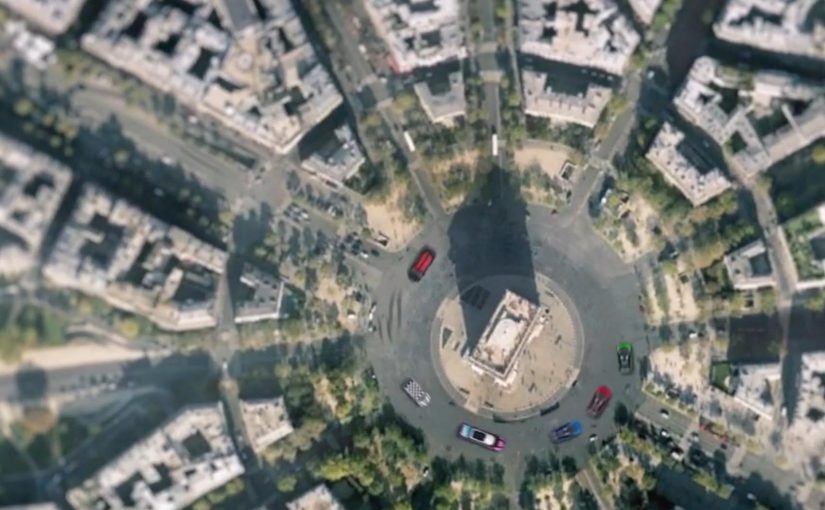
Google Maps Racing Advergame

Mini France has managed to successfully offer a virtual Mini experience with the help of a Social/Google Maps mash-up advergame called “Mini Maps”. Here, advergame means a branded game that turns the marketing idea into the experience itself.

With DDB Paris and Unit9 they created a Facebook app that lets you customize a virtual Mini and then challenge Facebook friends to time trials around the world through Google Maps. In the challenge you are racing your friends over satellite images of your favorite locations around the world!

Why this works

  • The idea is instantly graspable. Customize your Mini. Pick a place. Race the clock. Challenge friends.
  • Google Maps is not a backdrop. The satellite layer becomes the playable surface, which makes every track feel personal.
  • Social competition is built in. Time trials make it easy to compare performance without complex multiplayer setup.

In interactive brand marketing, the scalable advantage comes when a familiar platform becomes part of the mechanic, not just part of the media plan.

What this signals for interactive brand experiences

The real question is not whether a brand can borrow a popular platform, but whether the platform becomes the mechanic that makes the brand memorable. The strongest move here is that Google Maps is not a skin around the idea. It is the idea in use. That matters because location becomes the hook, customization becomes the commitment step, and friendly competition becomes the retention loop, meaning the simple reason people come back and play again. This gives the brand repeat interaction instead of one-time exposure.

Extractable takeaway: When the platform supplies the play mechanic, the brand experience feels more native, more personal, and easier to revisit with friends.

What to steal for map-based social games

  • Use real places as the content. When the track is a familiar location, the hook is instant and personal.
  • Make competition the retention loop. Time trials against friends give players a reason to come back and improve.
  • Keep customization lightweight but expressive. A few visible choices are enough for ownership without slowing play.
  • Build the platform into the mechanic. If Google Maps is the story, the experience should demonstrate it, not just reference it.

A few fast answers before you act

What is “Mini Maps”?

“Mini Maps” is a Facebook advergame for Mini France that combines social sharing with Google Maps to create location-based time trial races.

What does the viewer actually do?

You customize a virtual Mini and then challenge Facebook friends to time trials across Google Maps locations, racing over satellite imagery.

Why is Google Maps central to the experience?

Because it provides the world itself. The satellite view turns real places into tracks, which makes the challenge feel more personal and replayable.

What is the reusable pattern here?

Start with a concrete action, move to a simple challenge mechanic, then let social competition drive repeated return visits.

What should brands copy from this model?

Use a platform feature as the core mechanic, keep the player action simple, and add a lightweight social challenge that gives people a reason to come back.
SAS: Up for Grabs on Facebook

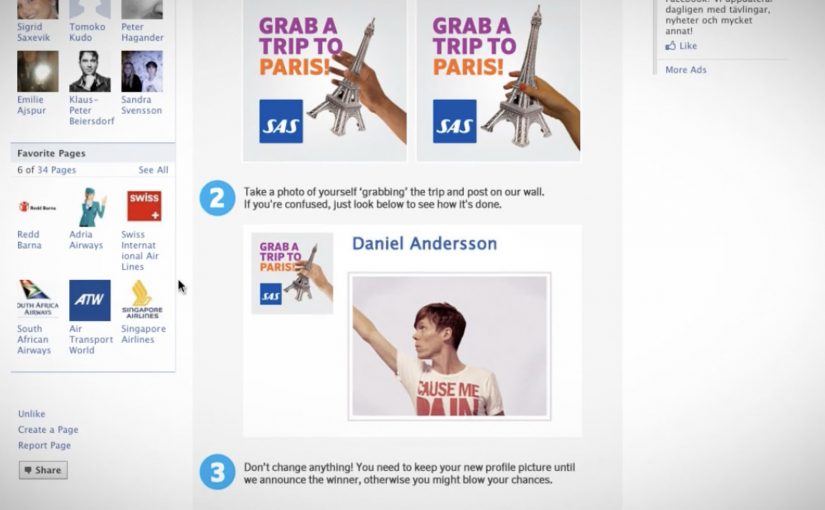
To promote a million-seat fare sale, Scandinavian Airlines (SAS) and Crispin Porter + Bogusky Stockholm ran a Facebook competition where fans could “grab” a free trip. The ask was visual and dead simple, and it turned participation into the media.

Fans changed their profile picture into a custom “Up For Grabs” image, then posted a matching photo on the SAS Facebook wall where they physically “grabbed” the trip. Every entry looked like an ad, and every ad looked like a friend.

The mechanic that turns fans into distribution

The campaign’s mechanism was a two-step loop. First, replace your profile image with a branded frame that signals you are “in”. Second, publish a playful photo on the brand wall that demonstrates the concept, grabbing the prize. That wall then becomes a live gallery of social proof, with each new post re-selling the fare sale in a more human way than a banner ever could.

In airline marketing, promotions that convert participation into shareable images can outperform price-only fare announcements.

Why it lands

It turns an abstract offer into a physical gesture. “Grab a trip” becomes something you can perform, photograph, and show. The profile-picture switch is a light commitment that broadcasts intent, and the wall post is a public performance that invites imitation. The momentum comes from visibility, because the more entries you see, the more “normal” it feels to join.

Extractable takeaway: When you need scale fast, design one participation artifact that doubles as an ad unit, and make the action easy enough that people will copy it without instructions.

What the shutdown reveals about the strategy

The campaign was reportedly against Facebook promotion terms, and it was shut down. That ending is part of the story, because it highlights the tightrope of social-first promotions. The creative is built on a behavior Facebook historically restricts for contest entry, asking people to publish specific content as a condition of participation, even if the idea is clever and the buzz is real.

The real question is whether the participation mechanic can spread the offer without depending on a platform behavior that can be switched off overnight.

The stronger strategic read is that the creative idea is right, but the distribution mechanic is too dependent on borrowed platform rules.

What to steal for your own launch

  • Make the entry format the message. If the entry itself demonstrates the offer, you get free repetition of the proposition.
  • Use a low-friction first step. Profile-picture frames and templates work because they are fast and socially legible.
  • Design a single visual trope. “Grabbing” is a trope anyone can reproduce, and that consistency creates a recognizable feed.
  • Build compliance in from day one. If the mechanic depends on prohibited platform behaviors, plan a compliant alternative before launch.

A few fast answers before you act

What is the core idea of Up for Grabs?

A Facebook contest where fans change their profile picture to a branded frame and post a “grabbing the trip” photo on the SAS wall to compete for a free flight.

Why does the profile-picture step matter?

It turns participation into persistent visibility. The frame signals “I am in”, and it spreads through everyday browsing without requiring an additional media buy.

What made the campaign travel beyond the SAS page?

Each entry was both participation and promotion. When fans changed their profile picture and posted a matching photo, the fare sale moved into personal networks instead of staying inside brand media.

Why was it shut down?

It was reportedly closed for violating Facebook promotion rules by conditioning entry on specific platform actions, such as posting photos on the wall.

How do you keep the upside without the platform risk?

Keep the visual template and the “grab” trope, but move the submission mechanic to a compliant entry flow, then allow optional sharing that is not required to participate.

KLM: Surprise

KLM launched a social media customer engagement idea that starts with a simple observation: waiting to board is boring, and “price messages” do not help anyone in that moment. So the brand looks for passengers who check in on Foursquare for flights or tweet about waiting to board a KLM service, then surprises a few of them to see how happiness spreads.

From check-in signal to gate-side surprise

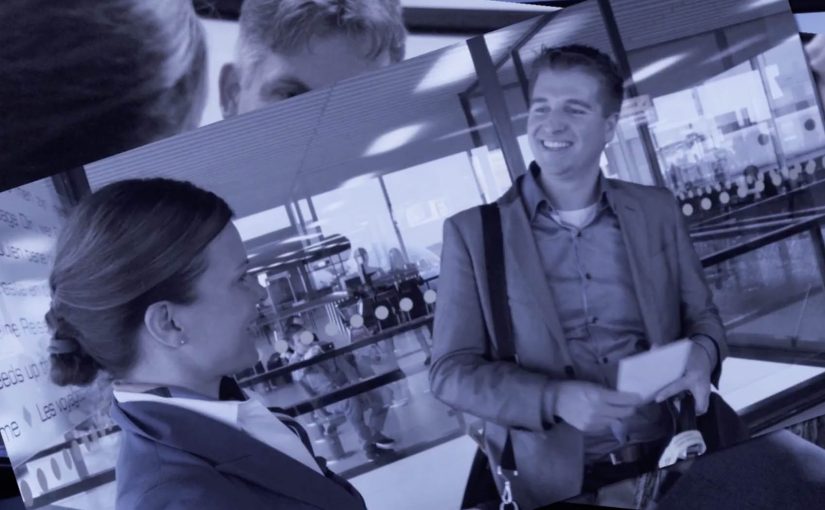
The mechanic is straightforward. Someone publicly signals they are flying KLM or waiting at the gate. The team selects a passenger, scans what that person has publicly shared across social profiles, and chooses a small, relevant gift. Then they hand-deliver it at the airport gates.

In airline customer experience, social signals can be converted into small, high-salience service moments that strengthen loyalty without changing the core product.

Why this beats generic “engagement”

Many brands greet customers after a check-in, and that is already a best practice on location platforms. KLM Surprise goes further because it moves from acknowledgement to action. Because the team delivers the surprise at the gate while the passenger is waiting, the gesture lands as relief, not advertising. The passenger gets something real, in real time, in the same physical context where frustration often accumulates.

Extractable takeaway: When you can act on an intent signal in the same moment and place it was expressed, the interaction reads as service and earns talk value without needing a big reward.

The real question is whether public intent signals can trigger timely, human service moments that customers will retell.

Brands should treat public social signals as service triggers, not engagement bait.

The personal touch is the product

The gift is intentionally small. The point is that it is specific. That specificity tells the passenger the brand paid attention, not that the brand spent money. It also turns the interaction into a shareable story because it feels improbable. Someone noticed me. Someone acted on it. Someone found me.

What the brand is really testing

Beyond the feel-good moment, this functions as a live experiment in social CRM: can public signals help identify passengers worth surprising, and can a human-scale intervention create disproportionate talk value? Here, “social CRM” means using public social signals to choose and personalize service actions for known customers. The campaign also quietly reframes “social media” as a service channel, not only a marketing channel.

Stealable moves from KLM Surprise

  • Trigger on clear intent signals. Check-ins and “waiting to board” posts are unambiguous moments where help or delight is welcome.
  • Keep the benefit small but specific. Relevance beats value. A perfect small gift travels further than a generic large one.
  • Deliver in the same context as the pain. Airport gates are where waiting is felt. That is why the gesture matters.
  • Make it operationally repeatable. A lightweight process and a small budget lets the idea run more than once without becoming theatre.

A few fast answers before you act

What is KLM Surprise in one line?

A real-time airport activation where KLM monitors public check-ins and tweets, selects passengers, then delivers small personalized gifts at the gate.

Why does it work better than simply replying on social?

Because it converts acknowledgement into action in the physical world, creating a stronger memory and a more shareable story.

Is the gift the main value?

No. The main value is the signal of attention and timing: “you were noticed” and “it happened right now when waiting felt longest”.

What is the transferable lesson for other brands?

Use public intent signals to trigger small, context-relevant service moments that are easy to repeat and easy for customers to retell.

What needs to be true to run this more than once?

A lightweight workflow for monitoring signals, selecting passengers, choosing small relevant gifts, and delivering them at the gate, plus a modest budget and clear staffing ownership.