
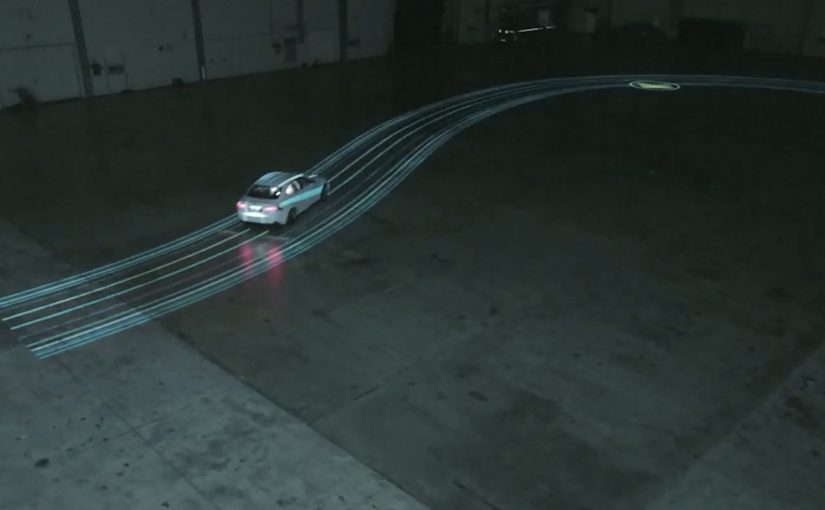
Lexus Trace Your Road: life-sized racing game

To promote its new high-performance hybrid car, Lexus, together with Saatchi & Saatchi Italy, creates “Trace Your Road”, an experiential event featuring Formula 1 driver Jarno Trulli.

Ten Lexus fans are selected from hundreds of applicants on Lexus’ Facebook page. Each winner rides in the passenger seat of the hybrid while Trulli drives, and the passenger “draws” the course on an iPad. That path is projected onto the floor of an aircraft hangar using special projectors, while a custom high-resolution infrared (IR) camera system tracks the car’s position in real time.

How the experience works

The format is a life-sized driving game with the audience literally designing the track. The event flow is built around three moving parts.

  • Live track creation. The passenger traces a route on the iPad, creating spontaneous turns, straights, and corners.
  • Real-world projection. The route appears at scale on the hangar floor, so the “racetrack” becomes a physical space.
  • Real-time tracking. An IR camera system follows the car so penalties and scoring can be applied accurately.

What makes it competitive, not just cinematic

Trulli’s driving is put to the test as he attempts to follow the improvised paths at speed. Penalty points are given when the car goes outside the projected route or touches the hangar walls. The goal is to hit seven selected touch points in the quickest time, and the fan with the best score wins.

In automotive launches and premium brand marketing, turning a test drive into a participatory game makes performance feel experienced, not explained.

The real question is whether your launch makes the product truth the win condition, not just the headline.

Why it lands: performance becomes legible

Hybrid performance can be hard to dramatize without slipping into numbers. Because the passenger-designed route and visible penalty rules force precision, control and handling become legible without a spec sheet, while the story stays human through the passenger’s real-time choices and Trulli’s visible skill.

Extractable takeaway: When you can turn a product claim into a rule set with visible penalties, the audience understands it instantly and the content becomes inherently shareable.

What Lexus proves with “Trace Your Road”

The brand is not only saying “this car performs”. It is staging a situation where performance is the only way to succeed. This is a stronger way to market performance than listing specs, because it forces the car to prove itself under constraints. The experience also rewards participation: winners influence the outcome, spectators understand the rules instantly, and the filmed content has a clear narrative arc.

Make the claim playable: launch moves worth copying

  • Let the audience shape the challenge. When participants create the rules in real time, attention spikes because outcomes are unpredictable.
  • Translate product claims into constraints. Handling, control, and precision become visible when the environment punishes mistakes.
  • Build a scoring model people can explain. Simple penalties and a clear finish condition make the story travel.
  • Use tech as infrastructure, not the headline. Projection and tracking matter most when they disappear into the experience.

A few fast answers before you act

What is Lexus “Trace Your Road”?

It is an experiential event where a passenger draws a racetrack on a tablet and the route is projected onto a hangar floor, while Jarno Trulli drives a Lexus hybrid along that path in real time.

How is the racetrack created and shown?

The passenger traces the course on an iPad, and the design is projected at scale onto the floor using multiple projectors so the track becomes a physical space to drive in.

How does the system know if the car stayed on the route?

A custom high-resolution IR camera tracking system monitors the car’s position against the projected route so penalties can be applied when it leaves the path.

What makes this more than a one-off stunt?

The format produces repeatable rounds, clear scoring, and a strong spectator story, which makes it easy to capture as a campaign film and behind-the-scenes content.

What is the main lesson for experience design?

Make the product truth the win condition. When success requires the product’s strengths, the message feels demonstrated rather than claimed.

Metro Trains Melbourne: Dumb Ways to Die

Accident rates on the Melbourne Metro were rising due to an increase in risky behavior around trains, and a rail safety message was the last thing people wanted to hear.

So McCann Melbourne turned the message people needed to hear into a message people wanted to hear, by embedding it into a song and an accompanying music video. Dumb Ways to Die.

Entertainment-first safety communication

The mechanism is a deliberate format swap. Replace shock tactics and lecturing with an original song, a playful animated world, and a chorus that makes the safety points memorable enough to repeat.

In large urban public-transport systems, the most effective safety communication often feels like entertainment first, with the message carried by repetition and recall rather than warning language.

Why it lands

It works because it respects audience resistance instead of fighting it. The real question is how you make a safety message travel when the audience does not want to hear a safety message at all. For resistant audiences, entertainment-first is the stronger safety strategy because it earns voluntary attention before it asks for behavior change. People who tune out safety ads will still watch and share a catchy video, and the refrain makes the cautionary points stick through rhythm and humor. The legacy write-up reports that the campaign quickly moved beyond advertising into social currency, with very high sharing in its first month.

Extractable takeaway: When your audience actively avoids the topic, make the format shareable enough that people choose to spread it for the entertainment value, then let repetition do the behavior-change work.

The proof of spread

By using entertainment rather than shock tactics, the message is described as transcending advertising to become something people shared. Here is the case video.

What safety communicators can borrow

  • Start with a format people opt into. If attention is the barrier, do not begin with a PSA tone.
  • Write for recall. A chorus and simple phrasing can outperform “important information” copy.
  • Build a visual system. Distinct characters and repeatable scenes make the idea remixable and memorable.
  • Package the case story separately. A dedicated case video helps the idea travel in marketing circles without diluting the original film.

A few fast answers before you act

What is Dumb Ways to Die?

A rail-safety campaign for Metro Trains Melbourne that delivers the safety message through a catchy song and animated music video instead of traditional PSA warnings.

Why use humor for a serious safety topic?

Because the target audience resists conventional safety messaging. A humorous, musical format earns voluntary attention and repeat viewing, which increases recall.

What made it spread so widely?

A simple hook, a memorable chorus, and highly shareable animation that people could pass along as entertainment, with the safety message embedded inside.

What is the case video for?

It explains the strategy and rollout behind the campaign, and it packages results and rationale for marketers and stakeholders.

What is the main risk with “entertainment-first” safety work?

If the humor overwhelms the behavioral point, the audience remembers the joke but not the safety action you want them to change.

Molson Canadian: The Beer Fridge

First various brands created campaigns with red buttons, then came one with a pink phone, and now Molson, a Canadian beer brand, revolves a whole campaign around bright red refrigerators.

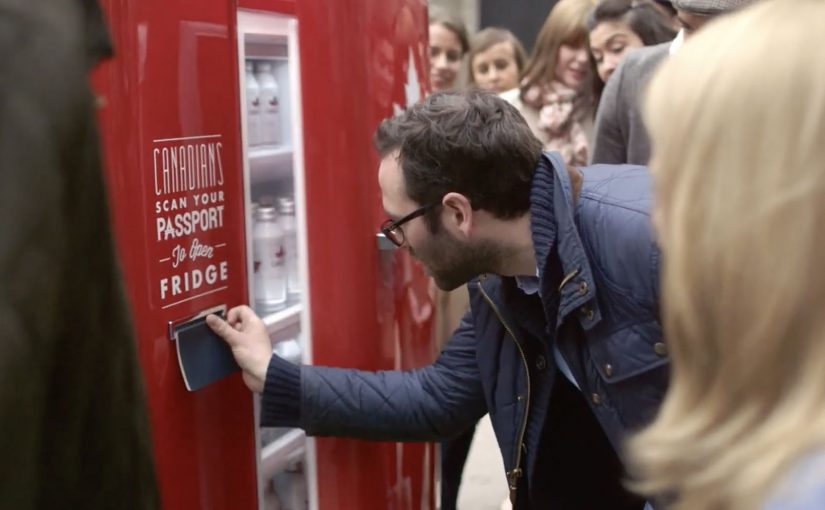
These eye-catching fridges were filled with Molson Canadian beer and strategically placed across a variety of European locations to attract crowds. The catch is simple. The fridge can be opened only by scanning a Canadian passport.

The campaign was created by Rethink Canada to bring back the classic tagline, “I Am Canadian.” The footage collected from the different locations was then cut into a longer online film and a shorter TV ad, described as running during the Stanley Cup Finals.

A gate that turns identity into a moment

The mechanism is a physical “access rule” everyone understands. Here, the access rule is simple: only a scanned Canadian passport opens the fridge. A fridge full of free beer is a magnet. The passport scan turns that magnet into a social filter, because the only way anyone drinks is if a Canadian is present and willing to open it. In one move, the crowd goes from spectators to collaborators.

In multinational brand building, national identity can easily become abstract. This makes it concrete in public, in seconds, with a prop people instinctively gather around.

Why it lands

It works because the restriction creates a mini-drama with a friendly payoff. People try. People fail. Then the “right” person arrives, the door opens, and the whole crowd benefits. The brand gets an emotional signature without needing to over-explain heritage, or wave flags on screen.

Extractable takeaway: If you want a brand idea to travel, design a simple rule that forces strangers to interact. Make the rule easy to understand, visibly enforced, and rewarding for everyone, not only the “qualified” participant.

What Molson is really reviving

The fridge is the stunt, but the strategic job is memory refresh. “I Am Canadian” is not a new line. The activation re-earns the right to say it by staging a situation where being Canadian is the key that unlocks a shared experience.

The real question is whether a legacy national tagline can earn fresh relevance without sounding like a rerun. Molson gets this right because the stunt turns identity from a slogan into a shared public reward.

What brand teams can take from it

  • Use a physical object as a social trigger. Fridges, doors, vending machines, and switches pull people in because they promise an outcome.
  • Let the rule do the storytelling. One constraint can communicate positioning faster than a paragraph of copy.
  • Make the payoff collective. If only one person wins, the crowd turns cynical. If everyone wins, the crowd turns into distribution.
  • Film what the rule creates. The best “campaign video” is documentation of real behavior the mechanic generates.

A few fast answers before you act

What is Molson Canadian’s “Beer Fridge” campaign?

It is an activation built around bright red fridges placed in public locations. The fridge opens only when a Canadian passport is scanned, turning identity into the key that unlocks free beer.

Why require a Canadian passport?

The passport requirement creates instant tension and a clear story. It forces a social moment where Canadians become the enablers, and everyone around them shares the reward.

What does this have to do with “I Am Canadian”?

The mechanic makes “Canadian-ness” functional rather than symbolic. The tagline lands as a conclusion the crowd just witnessed, not a claim the ad simply states.

Why place the fridges in Europe?

Because it creates contrast and visibility. A Canadian-only key in a non-Canadian setting produces curiosity, crowds, and a stronger “identity unlocks access” narrative.

How can another brand apply this pattern?

Choose one brand truth, translate it into an access rule, and attach a collective payoff. Then design the experience so the resulting human interactions are worth filming.