KitKat: The Slooowest Vending Machine

I have covered dozens of unique vending machines over the years. The last one was as far back as 2018, when Ford used a car vending machine in Guangzhou, China. Now fast forward to 2026 and KitKat has successfully reimagined waiting time at a regular vending machine into the brand experience itself.

When a break brand faces a speed problem

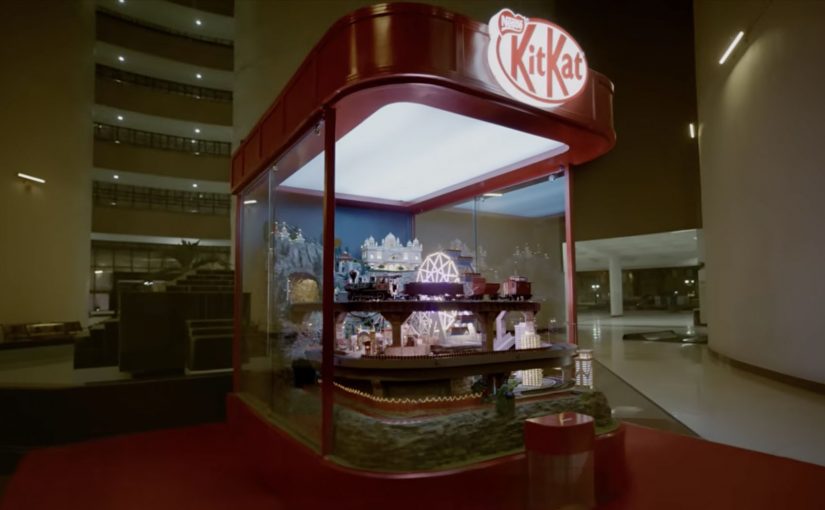
KitKat’s reported premise is simple. In a culture of compressed attention, even the break is getting shortened. So the brand in Hyderabad, India took one of the most convenience-coded retail objects possible, a vending machine, and used it to restage “Have a Break” as something you feel, not just something you read. The activation was developed by VML India and VML Netherlands and brought to life with Delhi-based production house The Other Half.

That setup matters because vending machines normally stand for speed, utility, and instant gratification. KitKat flipped that expectation on purpose. Instead of using the machine to remove waiting, it used the machine to make waiting visible, memorable, and unmistakably on-brand.

How KitKat turned waiting into the product demo

Instead of dropping a bar in seconds, the transparent machine sends it through a miniature sequence inspired by everyday Indian life, including a toy train, a Ferris wheel, a truck ride, a river journey, and a festive procession. Reported timings make the contrast do real work. A normal vending machine interaction is framed at about three seconds. This one stretches the moment to around three minutes.

That matters more because the machine sat inside one of Hyderabad’s busiest commercial hubs, where speed is the default behavior and pausing is the unusual act.

The mechanism works because the extra time is not dead time. It is branded time, which turns delay into attention and makes the promise of a break tangible before the product is even consumed.

The smart part is that the machine does not merely slow the transaction. It choreographs the delay. That is why the pause feels closer to a scenic reward than a service failure.

Why the stunt lands harder than a normal activation

This is the rare activation where added friction strengthens the brand instead of weakening it.

KitKat wins here by using deliberate friction. Deliberate friction is an intentional pause or extra step added to an experience so the brand can increase attention, memory, or meaning instead of just reducing effort.

Most friction in customer experience is accidental and expensive. It comes from broken UX, poor orchestration, slow service, or unclear process. KitKat does the reverse. The pause is visibly intentional, visibly crafted, and tightly linked to a long-established brand promise, which is why reported reactions centered on watching, smiling, lingering, and sharing instead of irritation.

There is also a crowd mechanic at work here. The machine is slow enough to create curiosity, visual enough to hold attention, and simple enough for bystanders to understand within seconds. That combination turns one person’s purchase into a shared piece of theatre.

Where the business value actually sits

The enterprise lesson is not that brands should slow down checkout, navigation, or service recovery. The real question is where speed is hygiene and where tempo is part of the value exchange.

For consumer experience platforms and MarTech teams, that translates into a cleaner operating rule. Keep utility moments brutally fast, such as search, payment, account access, and complaint handling. But in moments tied to ritual, reveal, education, reward, sampling, or branded storytelling, controlled pacing can sometimes do more commercial work than raw speed because it increases attention, recall, and distinctiveness.

The business intent here is not transaction efficiency. It is brand encoding. KitKat is defending a recognizable promise in a category where faster is easy to copy, but a meaningful pause is harder to own.

That is the part many teams miss. Brand platforms do not become durable because they are repeated in copy. They become durable when the operating design of the experience makes the promise physically true.

How deliberate friction can strengthen a break brand

Deliberate friction only works when three conditions hold. The pause must express the brand idea, the consumer must understand why it exists, and the wait must be short enough and crafted well enough to feel rewarding rather than defective. Break any one of those rules and the same device becomes irritation, not experience design.

Add friction only when it makes the promise more tangible than speed would. If the delay is not visibly on-brand, clearly signposted, and tightly controlled, it is not experience design but bad service.


A few fast answers before you act

What is KitKat’s Slooowest Vending Machine?

It is a reported experiential installation in Hyderabad that turns a snack vending machine into a three-minute miniature journey, so the wait itself becomes the break.

Why does the idea work?

It works because the delay is visibly intentional and tightly tied to KitKat’s break positioning, so the pause feels like the product experience rather than a machine malfunction.

What is the operator lesson?

Speed is not the only KPI. In selected touchpoints, controlled pacing can increase attention, memory, and brand fit more effectively than pure efficiency.

Where should brands not copy this?

Do not add friction to utility-heavy moments like payment, login, navigation, or complaint handling, where speed and clarity are the promise.

What should CX and MarTech teams measure if they test a similar move?

Measure dwell time, completion rate, abandonment, recall, sharing, and whether the experience strengthened the brand association you intended to encode.

Škoda & Citroën: Fixing Mobility Friction

The journey is now part of the product

This is not the first time a car brand has moved into adjacent safety or wellbeing territory.

What makes these two examples stronger is that they do not feel random. Škoda and Citroën are both dealing with small but consequential failures around the trip itself, not trying to invent a new category for the sake of it. That is a more credible stretch because the problem sits close to how the brand is already experienced.

What Škoda and Citroën are really addressing is mobility friction. Mobility friction is the small but consequential failure around a journey that changes safety, comfort, or control without changing the vehicle itself.

One brand is tackling external awareness around cyclists and pedestrians. The other is tackling in-car stress for pets. Different use cases, same underlying move. Both are extending the brand promise into the part of the journey where the consumer actually feels the problem.

Škoda and the new urban safety gap

Škoda starts with a simple failure. Standard bike bells are easier to miss when pedestrians are wearing active noise-cancelling headphones, or ANC, so the company worked with the University of Salford to identify a narrow 750 to 780 Hz band that cuts through ANC more effectively and built DuoBell around that finding. Škoda says the product also uses a second resonator and an irregular strike pattern to make the alert harder for ANC systems to suppress.

That line of thinking fits a brand whose history began with bicycles and that still maintains a visible connection to cycling today.

This lands because the fix is practical, easy to explain, and directly tied to a real safety failure on the street.

Škoda also has the stronger proof layer here. The idea is backed by publicly available Salford research, and Škoda reports that testing showed pedestrians wearing ANC headphones gained up to 22 metres of additional reaction distance when DuoBell was activated.

This is the right kind of adjacent product move for an automotive brand.

Citroën and comfort beyond human passengers

Citroën starts from a different failure. For many pets, the car is not a neutral space. It is a stressful one. The Calm Diffuser is designed to release calming pheromones during the journey so the ride feels less anxious for dogs and cats. Citroën frames the device as an extension of its comfort promise to everyone on board, including pets.

That is why the idea works. Citroën is not leaving its lane here. It is widening a promise it already owns.

The brand logic matters more than the object itself. Citroën has long tried to make comfort a differentiator, and Calm Diffuser extends that positioning from human occupants to pet occupants. That is a small move on paper, but it reflects a larger shift in how consumers define who the journey is for.

What enterprise teams should notice

The real question is whether the brand is removing a journey failure consumers already feel, in a way that fits a promise it already owns.

That is not just a creative decision. It is an operating model decision. Teams need to know where friction shows up, which audience feels it most, which brand promise gives permission to act, and whether the answer belongs in product, service, content, partnership, or commerce. That is where consumer experience platforms and MarTech matter, because they help surface repeated friction, validate demand, segment relevance, and scale the explanation layer across touchpoints instead of treating each move as a one-off stunt.

The commercial upside is bigger than the product itself. The stronger capability is learning how to identify adjacent consumer problems early, prove that they matter, and translate brand promise into something operational and useful.

What mobility brands should take from this

The lesson is not that every automotive brand now needs a side product. The lesson is that adjacent innovation works when it removes a nearby failure in the journey, reinforces an existing promise, and can be supported across owned touchpoints, retail, CRM, and service.

The takeaway is clear. The brands that win these moves will not be the ones that look most inventive. They will be the ones that make the journey measurably safer, calmer, or easier in ways the business can actually support.


A few fast answers before you act

What is Škoda DuoBell?

Škoda DuoBell is a bicycle bell designed to be more detectable to pedestrians wearing ANC headphones. Škoda developed it with the University of Salford to respond to rising cyclist and pedestrian risk in dense urban settings.

What makes DuoBell different from a normal bike bell?

Škoda says DuoBell was tuned around a 750 to 780 Hz band that can cut through ANC more effectively than a conventional bell, with additional sound design choices to improve detectability.

What is Citroën Calm Diffuser?

Calm Diffuser is Citroën’s in-car device designed to release calming pheromones for pets during travel. Citroën presents it as a way to make journeys more comfortable for all passengers, including pets.

Why does Calm Diffuser fit Citroën so well?

It fits because Citroën has long treated comfort as a core brand promise. Calm Diffuser extends that promise from human occupants to pet occupants without feeling forced.

Why do these two launches matter beyond novelty?

They matter because they show a more disciplined way to extend a brand. Instead of chasing spectacle, both ideas target a specific friction point around the journey and connect the solution back to a promise the brand already owns.

6 Best Campaigns: Clarity Wins in March

When brand logic becomes visible

Across Burger King, Aerie, Yahoo Mail, Hotels.com, Huggies, and Cheetos, the work does not resolve into one dominant style. What it does share is something more useful. Each campaign makes the underlying brand logic easier to grasp without needing the case-study explanation afterward.

Brand logic is the commercial rule that links what a brand says, what it does, and why the audience should care. The strongest work this month makes that rule visible early, which matters because a legible mechanism improves comprehension, speeds recall, and gives the campaign a better chance of carrying business intent instead of just generating surface attention.

For enterprise brand teams, that is not a creative nuance but an operating advantage, because clearer strategy survives translation across agencies, channels, retail partners, and internal stakeholders.

It also travels better across consumer experience platforms and MarTech systems, where the strategy has to remain legible through content, CRM, personalization, commerce, and media execution.

The strongest campaigns now win by making strategy legible before they try to make execution louder.

The real question is whether people can decode the commercial intent fast enough for the work to compound in culture instead of stalling as cleverness.

Six campaigns that made strategy easier to see

Burger King: There’s a New King, and It’s You

Burger King turns turnaround work into the campaign itself. Burger King U.S. and Canada president Tom Curtis helps anchor the message, and the brand shifts the crown from the mascot to the guest, ties the story to years of restaurant modernization, operational improvement, and feedback loops, and makes the listening agenda visible instead of hiding it behind generic brand language. That is why the work lands. It turns brand repair into a public narrative people can understand immediately.

Aerie: 100% Aerie Real

Aerie does not use AI as a trend hook. It uses Pamela Anderson to reinforce a policy-backed position that the brand will not use AI-generated bodies or people in marketing, extending its broader authenticity stance. The important move here is operational, not cosmetic. A cultural tension becomes a codified boundary, and that makes the brand stance more credible than a one-off message about authenticity.

Yahoo Mail: Planner

Yahoo Mail gives its AI feature a human entry point. In Yahoo’s launch framing, Planner is an AI-powered personal productivity hub, and rapper Cardi B introduces “FOMSI,” or fear of missing something important, as the tension the feature resolves. That is the smart translation layer. The product is not positioned as abstract intelligence. It is positioned as relief from inbox anxiety.

Hotels.com: It’s All in the Name

Hotels.com strips the proposition down to literal truth. In its new brand platform, the company argues that plenty of things in life are misleading, but its own name is not, and pairs that with a refreshed visual identity and a promise around rewards, simplicity, and flexibility. The discipline here is the point. The brand does not add complexity to seem more interesting. It removes abstraction so the value proposition is easier to decode and remember.

Huggies: Expensive Sh*t

Huggies takes a functional claim and stages it as risky entertainment. The one-hour event put 18 babies in Huggies Little Snugglers on high-value luxury items, streamed the result across TikTok Live, Instagram Live, and YouTube Live, and turned blowout protection into proof people would actually watch. That is what elevates it. The demonstration is not just believable. It is designed for distribution.

Cheetos: Pickle’s Back

Cheetos relaunches Flamin’ Hot Dill Pickle by packaging the return as entertainment first and product news second. The official music video pairs Megan Thee Stallion with Nickelback and turns a flavor comeback into a cultural moment rather than a standard limited-time announcement. That is the lesson. Launch mechanics matter more when the format feels native to how people already consume and share attention.

What brand teams should take from March’s best work

The common move across all six examples is not louder storytelling. It is clearer exposure of the mechanism.

  • Burger King makes operational change visible.
  • Aerie makes the authenticity rule visible.
  • Yahoo makes the AI utility visible.
  • Hotels.com makes the product proposition visible.
  • Huggies makes the product performance visible.
  • Cheetos makes the launch format visible.

The best campaigns of March 2026 did not win by saying more. They won by making the strategy easier to see, easier to feel, and easier to repeat.


A few fast answers before you act

What defined the strongest campaigns in March 2026?

The strongest work made the commercial idea immediately legible. Instead of asking the audience to infer the strategy, the campaigns surfaced it through proof, policy, simplicity, or entertainment.

How are brands using AI differently in campaigns?

The better use cases split in two directions. Some brands, like Yahoo Mail, frame AI as practical relief for a real problem. Others, like Aerie, turn their refusal to use AI in customer-facing imagery into a differentiating brand stance.

Why is clarity becoming a competitive advantage in advertising?

Clarity lowers decoding effort. When people understand the mechanism quickly, recall improves, the message travels faster, and the campaign is more likely to carry commercial intent instead of being remembered only for style.

What role does product demonstration play now?

Product demonstration still works, but it works harder when it is engineered for attention, social circulation, and emotional payoff, not when it stays trapped in a conventional feature explanation. Huggies is the clearest example this month.

What is changing in how brands launch products?

More launches are being wrapped in formats people actively choose to watch, including music video logic, creator energy, or entertainment structures. Cheetos shows how a product return can behave more like culture than an announcement.