
Quilmes: Mitigol

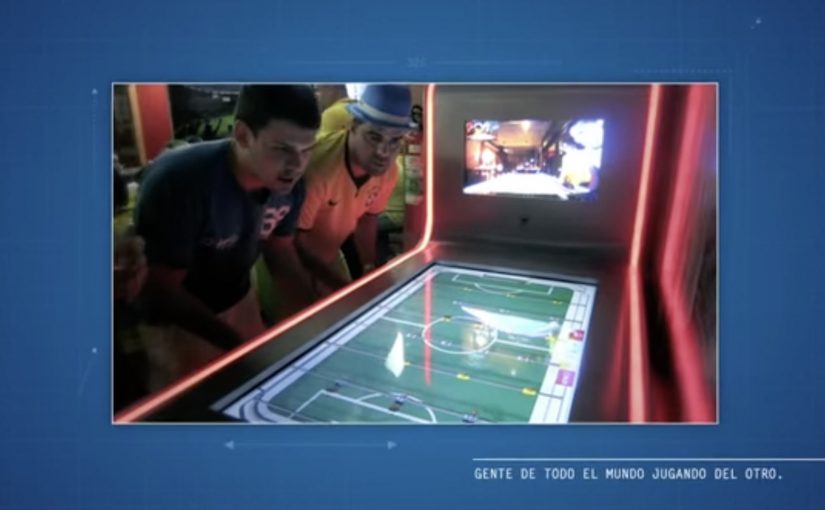
Quilmes and their agency +Castro reinvented the classic game of foosball. In its new version they enabled Argentinians and Brazilians to play each other in real time through a custom made digital foosball table.

Dubbed “Mitigol”, the activation turns foosball into a cross-border live match. One half of the table was placed in Argentina and the other half in Brazil. During the game, players could see their opponent via special in-built video cameras that further enhanced the real time experience of the game. As a prize, Quilmes gave away free beer.

How Mitigol works

The mechanism is a physical game with a digital bridge. A custom table syncs the ball and player movement across distance, while embedded cameras add face-to-face presence so it feels like a real match rather than a remote demo.

In sports and event-led marketing, shared-play installations can turn rivalry into participation because they give fans something to do together, not just something to watch.

Why it lands

This works because it makes a national rivalry tangible without needing a screen-first experience. Foosball already has competitive tension built in, so the cross-border connection raises the stakes instantly. The cameras then do the emotional work by proving the opponent is real, right now, reacting in real time.

Extractable takeaway: When you want “real time” to feel meaningful, do not rely on the word. Add one physical interaction that people already understand, then layer in live presence so the distance becomes the headline.

What Quilmes is really buying

The real question is how to turn passive rivalry into a shared act people want to join.

Beyond novelty, Mitigol is a closeness story. It borrows the energy of an event moment and converts it into a branded experience where the fan is the performer, not the spectator. The prize is just the nudge that keeps the line moving and the competition sharp.

What to steal from Mitigol

  • Start with a familiar game. If the rules are known, participation spikes.
  • Make distance visible. The split-table concept is the idea. Do not hide it.
  • Add live presence. Cameras or live feedback make “remote” feel human.
  • Reward the behavior you want. Small, immediate prizes keep throughput high.

A few fast answers before you act

What is Mitigol?

It is a custom foosball table experience that connects two locations so players in different countries can play the same match in real time.

Why split the table across Argentina and Brazil?

Because the physical split makes the cross-border rivalry concrete. It is instantly legible as “we are playing each other right now”.

What role do the built-in cameras play?

They add live presence and reaction, which makes the experience feel like a real opponent rather than a remote simulation.

What is the simplest way to copy the principle?

Take a familiar physical activity, connect it across distance with tight synchronization, then add a live human layer so the interaction feels personal.

What should you measure for an activation like this?

Participation volume, repeat play, dwell time, and how often spectators convert into players once they see it in action.
Castello: Eat the Art

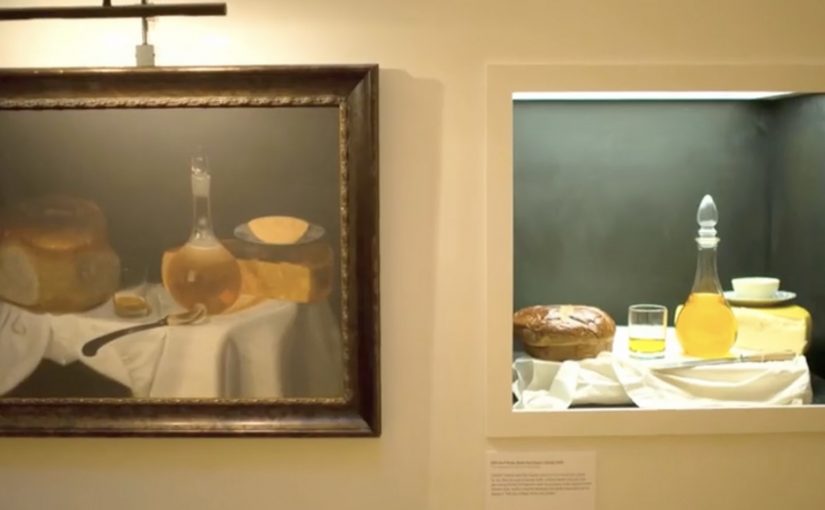
Cheese brand Castello teams up with ad agency Duval Guillaume to give New Yorkers the opportunity to taste their cheese in a very original way. A pop-up museum is set up at Grand Central Terminal, where famous still-life paintings that contain cheese are reproduced with great precision using real Castello cheeses. The difference is simple. You can smell and eat the copied works of art.

Over the course of two days, more than 500,000 visitors reportedly pass through the exhibition, and around 40,000 people actually taste the cheese.

Turning “look” into “taste”

The mechanism is sensory sampling disguised as culture. Borrow the credibility of recognizable art, rebuild it with the product itself, then let the audience complete the experience by tasting the thing they are looking at.

In urban retail environments where people are overloaded with visual messages, multisensory experiences create disproportionate stopping power because they feel like a break from advertising, not another ad unit.

Why it lands

This works because it turns product trial into a story people want to repeat. A free sample is forgettable. “I ate a painting made of cheese at Grand Central” is social currency, which means it is a simple story people want to pass on. It gives the brand an earned reason to be talked about without needing heavy branding on every surface.

Extractable takeaway: If your category wins on taste, do not hide behind claims. Build a public moment where trying the product feels like participating in something bigger than a sample.

What the business intent looks like

The real question is how to turn food sampling into a public moment people actively choose and then talk about. Castello gets scale and relevance in one move. Grand Central delivers footfall. The art framing delivers permission to pause. And the tasting converts attention into the only proof that matters for food. “It is good”. This is a stronger food-marketing move than standard sampling because it makes trial memorable.

What food brands can steal from this

  • Wrap sampling in a reason to stop. People do not queue for “try this”. They queue for a moment.
  • Use a familiar cultural code. Still-life paintings are instantly legible, even at walking speed.
  • Let the product be the medium. When the product is literally the artwork, the message cannot be missed.
  • Design for retellability. If the experience can be summarized in one sentence, it travels further.

A few fast answers before you act

What is Castello “Eat the Art”?

It is a pop-up museum experience where still-life paintings featuring cheese are recreated using real Castello cheeses, and visitors can smell and taste the “art”.

Why stage it in Grand Central Terminal?

Because high footfall increases reach, and a transit setting makes the surprise feel bigger. You find a museum moment in the middle of a commute.

Is this advertising or sampling?

It is sampling, delivered through an ambient, cultural format that makes the trial feel special rather than transactional.

What makes the concept effective for food brands?

It converts attention into taste. Food marketing becomes more persuasive when it gets people to try the product quickly, in a memorable context.

What is the simplest way to adapt the pattern?

Pick a familiar cultural frame your audience already respects, then embed product trial directly into that frame so trying the product feels like participation.

Hellmann’s: Recitweet

In the past, Hellmann’s has used novel ways to encourage consumers to use their mayonnaise for more than just sandwiches. Now, for their latest campaign, they team up with Ogilvy Brazil to create Recitweet.

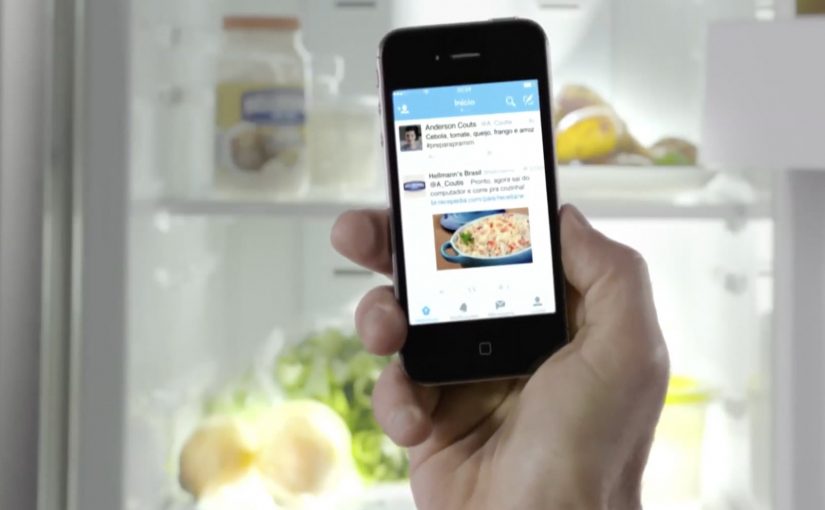
The use case is instantly familiar. You open the fridge, you see ingredients, and you still do not know what to cook. With Recitweet, consumers tweet their ingredients with the hashtag #PreparaPraMim (“prepare for me” in Portuguese). Hellmann’s replies with a recipe that is designed to use those exact ingredients.

A recipe engine built on a social reply

The mechanism is ingredient matching through a public tweet. The input is a short list of what you have at home. The output is a tailored recipe suggestion delivered back as a tweet reply, so the brand behaves like a lightweight cooking helper rather than a broadcaster.

In FMCG food brands, this utility-led social pattern turns content into a small service that appears at the exact moment the consumer is stuck.

The real question is: can a food brand reliably remove the “what should I cook” hurdle in the channel where people already ask for help. When you can answer fast and specifically, the helper role beats another round of broadcast recipes.

Why it lands

It respects the consumer’s real problem. “I have food, I lack an idea.” The campaign does not start with a product claim. It starts with a decision obstacle, then uses the brand to remove it. That makes the engagement feel earned, because the interaction produces something usable in the next 30 minutes.

Extractable takeaway: If your product is an ingredient, win by solving the “what do I do with what I already have” question. Make the brand the shortest path from inventory to action, using the channel where the consumer already asks for help.

Stealable moves for social utility

  • Constrain the input. A short list of ingredients forces clarity and makes the interaction easy to start.
  • Return a specific next step. A recipe beats a generic tip, because it includes implied quantities, sequence, and outcome.
  • Make the service feel personal, at scale. The reply is the moment of value. Treat it like customer service, not advertising copy.
  • Design for repeat behavior. The best activations are not one-off stunts. They create a habit loop people can use again the next time the fridge looks random.

A few fast answers before you act

What is Recitweet in one sentence?

Recitweet is a Twitter-based recipe helper that takes a list of tweeted ingredients and replies with a recipe designed to use them.

Why use a hashtag like #PreparaPraMim?

It standardizes the request so the brand can find, process, and respond to it consistently, while keeping participation friction low.

What makes this more effective than posting recipes on a website?

It is contextual and initiated by the consumer. The recipe arrives when the person is actively deciding what to cook, using what they say they have.

What is the minimum viable version of this idea?

A constrained ingredient input and a fast, specific reply that gives one clear next step, without forcing the consumer to leave the channel to “go search.”

What is the biggest operational risk?

Response quality and response time. If replies are slow, irrelevant, or repetitive, the “service” framing collapses and it starts to feel like a gimmick.