
Coca-Cola Live Tweets #LetsEatTogether

Coca-Cola Live Tweets #LetsEatTogether

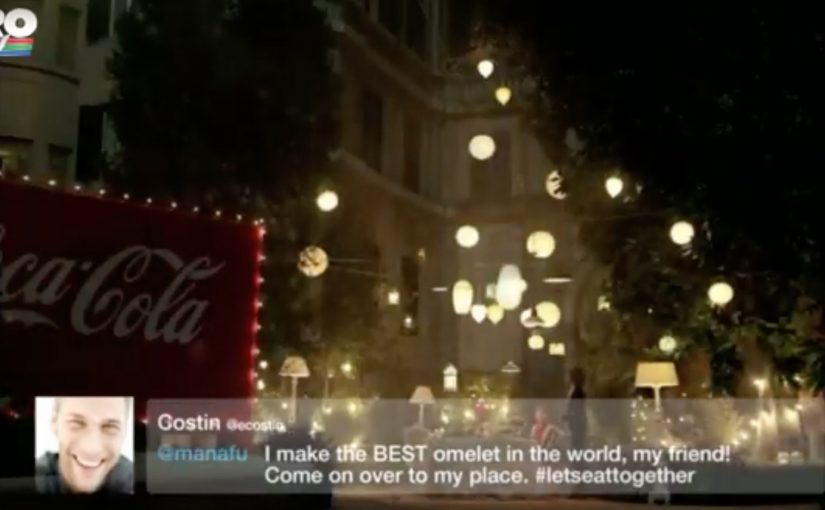
Coca-Cola in Romania seems to have broken new ground in the country with its integration between Twitter and TV, as it included live consumer tweets during its ad.

The insight for the campaign came from the fact that in Romania 60% of people don’t eat meals together, but instead eat them alone while sitting in front of their TV. So Coca-Cola decided to use tweets to create open invitations for people to actually come together and have a meal with a Coke.

As shown in the video below, the TV ad included a subtitle bar that was used to run the tweets that consumers sent using the hashtag #LetsEatTogether. Coca-Cola’s ad agency, MRM Worldwide, then edited the tweets and inserted five to seven of them into each ad placement.

The campaign increased Coke’s Twitter followers in Romania by 15% as hundreds of tweets were aired on TV. The campaign even made it to the evening news as its uniqueness made Romanians wait everyday for the ad.

Why this Twitter plus TV integration worked

The execution is simple. It borrows the visual language of TV subtitles, then uses it for social proof, meaning viewers can see other people already taking part. Viewers see real people inviting others to eat together, in real time, inside the ad break itself. That makes the message feel less like a brand instruction and more like a public invitation.

Extractable takeaway: When you make audience participation visible inside the main media placement, the campaign can feel more social, more immediate, and more worth watching.

It also turns participation into a lightweight ritual. Tweet the hashtag. Watch for your message. Share the moment when it appears. The format gives people a reason to keep an eye out for the ad, which is the opposite of what usually happens during commercials.

The real question is not whether people can respond to a campaign, but whether that response is visible enough to change how the ad itself feels.

In mass-reach brand advertising, this matters because the primary screen can carry participation directly instead of pushing interaction off to a second screen.

What Coca-Cola was really buying here

This is a smart cross-media play because it does more than collect engagement. It upgrades a standard TV placement into something people anticipate, talk about, and actively watch for.

The business intent is clear. Coca-Cola is using participation to make the ad break itself feel more alive, increase repeat viewing, and turn audience response into earned attention for the brand.

What to steal if you design campaigns with live participation

  • Use a single, explicit mechanic. One hashtag, one behavior, one clear outcome.
  • Make the audience visible inside the media. The tweets are not a second screen. They are on the primary screen.
  • Curate without killing authenticity. Editing keeps it brand-safe while still feeling consumer-led.
  • Reward repeat viewing. New tweets each placement create a reason to watch again.

A few fast answers before you act

What did Coca-Cola Romania do in this campaign?

They integrated live consumer tweets into a TV ad by running curated hashtag messages in a subtitle bar during the commercial.

What was the insight behind #LetsEatTogether?

That many people in Romania ate alone in front of the TV, so the campaign used tweets as open invitations to share meals together.

How were tweets handled for broadcast?

Tweets using #LetsEatTogether were edited and five to seven were inserted into each ad placement by the agency.

What changed in performance?

Coke’s Twitter followers in Romania increased by 15% and hundreds of tweets were aired on TV.

What is the core lesson for cross-media experiences?

If you bring live participation into the primary screen, you can turn an ad break into an event people actively watch for.
Cheetos Mix-Ups: Cheetahpult Dual-Screen Game

Cheetos Mix-Ups: Cheetahpult Dual-Screen Game

In March I had written about how Google had inspired developers to convert mobile phones and tablets into remote controls for desktop browsers via a simple mobile URL. Now Cheetos, an American brand of cheese-flavored puffed cornmeal snacks, has successfully tapped this technology to engage with viewers as they watch a regular TV commercial on YouTube.

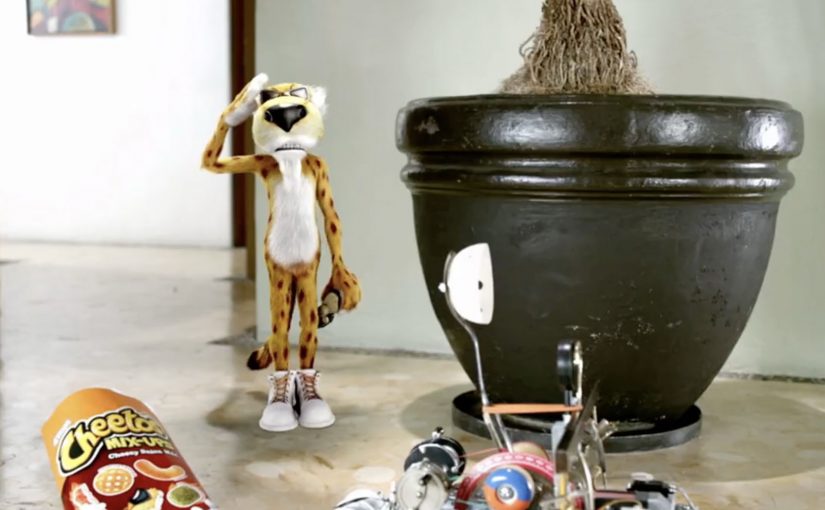
Viewers watching the Cheetos Mix-Ups ad on YouTube get a dual-screen experience. They can fling the new Cheetos Mix-Ups snacks from their phone into a video playing on their desktop. The campaign creates a new way to engage with the ad, and to get to know the product’s new shapes and colors through play.

At this point, the video is reported to have reached 8.5 million views on YouTube. People who played the game are reported to have stayed for an average of 7 minutes and 17 seconds, and flung an average of 56 Cheetos per game.

A YouTube ad that behaves like a game

The trick is simple and surprisingly scalable. Your desktop stays on YouTube, playing the film. Your phone becomes the controller via a lightweight URL experience, so interaction happens in your hand while the “world” of the ad stays on the big screen.

How the dual-screen catapult works

Instead of treating the mobile device as a companion banner, the experience treats it as an input device. You aim, fling, and see the result immediately in the desktop video frame, which turns passive viewing into a loop of action, feedback, and repeat.

In global FMCG launches, second-screen interactivity works best when it turns product attributes into gameplay, and makes “learning the product” feel like time well spent.

Why this lands while people are “just watching YouTube”

It hijacks a familiar behavior. People already watch ads on desktop while their phone is in hand. Cheetahpult converts that split attention into viewer control, and uses physics and repetition to teach what Mix-Ups actually is, in a way a standard product shot cannot. The real question is whether the interaction helps people understand Mix-Ups faster than a normal product shot would. In this case, it does, because the mechanic turns product variety into something people learn by doing.

Extractable takeaway: If your product is hard to describe in one sentence, let people handle it. Build a micro-game where the mechanic is the product benefit, and the reward is comprehension.

What Cheetos is really buying here

This is product education disguised as entertainment. The intent is to turn a new SKU with multiple shapes and flavors into something memorable, then associate that memory with the brand, so the next shelf moment feels familiar.

What Cheetos teaches about interactive video

  • Design for the device people already hold. Dual-screen works when the phone is the controller, not an afterthought.
  • Make the mechanic teach the product. If the game can be reskinned for any brand, it is not specific enough.
  • Keep the loop short and replayable. Fast rounds create “just one more try” behavior, which is where learning happens.
  • Use the main video as the stage. The desktop frame should feel like the real world, and the phone should feel like the tool.

A few fast answers before you act

What is Cheetahpult?

Cheetahpult is a dual-screen YouTube experience that turns a Cheetos Mix-Ups video into a simple physics-style game, with the phone acting as the controller and the desktop video acting as the playfield.

Why does second-screen interaction help an ad?

It converts passive reach into active time. When people interact, they process product details more deeply, and the ad becomes something they did, not just something they saw.

What makes this different from a typical “interactive ad”?

The interaction is not layered on top as buttons. The phone becomes a controller, and the main video becomes the environment, so the ad and the game feel like one system.

When should a brand use this pattern?

When a launch needs fast product education, and when the product has attributes that benefit from repetition, variation, and play, like shapes, combinations, flavors, or configurations.

What should a brand avoid when copying this idea?

Avoid mechanics that are fun but unrelated to the product. If the interaction does not teach something specific about the item being launched, the brand gets playtime but not product understanding.

Social Robots: San Pellegrino and Coca-Cola

Social Robots: San Pellegrino and Coca-Cola

In 2011, Andes Beer in Argentina used robots in their campaign to enable people to virtually experience a real-life event. Fast forward to 2013 and social robots show up again, this time in campaigns from Italy and Israel. Here, “social robots” means telepresence robots used as remote-controlled avatars at live events.

When “social” becomes physical

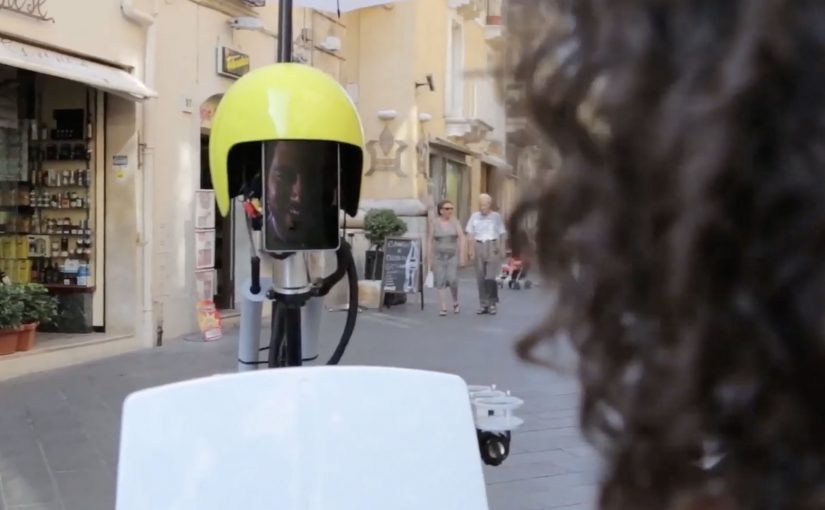
The mechanism in both examples is telepresence. A robot with a webcam and microphone acts as a movable avatar in a real location. People at home control where it goes, what it looks at, and who it talks to, turning a distant event into something they can actively explore rather than passively watch.

In experiential marketing, telepresence robots let brands scale a place-bound moment to remote audiences without reducing it to a simple livestream.

Why the robot format lands

This works because it restores a missing ingredient of remote content. Presence. You are not only consuming footage. You are choosing what to look at, moving through the environment, and having real-time interactions that feel personal. Because telepresence combines viewer control with two-way contact, it turns remote viewing into participation. Telepresence is worth the operational hassle only when “being there” is the product. The real question is whether your remote audience needs presence, not just access.

Extractable takeaway: If your brand moment is tied to a physical place, give remote audiences viewer control over a live viewpoint. Even small control makes the experience feel earned, and earned experiences get talked about.

Three minutes in Italy

San Pellegrino invited Facebook fans to discover the Sicilian village of Taormina and explore its cobblestone streets via a webcam and microphone enabled robot controlled from their own computer.

Coca-Cola Summer Love 2013

Coca-Cola Summer Love is the annual summer event for Israeli teenagers. Not everyone can join in person, so Coca-Cola created robots that allowed teens to be part of the camp without leaving their homes. The robots carried webcams and microphones and were controlled by users who could not physically be there.

Users could navigate around the campus, talk with friends, watch shows, participate in competitions, and be part of the experience. The robots were welcomed, danced with, and treated like real attendees, becoming the “stars” and a natural media magnet inside the event.

Practical steals for telepresence events

  • Make control the feature. Remote access becomes meaningful when people can choose what happens next.
  • Keep interactions human-scale. Let remote users talk to real people, not just watch a feed.
  • Time-box the experience. Constraints like “three minutes” create urgency and reduce operational load.
  • Design for friendliness. The robot should invite social acceptance in the space, not disrupt it.

A few fast answers before you act

What is a “social robot” in these campaigns?

A telepresence robot that carries a live camera and microphone, letting a remote person control movement and interact with people on-site in real time.

Why is telepresence more compelling than a normal livestream?

Because it adds viewer control and two-way interaction. Control makes the experience feel personal, and two-way contact makes it feel like participation rather than content consumption.

What is the main operational risk?

Latency, connectivity, and crowd behavior. If the robot is hard to control or gets blocked, the magic disappears quickly.

Where does this pattern fit best?

Events, tourism, launches, and experiences where the value is being “there,” and where remote audiences have strong motivation but limited ability to attend physically.

How do you keep the robot from becoming a distraction?

Set simple on-site rules, give the robot a friendly presence, and design short, guided interactions so crowds do not block or hijack it.