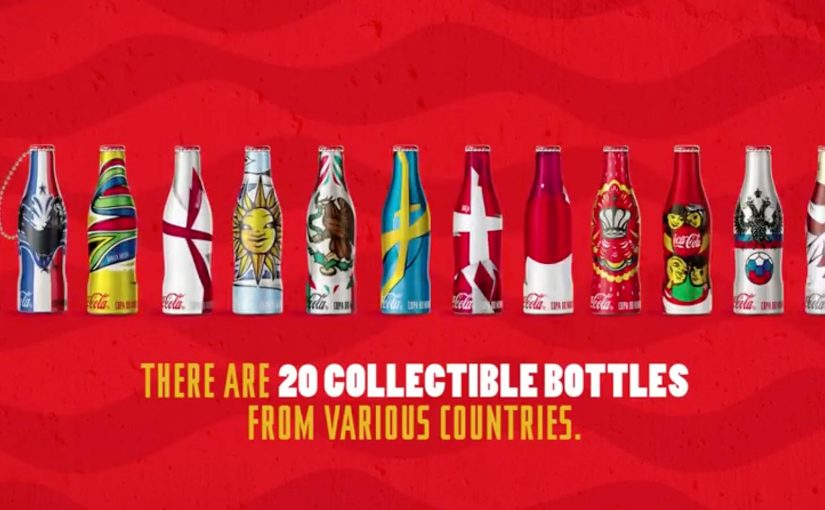
Coca-Cola has launched 20 special edition mini bottles to get fans around the world excited about the upcoming 2014 FIFA World Cup, which will take place in Brazil from June 12th to July 13th.
The bottles come wrapped in flags of countries that have hosted the World Cup previously. Argentina, Chile, Uruguay, Mexico, USA, England, Germany, Spain, France, Italy, Sweden, Switzerland, South Africa, Japan and South Korea. As well as the three upcoming host countries Brazil, Russia and Qatar. Plus two special Coca-Cola editions.
Coca-Cola fans can also create and send special messages and avatars to other bottle owners through Facebook and iPhone or Android apps. In addition, special markers on the bottles activate augmented reality animations when held up to a smartphone camera.
What makes these bottles more than packaging
This is a simple shift with big implications. The bottle is not only a container. It becomes a trigger. A collectible. And a social connector. This is smart brand design because it turns packaging into media without asking people to leave the product in their hand.
The real question is how to make a small physical object behave like media, participation, and social signal at the same time.
The flags do the first job. They make the bottles instantly recognizable and tradable. People have a reason to hunt for specific countries and compare what they found. The digital layer does the second job. By digital layer, this means the messages, avatars, and AR animations unlocked through the bottle. It turns ownership into participation, because the bottle now links to messages, avatars, and AR animations.
Why augmented reality fits this moment
AR works best when the behavior is natural. Here the behavior is already there. You hold the bottle in your hand. You point your phone at it. You get something back instantly. That is what makes the marker idea effective, because it adds a reward to an existing behavior instead of asking people to learn a new one.
Extractable takeaway: When the product already sits in someone’s hand, the strongest digital layer is the one that rewards curiosity in the moment rather than redirecting attention somewhere else.
In global brand portfolios, this matters because packaging that doubles as an activation point can scale engagement and give people a stronger reason to choose the brand at shelf without adding a separate physical touchpoint.
What to borrow from collectible packaging activations
- Make the physical object the interface. The bottle is the entry point, not a poster, banner, or separate microsite.
- Give fans something to collect and trade. Flags are a built-in collecting mechanic.
- Add a social layer that only owners can unlock. Messaging and avatars make participation feel earned, not generic.
- Use mobile as the bridge. iOS and Android apps turn “I saw it” into “I can activate it” immediately.
A few fast answers before you act
What are Coca-Cola Interactive Mini Bottles?
They are 20 special edition mini bottles designed to build excitement for the 2014 FIFA World Cup, using country-flag designs plus a digital interaction layer.
What is interactive about them?
Owners can send messages and avatars to other bottle owners via Facebook and iOS or Android apps. The bottles also include markers that trigger augmented reality animations through a smartphone camera.
Why use country flags on the bottles?
It creates instant collectability. People can look for specific countries, compare what they found, and feel part of a shared event build-up.
What is the role of augmented reality here?
AR turns the label into an activation point. Point your phone at the bottle, and the design becomes an animation experience rather than static packaging.
What is the main marketing idea worth copying?
Make the product itself the gateway to the experience. When the physical object triggers the digital layer, participation becomes effortless and more memorable.