
Restaurant of the Future: AR Dining

The restaurant of the future is a technology experience

Restaurants of the future are no longer defined only by food, service, or ambiance.

They become technology-driven environments, where digital interfaces blend directly into the dining experience.

Smartglasses, augmented reality, gesture-based interfaces, customer face identification, avatars, and seamless wireless payments begin to coexist at the table.

The result is not a single gadget. It is a fully integrated experience.

When dining becomes augmented

In the restaurant of the future, the menu does not need to live on paper or even on a phone.

Information can appear in front of the guest through smartglasses or augmented displays. Dishes can be visualized before ordering. Nutritional details, origin stories, or preparation methods can surface on demand.

Gestures replace clicks. Presence replaces navigation.

The dining experience becomes interactive without feeling mechanical.

Identity replaces interaction

Face recognition and customer identification change how restaurants think about service.

Returning guests can be recognized instantly. Preferences, allergies, and past orders can be recalled automatically. Avatars and digital assistants can guide choices or explain dishes without interrupting human staff.

The restaurant adapts to the guest, not the other way around.

Payment disappears into the experience

Wireless payment technologies remove the most artificial moment in dining.

There is no need to ask for the bill. No waiting. No interruption.

Payment happens seamlessly as part of the experience, triggered by confirmation, gesture, or departure. Money moves, but attention stays on dining.

Mirai Resu. Japan’s restaurant of the future

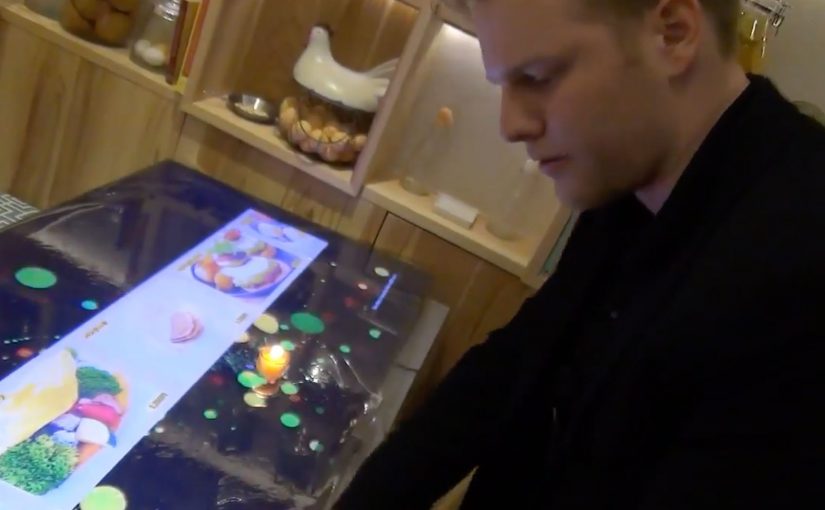
To illustrate this vision, a short video from Mirai Resu in Japan shows what a fully integrated restaurant experience can look like.

Smartglasses, augmented visuals, gesture-based interaction, avatars, and invisible payment mechanisms come together into a single flow.

This is not a concept mock-up. It is a concrete glimpse into how dining, technology, and experience design merge.

In hospitality experience design, technology only “wins” when it fades into the flow and makes the human experience feel more effortless.

The real shift. Experience over interface

The most important takeaway is not the individual technologies. It is the shift away from explicit interfaces toward ambient interaction. Guests do not use systems. They experience them. Technology fades into the background. The experience becomes the focus.


A few fast answers before you act

Is this about replacing staff with machines?

No. The value is removing friction so staff can focus more on hospitality and less on transactional steps.

Why does augmented reality matter in dining?

It can add information and interaction in-context, without pulling guests out of the moment or forcing phone-first behavior.

What does the Mirai Resu example actually demonstrate?

It demonstrates orchestration. Multiple technologies can be combined into one coherent service flow, rather than isolated gimmicks.

Where does “customer identification” fit in this vision?

It enables recognition on approach and service personalization, but it only works when guests understand the trade and feel in control.

What is the design principle to steal?

Design for experience continuity. Keep attention on dining, and make technology support the flow rather than interrupt it.

Pepsi Max – Unbelievable Bus Shelter

Pepsi Max for its new ‘Unbelievable’ campaign rigged an ordinary bus shelter in London, to perform tricks on unsuspecting travellers.

Using a custom see-through digital display, people waiting at the bus shelter were made to believe that they were actually seeing things like hovering alien ships, a loose tiger, a giant robot with laser beam eyes and so on.

The reactions to these ‘unbelievable’ scenarios were then captured and put in the below viral video.

Why this works. Even before you talk about “tech”

The technology is impressive, but the mechanic is simple. It takes an everyday moment. It inserts a believable layer of impossible. Then it lets people do the rest. React, laugh, point, film, share.

That is the real move. It transforms passive waiting time into a story that feels personally witnessed.

The bus shelter as a “media product”

This activation treats the bus shelter like a product interface, not just a placement. It has inputs and outputs.

  • Input. People arrive with low expectations and spare attention.
  • System. A “window” that looks like reality, then breaks it in a controlled way.
  • Output. Instant emotion, social proof from nearby strangers, and a camera-ready moment.

In other words, it is not only out-of-home. It is an experience designed to be recorded and re-distributed.

What makes it shareable. And why the video is the second product

The live moment is the first product. The viral video is the second product. The second product extends the reach far beyond the street corner.

  • High signal in seconds. You understand what is happening instantly.
  • Escalation. Each new “unbelievable” scene raises the stakes and keeps attention.
  • Human faces. The reactions are the content. The brand stays present but not intrusive.
  • Social permission. If others are reacting, you react too. Then you share.

What to take from this if you build brand experiences

  1. Design the moment first. The best “viral videos” start as real-world moments people want to show others.
  2. Keep the premise instantly legible. If it needs explanation, it loses momentum.
  3. Make capture a feature. If people will film it, stage it so the footage works.
  4. Build a repeatable format. One idea, multiple scenarios, consistent payoff.
  5. Let the audience star. The most believable proof is human reaction, not brand claims.

A few fast answers before you act

What is Pepsi Max “Unbelievable” in one sentence?

It is a London bus shelter activation that used a see-through digital display to create impossible scenes, then turned real public reactions into a viral video.

Is this augmented reality?

It functions like augmented reality for the audience, because it overlays illusions onto what looks like a real street view, even though the experience is delivered through a physical digital screen.

Why do people share this kind of content?

Because it triggers instant emotion and disbelief, and it is easy to explain visually. People share it to pass on the surprise.

What is the key design principle behind the activation?

Make the better story happen in the real world. Then make it easy for the story to travel as video.

What is the practical takeaway for marketers?

When you create a moment that people genuinely want to record, distribution becomes an outcome of the experience, not a separate media plan.

Coca-Cola Interactive Mini Bottles

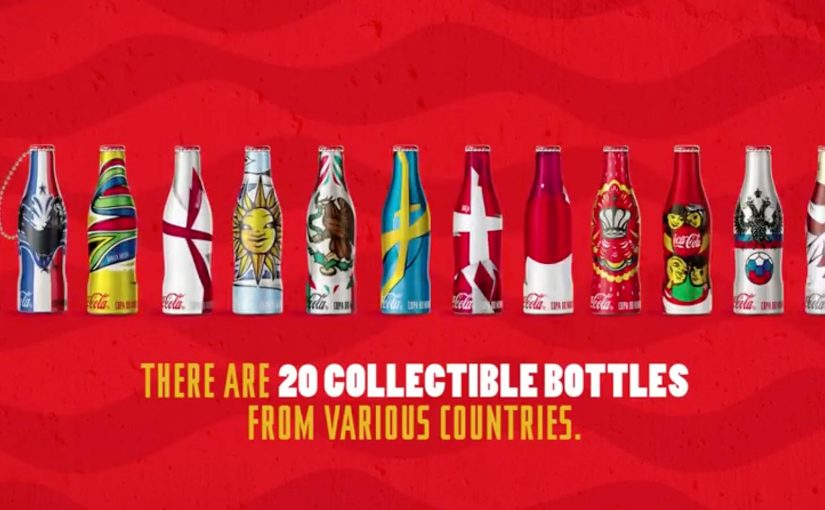
Coca-Cola has launched 20 special edition mini bottles to get fans around the world excited about the upcoming 2014 FIFA World Cup, which will take place in Brazil from June 12th to July 13th.

The bottles come wrapped in flags of countries that have hosted the World Cup previously. Argentina, Chile, Uruguay, Mexico, USA, England, Germany, Spain, France, Italy, Sweden, Switzerland, South Africa, Japan and South Korea. As well as the three upcoming host countries Brazil, Russia and Qatar. Plus two special Coca-Cola editions.

Coca-Cola fans can also create and send special messages and avatars to other bottle owners through Facebook and iPhone or Android apps. In addition, special markers on the bottles activate augmented reality animations when held up to a smartphone camera.

What makes these bottles more than packaging

This is a simple shift with big implications. The bottle is not only a container. It becomes a trigger. A collectible. And a social connector.

The flags do the first job. They make the bottles instantly recognizable and tradable. People have a reason to hunt for specific countries and compare what they found. The digital layer does the second job. It turns ownership into participation, because the bottle now links to messages, avatars, and AR animations.

Why augmented reality fits this moment

AR works best when the behavior is natural. Here the behavior is already there. You hold the bottle in your hand. You point your phone at it. You get something back instantly.

That is what makes the marker idea effective. It does not ask people to do something unfamiliar. It simply adds a reward to something they already do when they are curious about a special edition design.

What to borrow if you build brand experiences

  • Make the physical object the interface. The bottle is the entry point, not a poster, banner, or separate microsite.
  • Give fans something to collect and trade. Flags are a built-in collecting mechanic.
  • Add a social layer that only owners can unlock. Messaging and avatars make participation feel earned, not generic.
  • Use mobile as the bridge. iOS and Android apps turn “I saw it” into “I can activate it” immediately.

A few fast answers before you act

What are Coca-Cola Interactive Mini Bottles?
They are 20 special edition mini bottles designed to build excitement for the 2014 FIFA World Cup, using country-flag designs plus a digital interaction layer.

What is interactive about them?
Owners can send messages and avatars to other bottle owners via Facebook and iOS or Android apps. The bottles also include markers that trigger augmented reality animations through a smartphone camera.

Why use country flags on the bottles?
It creates instant collectability. People can look for specific countries, compare what they found, and feel part of a shared event build-up.

What is the role of augmented reality here?
AR turns the label into an activation point. Point your phone at the bottle, and the design becomes an animation experience rather than static packaging.

What is the main marketing idea worth copying?
Make the product itself the gateway to the experience. When the physical object triggers the digital layer, participation becomes effortless and more memorable.