
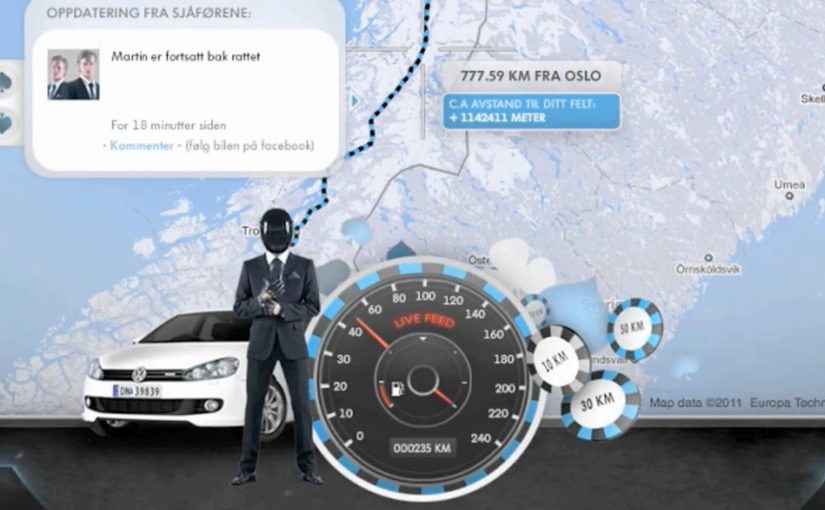
Volkswagen: BlueMotion Roulette

Volkswagen has turned the E6, often described as the Norwegian equivalent to Route 66, into a real-time online game of roulette using Google Maps and Street View.

TRY/Apt from Oslo devised the game to highlight the main feature of the new Golf BlueMotion, its low fuel consumption, in a meaningful and memorable way.

By “roulette”, Volkswagen literally meant dividing the E6 into thousands of map “slots” and asking people to bet on the exact spot where a fully tanked Golf BlueMotion would finally run out of fuel. Each person could place only one guess. If the car stopped on your chosen spot, you would win it.

Why the mechanic forces learning

The one-guess rule is the underrated design choice. If you only get one bet, you do not throw it away casually. You start researching. How efficient is the car, really. How far could it realistically go. What kind of driving conditions matter. The game turns “I saw an MPG claim” into “I tried to estimate a real outcome.”

The real question is how far it will go in real conditions when you only get one chance to be right.

This is a smart way to market efficiency because it turns a fuel-consumption spec into a public, falsifiable outcome people can debate, predict, and verify.

That is the brand win. You are not pushing information at people. You are pulling them into the proof.

In automotive efficiency marketing, a technical number only becomes persuasive when people can translate it into distance, time, and a story they want to test.

What made it stick beyond the stunt

Published campaign results describe close to 50,000 people placing bets, with roughly the same number visiting the site on the day of the drive. The car reportedly kept going for 27 hours and came to a halt about 1,570 km north of Oslo, turning a fuel-consumption spec into a distance people can picture. Even better. There was a real winner. The reporting names Knud Hillers as the person who picked the precise spot where the car finally stopped.

Extractable takeaway: If you want a spec to travel, turn it into a single, answerable public question, then design one constraint that forces participants to estimate, not just watch.

Steal this from BlueMotion Roulette

  • Convert a spec into a prediction. People remember what they estimate, not what they are told.
  • Limit participation to raise intent. One guess makes research feel rational.
  • Make the proof public. A live run creates shared tension and shared conversation.
  • Build the story around a single question. “How far can it really go” is the whole campaign.

A few fast answers before you act

What is BlueMotion Roulette?

BlueMotion Roulette is an interactive Volkswagen campaign that turns a real highway into a map-based betting game. People guess where a Golf BlueMotion will run out of fuel on one tank. If they guess correctly, they win the car.

Why use Google Maps and Street View for this?

Because it makes the “distance” claim tangible. The map gives precision, context, and credibility, and it lets people choose an exact location rather than a vague number.

What makes the one-guess rule so effective?

It increases commitment. If you only get one bet, you are more likely to look up facts and make a reasoned estimate, which forces deeper engagement with the product story.

What is the biggest risk with a live proof mechanic?

If the outcome is unclear or disputed, the proof collapses. The run, the rules, and the documentation of the final stopping point all need to be transparent and easy to understand.

What should you measure for a campaign like this?

Participation volume, repeat visitation on “event day”, social conversation during the live window, and whether people can correctly retell the mechanic and the proof outcome afterward.

#The8N8 Twitter Campaign

A celebrity tweets a question about the new Nokia N8. You spot the clue, follow the celebrity, and race to reply with the correct answer before everyone else. Do it fast enough, and you earn the follow-back. Repeat until you have eight.

The brief. Launching the Nokia N8 on Twitter

Wunderman Buenos Aires is given the task to launch the new Nokia N8 smart phone. They create a Twitter-based activation campaign called #The8N8. Here, “activation” means a participatory game on Twitter, driven by clue tweets and timed replies.

The real question is whether you can turn product features into a race people choose to replay.

This is a strong Twitter launch mechanic because it forces people to learn features under time pressure, while making the reward publicly visible.

How it works. Clues, speed, and follow-backs

  • Nokia enlists top celebrities to tweet questions, clues, and features of the phone.
  • Users find the clues, follow the celebrity, and respond correctly in the fastest time.
  • The reward is the celebrity following the user back.
  • The first eight people to get eight celebrities to follow them back win the new Nokia N8.

In consumer electronics launches on fast-moving social platforms, attention windows are short and social proof is a primary currency.

Why the follow-back works

By making the reward a follow-back from a celebrity, the mechanic converts speed and accuracy into instant social proof, which is why participants keep replaying the hunt.

Extractable takeaway: When you attach a visible status reward to answering product-feature clues fast, you can make launch messaging feel like a game instead of an ad.

Results. Reach and follower growth

The campaign is reported to reach 300,000 Twitter users. It is also reported to increase Nokia’s fan base on Twitter and Facebook by over 100%.

How to reuse the mechanic in a launch

  • Turn features into clues. Write prompts that translate key features into quick, answerable questions.
  • Make speed the differentiator. Keep the rule simple. First correct reply earns the follow-back.
  • Keep the reward visible. A follow-back is public, so the prize doubles as social proof.
  • Use a clear finish line. “Eight follow-backs” makes progress legible and creates urgency.

A few fast answers before you act

What is #The8N8?

A Twitter-based activation by Wunderman Buenos Aires to launch the Nokia N8.

What do participants actually do?

They follow participating celebrities, answer their clue tweets correctly, and do it faster than others to earn follow-backs.

What is the win condition?

Be among the first eight people to get eight celebrities to follow you back.

What are the reported outcomes?

Reported reach of 300,000 Twitter users and reported fan base growth on Twitter and Facebook by over 100%.

What is the transferable mechanic?

Turn product messaging into a speed-based game that rewards social proof. Here, that social proof is the follow-back.

Ariel Actilift: Facebook-Controlled Shoot

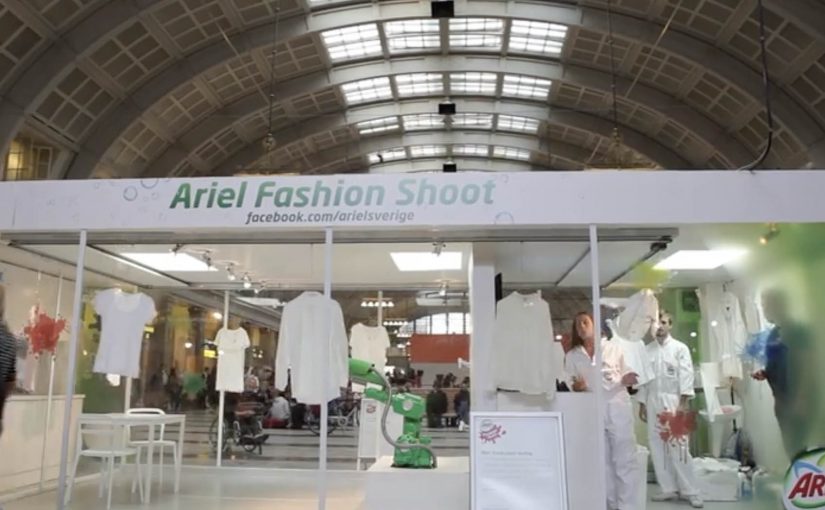
Procter & Gamble Nordics, in collaboration with Saatchi & Saatchi Stockholm, B-Reel and Atomgruppen, creates an interactive campaign centered on a specially built glass installation in Stockholm Central Station, Sweden.

For one week, passers-by at Stockholm Central Station can watch designer clothes hung on a washing line being soiled by ketchup, drinking chocolate and lingonberry jam via fans on the Ariel Sweden Facebook page (or Denmark, Norway, Finland equivalents).

The mechanic: stain it from Facebook, then win it back clean

In order to win the designer clothes, Ariel fans use a Facebook-controlled industrial robot cannon to soil them. The stained clothes are then sent in the post after being washed on-site with regular Ariel Actilift.

In high-traffic European transit hubs, the strongest “social media” ideas are the ones that visibly change the physical world in front of everyone, not just the feed.

Why it lands: it makes participation feel consequential

This is a neat reversal of how most product demos work. Instead of the brand creating a controlled “before and after”, it invites the audience to create the mess themselves, then proves the wash result under public scrutiny.

Extractable takeaway: If you want participation that people remember, make the audience’s input irreversible in the moment, then let your product do the recovery. The contrast between “I caused this” and “it still comes out” is stronger than any claim line.

The glass box is doing strategic work. It turns a Facebook click into a visible event for commuters, which makes the campaign feel bigger than the people who are actually playing.

What the campaign is really selling

At a surface level it is a stunt to win clothes. At a deeper level it is reassurance. The mess is extreme and deliberately unglamorous, so the cleanliness result reads as confidence, not a carefully staged demo.

The real question is whether a Facebook click creates enough public consequence to make the cleaning proof feel worth watching.

What to steal for your next social-plus-physical idea

  • Let the audience create the proof: user-generated “inputs” that change the outcome are more persuasive than brand-controlled setups.
  • Use a public stage: a transparent environment creates trust because the product has nowhere to hide.
  • Keep the control surface simple: one clear action. One obvious effect. No complicated UI.
  • Design a real reward path: the prize should be operationally credible, not a vague “chance to win”.
  • Make the brand step undeniable: show the product moment on-site so the claim is witnessed, not narrated.

A few fast answers before you act

What is the core idea of this Ariel activation?

A Facebook interface controls a robot cannon that stains designer clothes in a glass installation. Ariel then washes the clothes on-site, and participants can win the cleaned items.

Why combine Facebook with a physical installation?

Because it turns digital participation into a public spectacle. The online action has a visible consequence in the real world, which makes it more engaging and more shareable.

What product truth is being demonstrated?

That Ariel can handle tough, visible stains. The audience creates the stains, and the brand shows the wash outcome under observation.

What makes this different from a normal product demo?

The brand gives up control of the “mess creation” to the public. That makes the demonstration feel less scripted and more credible.

What should you measure if you run something like this?

Participation rate, dwell time at the installation, social engagement tied to the control interface, earned media pickup, and any lift in product consideration during the activation window.