
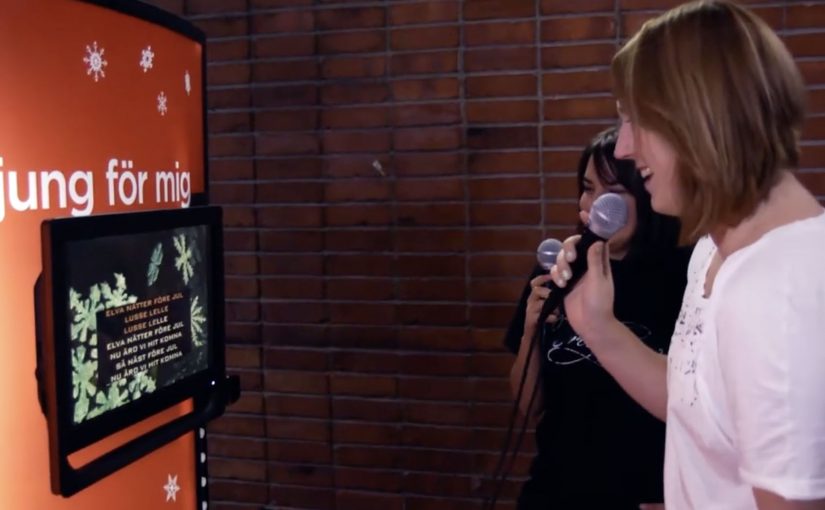
Coca-Cola: The Sing For Me Machine

As part of its global “Open Happiness” campaign, Coca-Cola has set up interactive vending machines in various parts of the world. In Singapore, consumers could hug for a Coke. In Korea, they could dance for a Coke.

And now in Stockholm they can sing for a Coke. The vending machine has been placed at the Royal Institute of Technology with the sign “Sing For Me” in the front.

When sampling becomes a public performance

The mechanism is simple: the machine replaces money with a human gesture. That “gesture for reward” model means the action itself becomes the price of entry. Dance moves in one market. A song in another. The reward is immediate, and the moment is automatically social because other people can see it. That swap works because it turns a private purchase into a visible act, giving the crowd a reason to watch, react, and join in.

In global FMCG sampling and brand experience work, “gesture for reward” machines turn distribution into participation by design.

The real question is whether the action is easy enough to trigger participation without making people shut down in public. The smart part of this format is not the free Coke, but the public behavior it creates around the sample.

Why it lands

This works because it makes the brand promise legible without explanation. A vending machine is normally transactional and forgettable. A performance-triggered machine is a small event, and the crowd reaction becomes part of the product. The setting helps too. A campus is full of friends, cameras, and people willing to try a slightly silly thing in public.

Extractable takeaway: If you swap payment for a simple public action, you turn sampling into a story people can witness, film, and retell. That social proof travels farther than the product ever could on its own.

The machine is one of a number of Happiness Machines Coca-Cola has deployed around the world since 2009.

What to borrow from performance sampling

  • Pick one obvious trigger: the instruction must be understood in one glance.
  • Make the reward instant: the dispense moment is the emotional payoff.
  • Design for bystanders: the format should recruit a crowd naturally.
  • Localize the gesture: keep the same principle, but choose a culturally comfortable action.
  • Capture reactions: real laughs and hesitation are the proof that the idea works.

A few fast answers before you act

What is the “Sing For Me” machine?

It is a Coca-Cola vending machine that dispenses a free Coke when people sing to it, turning a product handout into a public, participatory moment.

Why does “sing for a Coke” work as a mechanic?

Singing is visible and socially contagious. Once one person does it, others gather, react, and often try it themselves.

How is this connected to the broader “Happiness Machine” idea?

It follows the same pattern: replace payment with a feel-good interaction, then let real reactions become the distribution layer.

Where does this format work best?

High-footfall environments with social density, like campuses, events, malls, and transit hubs, where bystanders quickly become an audience.

What is the biggest risk with performance-for-reward activations?

If the action feels embarrassing or culturally off, participation drops. The trigger must feel playful, safe, and easy to attempt in public.
Coca-Cola Hilltop Mobile Ad

In March I had written about Google’s advertising experiment where they set out to re-imagine and remake some of the most iconic ad campaigns from the 1960’s and 1970’s with today’s technology.

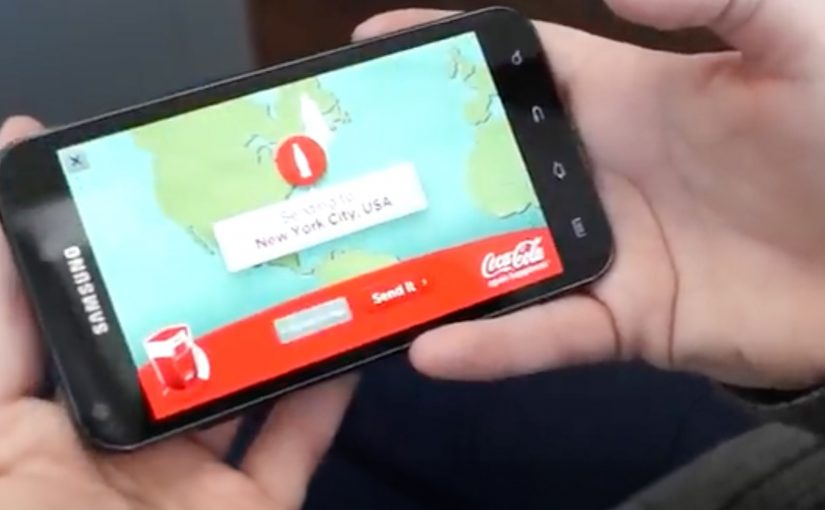
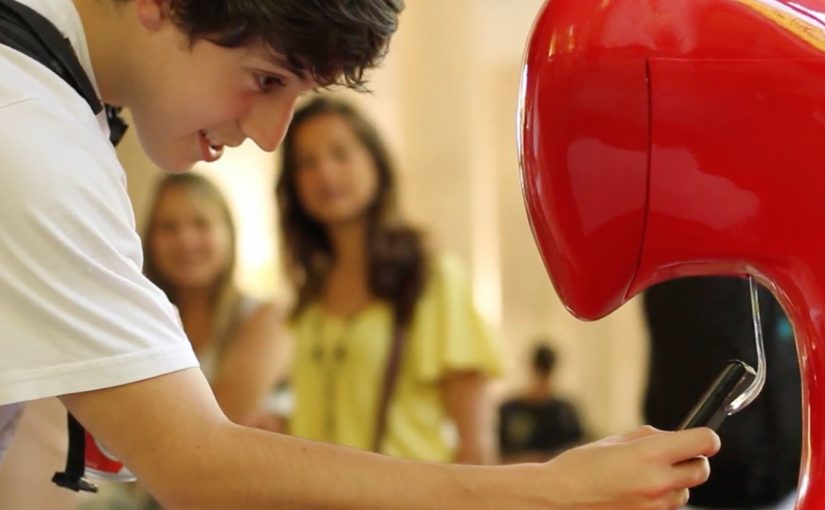
During these experiments the iconic Coca-Cola “Hilltop” ad campaign was re-imagined. Fulfilling the promise of the original ad, special vending machines were created that allowed users to instantly send a Coke around the globe to unsuspecting recipients.

Now the whole experience has been taken onto mobile and can be experienced through the Google AdMob network, across iOS and Android devices. Viewers can now truly ‘Buy the World a Coke’ with just a few taps on their mobile phones.

What changes when “Hilltop” moves to mobile

The original re-imagining leaned into physical surprise. A vending machine became a global gifting interface. Moving that same promise into an AdMob-delivered mobile experience changes the distribution model completely. Instead of waiting for someone to encounter a special machine, the interaction can show up wherever people already spend time on their phones.

That is the real upgrade here. Not just “mobile as a smaller screen,” but mobile as a friction-reducer for participation. A few taps can replicate the core gesture. Sending a Coke to someone else. Without requiring a specific location, a specific moment, or a special install. It works because mobile removes the location and setup barriers that made the vending-machine version memorable but limited.

In global brand portfolios, the scalable opportunity is turning a famous campaign promise into a simple action people can complete wherever they are.

The real question is not whether a classic ad can be remade for mobile, but whether its core promise becomes easier to act on.

Why this is more than a nostalgic remake

Remaking a classic can easily turn into pure tribute. The stronger move here is not the tribute. It is the translation of the original promise into a faster, more repeatable action. What keeps this one relevant is that it tries to honor the original promise with a modern mechanic. Here, the mechanic is the simple user action itself: send a Coke to someone else in a few taps.

Extractable takeaway: If you want a campaign to travel, design one action that people can complete quickly and understand instantly, then let the story emerge from participation rather than explanation.

What to borrow for your next mobile campaign

If you are planning mobile work right now, this points to a few practical moves:

  • Design for one clear action. In this case, sending a Coke. Everything else is supporting detail.
  • Make sharing native to the mechanic. Gifting is inherently social and inherently repeatable.
  • Use mobile distribution for scale. An ad network can turn a niche experience into a widely reachable one, without relying on a single physical activation.

A few fast answers before you act

What is the Coca-Cola Hilltop Mobile Ad?

It is a mobile version of the re-imagined “Hilltop” campaign experience, delivered through Google’s AdMob network across iOS and Android devices.

How does this relate to Google’s advertising experiment?

It extends the re-imagining of iconic 1960’s and 1970’s campaigns, taking the Coca-Cola “Hilltop” concept from the experiment into a mobile execution.

What was the original re-imagined mechanic?

Special vending machines were created that allowed users to instantly send a Coke around the globe to unsuspecting recipients.

What is the key user promise in the mobile version?

That viewers can “Buy the World a Coke” with just a few taps on their mobile phones.

Why is the mobile move important?

It shifts the experience from a location-based activation to scalable distribution. Participation becomes possible anywhere, not only where a special vending machine exists.

Coca-Cola: Happiness Refill

Connection as currency on Copacabana

For teens, happiness often means one thing: staying connected.

Coca-Cola in Brazil acted on this insight by creating a beachfront store on Copacabana Beach in Rio de Janeiro and installing a soda machine that delivered something more valuable than a drink.

The real question is whether your brand can trade something people have for something they cannot easily get in the moment.

Instead of only dispensing Coca-Cola, the machine rewarded users with free mobile internet credits. For young, emerging middle-class consumers who loved their mobile phones but could not afford generous data plans, the exchange was instantly clear and immediately useful.

How the Happiness Refill machine worked

The interaction was deliberately simple. Users accessed the machine through an exclusive Coca-Cola mobile browser. Completing the interaction unlocked internet credits directly on their phones.

No long registration. No delayed reward. Just a physical interface connected to a digital payoff.

The machine functioned as a bridge between the physical and mobile worlds, using hardware as a trigger and mobile connectivity as the reward.

By turning a quick physical action into instant connectivity, the mechanism created a visible payoff people could copy on the spot.

In mobile-first markets where data is a noticeable constraint, connectivity behaves like a form of currency.

Why free data landed harder than free soda

On a public beach, attention is fleeting. People move quickly, and distractions are constant.

Extractable takeaway: If you reward people with something scarce in their environment, the crowd becomes your distribution channel.

Free data solved a real, present problem. Connectivity was scarce, valuable, and socially visible. Watching someone gain internet access in front of you created instant social proof.

The machine became a gathering point. Not because it was novel technology, but because the value exchange was obvious and human.

The business intent behind Happiness Refill

Coca-Cola’s intent was not short-term sampling.

Utility beats messaging when attention is scarce and the payoff is immediate.

The goal was to make the brand’s long-standing “happiness” positioning tangible for a mobile-first audience by attaching it to everyday utility. Instead of asking teens to emotionally connect with a message, Coca-Cola embedded itself into a moment of real need.

This activation reframed the brand from advertiser to enabler.

What brands can steal from this activation

Here, an activation is a public, in-person brand moment designed to trigger a digital behavior.

  • Translate emotion into utility. Abstract values become powerful when expressed as something people actually need.
  • Design for instant payoff. Immediate rewards outperform persuasion in high-noise environments.
  • Create a public interaction. Physical touchpoints generate social visibility that digital ads cannot buy.
  • Respect economic reality. Value feels bigger when it acknowledges real constraints.

This machine also fits into a broader Coca-Cola pattern. It joins the growing number of Happiness Machines the brand has deployed globally since 2009.


A few fast answers before you act

What insight powered Coca-Cola’s Happiness Refill?

That for teens, happiness is often defined by connectivity. Free data mattered more than another free product.

What made the mechanism effective?

A simple physical interaction with an immediate digital reward. No delay, no complexity.

Why was Copacabana the right context?

The beach favors fast, visible experiences. The activation turned utility into a social moment.

What was the core business goal?

To reinforce Coca-Cola’s happiness positioning by delivering real-world value aligned with mobile behavior.

What is the transferable lesson?

When you make your brand genuinely useful in the moment, people do the distribution for you.