
Lexus Trace Your Road: life-sized racing game

To promote its new high-performance hybrid car, Lexus, together with Saatchi & Saatchi Italy, creates “Trace Your Road”, an experiential event featuring Formula 1 driver Jarno Trulli.

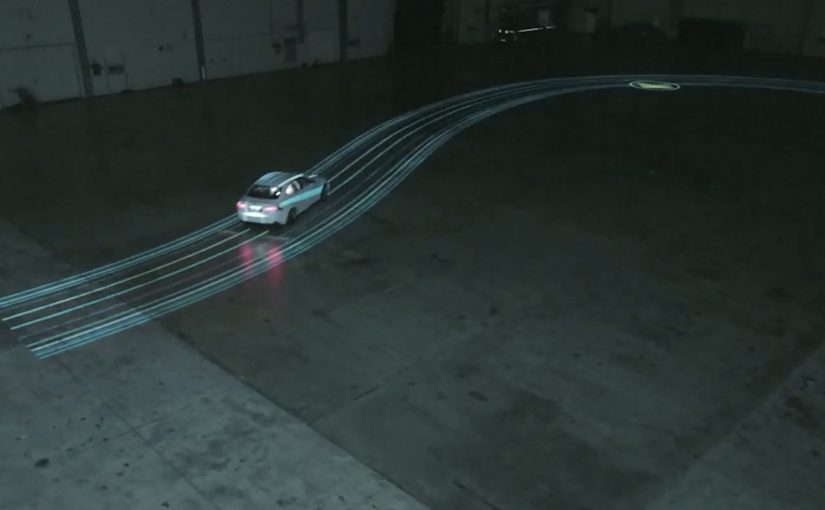
Ten Lexus fans are selected from hundreds of applicants on Lexus’ Facebook page. Each winner rides in the passenger seat of the hybrid while Trulli drives, and the passenger “draws” the course on an iPad. That path is projected onto the floor of an aircraft hangar using special projectors, while a custom high-resolution infrared (IR) camera system tracks the car’s position in real time.

How the experience works

The format is a life-sized driving game with the audience literally designing the track. The event flow is built around three moving parts.

  • Live track creation. The passenger traces a route on the iPad, creating spontaneous turns, straights, and corners.
  • Real-world projection. The route appears at scale on the hangar floor, so the “racetrack” becomes a physical space.
  • Real-time tracking. An IR camera system follows the car so penalties and scoring can be applied accurately.

What makes it competitive, not just cinematic

Trulli’s driving is put to the test as he attempts to follow the improvised paths at speed. Penalty points are given when the car goes outside the projected route or touches the hangar walls. The goal is to hit seven selected touch points in the quickest time, and the fan with the best score wins.

In automotive launches and premium brand marketing, turning a test drive into a participatory game makes performance feel experienced, not explained.

The real question is whether your launch makes the product truth the win condition, not just the headline.

Why it lands: performance becomes legible

Hybrid performance can be hard to dramatize without slipping into numbers. Because the passenger-designed route and visible penalty rules force precision, control and handling become legible without a spec sheet, while the story stays human through the passenger’s real-time choices and Trulli’s visible skill.

Extractable takeaway: When you can turn a product claim into a rule set with visible penalties, the audience understands it instantly and the content becomes inherently shareable.

What Lexus proves with “Trace Your Road”

The brand is not only saying “this car performs”. It is staging a situation where performance is the only way to succeed. This is a stronger way to market performance than listing specs, because it forces the car to prove itself under constraints. The experience also rewards participation: winners influence the outcome, spectators understand the rules instantly, and the filmed content has a clear narrative arc.

Make the claim playable: launch moves worth copying

  • Let the audience shape the challenge. When participants create the rules in real time, attention spikes because outcomes are unpredictable.
  • Translate product claims into constraints. Handling, control, and precision become visible when the environment punishes mistakes.
  • Build a scoring model people can explain. Simple penalties and a clear finish condition make the story travel.
  • Use tech as infrastructure, not the headline. Projection and tracking matter most when they disappear into the experience.

A few fast answers before you act

What is Lexus “Trace Your Road”?

It is an experiential event where a passenger draws a racetrack on a tablet and the route is projected onto a hangar floor, while Jarno Trulli drives a Lexus hybrid along that path in real time.

How is the racetrack created and shown?

The passenger traces the course on an iPad, and the design is projected at scale onto the floor using multiple projectors so the track becomes a physical space to drive in.

How does the system know if the car stayed on the route?

A custom high-resolution IR camera tracking system monitors the car’s position against the projected route so penalties can be applied when it leaves the path.

What makes this more than a one-off stunt?

The format produces repeatable rounds, clear scoring, and a strong spectator story, which makes it easy to capture as a campaign film and behind-the-scenes content.

What is the main lesson for experience design?

Make the product truth the win condition. When success requires the product’s strengths, the message feels demonstrated rather than claimed.
Coca-Cola Live Tweets #LetsEatTogether

Coca-Cola in Romania seems to have broken new ground in the country with its integration between Twitter and TV, as it included live consumer tweets during its ad.

The insight for the campaign came from the fact that in Romania 60% of people don’t eat meals together, but instead eat them alone while sitting in front of their TV. So Coca-Cola decided to use tweets to create open invitations for people to actually come together and have a meal with a Coke.

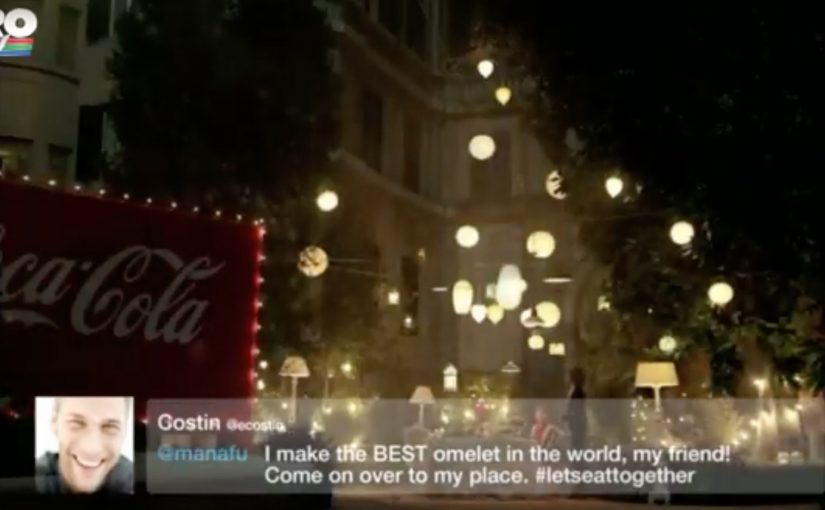
As shown in the video below, the TV ad included a subtitle bar that was used to run the tweets that consumers sent using the hashtag #LetsEatTogether. Coca-Cola’s ad agency, MRM Worldwide, then edited the tweets and inserted five to seven of them into each ad placement.

The campaign increased Coke’s Twitter followers in Romania by 15% as hundreds of tweets were aired on TV. The campaign even made it to the evening news as its uniqueness made Romanians wait everyday for the ad.

Why this Twitter plus TV integration worked

The execution is simple. It borrows the visual language of TV subtitles, then uses it for social proof, meaning viewers can see other people already taking part. Viewers see real people inviting others to eat together, in real time, inside the ad break itself. That makes the message feel less like a brand instruction and more like a public invitation.

Extractable takeaway: When you make audience participation visible inside the main media placement, the campaign can feel more social, more immediate, and more worth watching.

It also turns participation into a lightweight ritual. Tweet the hashtag. Watch for your message. Share the moment when it appears. The format gives people a reason to keep an eye out for the ad, which is the opposite of what usually happens during commercials.

The real question is not whether people can respond to a campaign, but whether that response is visible enough to change how the ad itself feels.

In mass-reach brand advertising, this matters because the primary screen can carry participation directly instead of pushing interaction off to a second screen.

What Coca-Cola was really buying here

This is a smart cross-media play because it does more than collect engagement. It upgrades a standard TV placement into something people anticipate, talk about, and actively watch for.

The business intent is clear. Coca-Cola is using participation to make the ad break itself feel more alive, increase repeat viewing, and turn audience response into earned attention for the brand.

What to steal if you design campaigns with live participation

  • Use a single, explicit mechanic. One hashtag, one behavior, one clear outcome.
  • Make the audience visible inside the media. The tweets are not a second screen. They are on the primary screen.
  • Curate without killing authenticity. Editing keeps it brand-safe while still feeling consumer-led.
  • Reward repeat viewing. New tweets each placement create a reason to watch again.

A few fast answers before you act

What did Coca-Cola Romania do in this campaign?

They integrated live consumer tweets into a TV ad by running curated hashtag messages in a subtitle bar during the commercial.

What was the insight behind #LetsEatTogether?

That many people in Romania ate alone in front of the TV, so the campaign used tweets as open invitations to share meals together.

How were tweets handled for broadcast?

Tweets using #LetsEatTogether were edited and five to seven were inserted into each ad placement by the agency.

What changed in performance?

Coke’s Twitter followers in Romania increased by 15% and hundreds of tweets were aired on TV.

What is the core lesson for cross-media experiences?

If you bring live participation into the primary screen, you can turn an ad break into an event people actively watch for.

Cheetos Mix-Ups: Cheetahpult Dual-Screen Game

In March I had written about how Google had inspired developers to convert mobile phones and tablets into remote controls for desktop browsers via a simple mobile URL. Now Cheetos, an American brand of cheese-flavored puffed cornmeal snacks, has successfully tapped this technology to engage with viewers as they watch a regular TV commercial on YouTube.

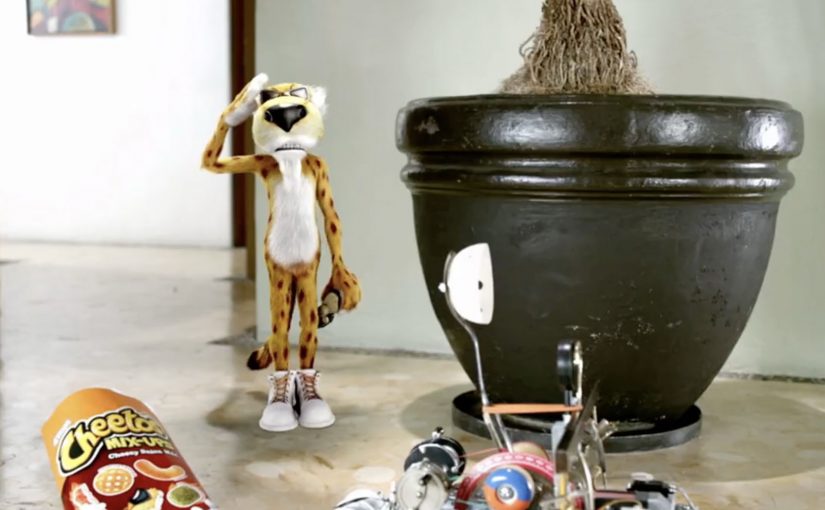
Viewers watching the Cheetos Mix-Ups ad on YouTube get a dual-screen experience. They can fling the new Cheetos Mix-Ups snacks from their phone into a video playing on their desktop. The campaign creates a new way to engage with the ad, and to get to know the product’s new shapes and colors through play.

At this point, the video is reported to have reached 8.5 million views on YouTube. People who played the game are reported to have stayed for an average of 7 minutes and 17 seconds, and flung an average of 56 Cheetos per game.

A YouTube ad that behaves like a game

The trick is simple and surprisingly scalable. Your desktop stays on YouTube, playing the film. Your phone becomes the controller via a lightweight URL experience, so interaction happens in your hand while the “world” of the ad stays on the big screen.

How the dual-screen catapult works

Instead of treating the mobile device as a companion banner, the experience treats it as an input device. You aim, fling, and see the result immediately in the desktop video frame, which turns passive viewing into a loop of action, feedback, and repeat.

In global FMCG launches, second-screen interactivity works best when it turns product attributes into gameplay, and makes “learning the product” feel like time well spent.

Why this lands while people are “just watching YouTube”

It hijacks a familiar behavior. People already watch ads on desktop while their phone is in hand. Cheetahpult converts that split attention into viewer control, and uses physics and repetition to teach what Mix-Ups actually is, in a way a standard product shot cannot. The real question is whether the interaction helps people understand Mix-Ups faster than a normal product shot would. In this case, it does, because the mechanic turns product variety into something people learn by doing.

Extractable takeaway: If your product is hard to describe in one sentence, let people handle it. Build a micro-game where the mechanic is the product benefit, and the reward is comprehension.

What Cheetos is really buying here

This is product education disguised as entertainment. The intent is to turn a new SKU with multiple shapes and flavors into something memorable, then associate that memory with the brand, so the next shelf moment feels familiar.

What Cheetos teaches about interactive video

  • Design for the device people already hold. Dual-screen works when the phone is the controller, not an afterthought.
  • Make the mechanic teach the product. If the game can be reskinned for any brand, it is not specific enough.
  • Keep the loop short and replayable. Fast rounds create “just one more try” behavior, which is where learning happens.
  • Use the main video as the stage. The desktop frame should feel like the real world, and the phone should feel like the tool.

A few fast answers before you act

What is Cheetahpult?

Cheetahpult is a dual-screen YouTube experience that turns a Cheetos Mix-Ups video into a simple physics-style game, with the phone acting as the controller and the desktop video acting as the playfield.

Why does second-screen interaction help an ad?

It converts passive reach into active time. When people interact, they process product details more deeply, and the ad becomes something they did, not just something they saw.

What makes this different from a typical “interactive ad”?

The interaction is not layered on top as buttons. The phone becomes a controller, and the main video becomes the environment, so the ad and the game feel like one system.

When should a brand use this pattern?

When a launch needs fast product education, and when the product has attributes that benefit from repetition, variation, and play, like shapes, combinations, flavors, or configurations.

What should a brand avoid when copying this idea?

Avoid mechanics that are fun but unrelated to the product. If the interaction does not teach something specific about the item being launched, the brand gets playtime but not product understanding.