
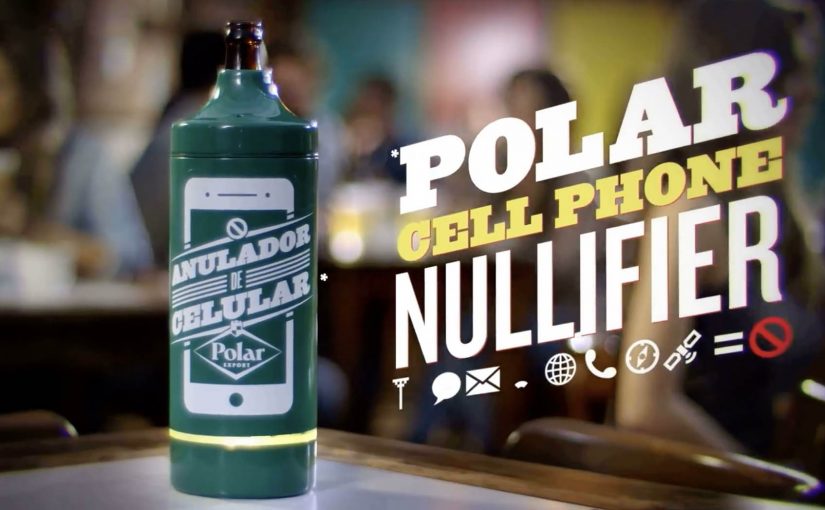
Polar Beer: Cell Phone Nullifier

Polar Beer: Cell Phone Nullifier

There is a specific kind of modern annoyance. You go out with friends, and ten minutes later the table is lit by phone screens instead of conversation.

Polar, a regional Brazilian beer brand, decides to treat that as a solvable problem. If phones steal the night, then the beer should give it back.

A beer cooler that changes the rules of the table

The mechanism is a physical prop with a blunt promise. A special Polar cooler is described as blocking 3G, 4G, Wi Fi, and GSM signals for devices within roughly a five-foot radius. Order Polar. Get served in the cooler. Watch the room look up.

In bar and nightlife settings, the strongest behavior-change ideas work when they attach to an existing ritual and alter it with minimal effort from the audience.

Because the cooler makes the phone temporarily useless at the table, conversation becomes the path of least resistance.

Why it lands, even if people hate it for a minute

This plays with a familiar tension. Everyone complains about “phubbing,” the habit of snubbing people in front of you by focusing on your phone, but nobody wants to be the first person to say “can we put phones away.” The cooler does the awkward social work on behalf of the group.

Extractable takeaway: If a social norm is breaking down, redesign the environment so the better behavior becomes the default. Remove the need for a lecture, and replace it with a small constraint that everyone experiences equally.

The brand benefit is also clean. Polar is not asking for attention. It is buying it back for you, then sitting at the center of the moment it created.

What the stunt is really selling

On the surface it is a gadget. Underneath it is a positioning move. Polar equates itself with real-world connection and the kind of night people say they want, even when their hands keep reaching for the screen.

The real question is whether you can earn attention by subtracting distraction, not by adding more stimulation.

This is a smart positioning move because it delivers the promise through the ritual, not through a slogan.

It is also a reminder that “anti-tech” can be a tech story. The cooler is not anti phone as an identity. It is pro conversation as an outcome.

Steal this for phone-free nights

  • Target the moment, not the attitude. Fix the table behavior, not the entire relationship with smartphones.
  • Use a prop that belongs in the setting. A cooler at a bar feels natural. A lecture does not.
  • Make it equal. The constraint applies to everyone in range, so it feels like a shared game, not a personal attack.
  • Build a story people retell in one sentence. “The beer that makes your phone stop” spreads fast.

A few fast answers before you act

What is Polar’s “Cell Phone Nullifier”?

It is a branded beer cooler concept described as cutting off nearby phone connectivity, so people ordering Polar are nudged into talking to each other instead of scrolling.

Why does blocking the signal work as a behavior-change tactic?

It removes the temptation rather than arguing with it. By changing the environment, it turns “I should put my phone away” into “my phone is not part of the table right now.”

What is the core creative mechanism here?

A familiar bar object is redesigned to enforce a social norm. The product ritual, ordering beer and receiving it in a cooler, becomes the delivery system for the idea.

How can brands adapt this without feeling preachy?

Focus on shared benefits and shared participation. Make the intervention playful and collective, and keep the user action simple and voluntary.

What is the biggest risk if you copy this idea?

If the constraint feels forced or punitive, it becomes the story instead of the conversation it was meant to protect. Keep it lightweight, contextual, and easy to opt into.
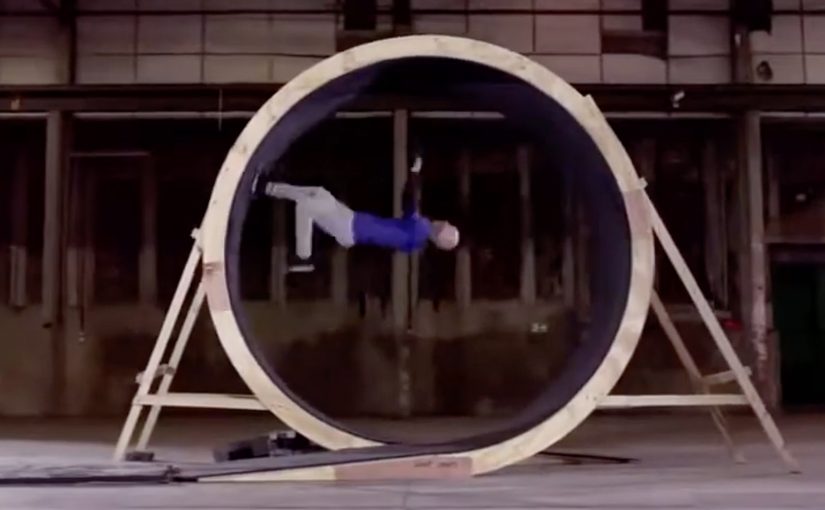
Pepsi Max: Human Loop

Pepsi Max: Human Loop

Last year, Pepsi Max for its ongoing #LiveForNow campaign created an unbelievable bus levitation stunt. Now continuing this “unbelievable feats and experiences” brand positioning, they challenged daredevil stuntman, Damien Walters to do another unbelievable stunt for them. Here, positioning means the single promise the brand wants people to remember and retell.

Pepsi Max provided Damien with a human-sized loop-the-loop in an abandoned warehouse and then got him to defy gravity for them…

In global FMCG marketing, stunts like this earn value when they reinforce an existing brand platform, not when they try to create one from scratch.

Why this stunt fits the brand

The mechanism is simple. A clearly defined physical challenge, executed by credible talent, makes the “unbelievable” promise feel real because the payoff is visible without narration.

Extractable takeaway: If your positioning is a claim, design one repeatable moment that functions as proof, then film it so the viewer can verify it without explanation.

  • It commits to the promise. “Unbelievable” is not a line here. It is the product.
  • It is instantly legible. You understand the challenge in one second, then you watch to see if it is possible.
  • It is built for replay. Stunts invite rewatching, pausing, and sharing because people want to verify what they saw.

How to make the stunt behave like proof

The real question is whether your brand promise can be proven in one obvious moment on camera.

This kind of spectacle earns its keep only when it is a direct proof point for an ongoing platform, not a disconnected attempt at “random viral”.

If your positioning is about experiences, you need executions that behave like proof. This kind of spectacle works when the idea is simple, the talent is credible, and the payoff is visible without explanation.

  • Make the promise behave like proof. If positioning is about experiences, the execution should demonstrate it, not describe it.
  • Keep the idea simple and the payoff visible. The viewer should understand the challenge instantly and see the outcome without explanation.
  • Use credible talent, then shoot for replay. Stunts invite rewatching, pausing, and sharing when people want to verify what they saw.

A few fast answers before you act

What is Pepsi Max “Human Loop”?

It is a Pepsi Max #LiveForNow stunt featuring Damien Walters attempting a human-sized loop-the-loop setup inside an abandoned warehouse.

Why does a loop-the-loop stunt perform so well in video?

The challenge is obvious, the risk feels real, and the outcome is visually conclusive, which makes it highly shareable.

What is the core pattern behind this kind of campaign?

Make the brand promise measurable in one moment, then capture it cleanly so the viewer does not need context to understand it.

How do you keep stunts from feeling like “random viral”?

Anchor them to an ongoing brand platform, use consistent talent and tone, and make each execution feel like a credible next chapter.

When should you avoid a stunt-led proof moment?

Avoid it when the idea cannot be understood instantly, the talent is not credible, or the execution does not ladder up to an ongoing brand platform.

DHL: DHL Is Faster Trojan Parcels

DHL: DHL Is Faster Trojan Parcels

A courier from UPS, TNT or DPD walks through a busy city centre carrying a large, plain-looking parcel. A few minutes later, the same box is effectively doing outdoor advertising for DHL, with a bright message reading: “DHL is Faster.”

Turning competitors into media

DHL’s large network of offices, trucks and employees is a straightforward speed story, but saying it loudly in a traditional ad campaign is expensive. So DHL worked with German trojan campaign specialists Jung von Matt/Neckar to make competitors unknowingly promote DHL as the fastest parcel delivery service. In this context, a trojan campaign hides the brand message inside a neutral object or someone else’s distribution until it reveals itself in public.

The mechanism: temperature reveals the punchline

Large, inconspicuous parcels were created and sealed with a thermo-sensitive foil. When cooled in refrigerators, the parcels appeared black, hiding the message. UPS, TNT and DPD were then asked to deliver these parcels to difficult but central city locations. Exposed to warmer street temperatures during delivery, the parcels shifted colour and revealed the words “DHL is Faster.”

A “trojan” mechanic in marketing is a message that travels inside a neutral object or someone else’s distribution, then reveals itself at the moment of maximum visibility.

In competitive European parcel logistics, a proof-by-demonstration stunt can move “we’re faster” from claim to spectacle without buying classic media.

Why this lands

It works because the reveal happens in public and in motion, exactly where speed matters, and it borrows credibility from the awkward fact that a rival courier is doing the carrying. The stunt also makes the comparison feel earned rather than asserted, because the message appears as a consequence of the journey.

Extractable takeaway: If your advantage is hard to believe as a headline, design a mechanism where the environment exposes the proof, and let the proof show up at the exact point where the audience can “see the claim happen.”

What DHL is really buying

The real question is how to turn a functional speed claim into a public proof people can instantly understand and retell.

This is less about humiliating competitors and more about reframing the category. It turns delivery speed into a street-level moment that people can film, retell, and instantly understand, while the brand pays for production rather than for repeated media placements.

What to steal from DHL’s reveal design

  • Build a reveal. Hide the message until the moment the audience is already watching.
  • Use context as a trigger. Temperature, light, movement, location. Let the world “activate” the story.
  • Put the proof on the distribution. The carrier becomes the billboard, not a separate ad unit.
  • Make the explanation obvious at a glance. If it needs a voiceover, the stunt is too clever.

A few fast answers before you act

What is the “DHL is Faster” stunt?

It’s a trojan-style activation where rival couriers deliver parcels that reveal “DHL is Faster” as they warm up in city conditions.

How does the reveal work?

The parcels are wrapped in a thermo-sensitive foil that looks dark when cooled, then changes to expose bright lettering when the parcel warms during delivery.

Why call it a trojan campaign?

Because the message travels hidden inside a neutral-looking object and is distributed by someone else, then reveals itself at the most visible moment.

What brand point does this communicate?

Speed and network scale, reframed as a live demonstration rather than a paid claim.

What’s the main risk with this kind of idea?

Brand backlash if the stunt feels mean-spirited or deceptive, and operational complexity if the reveal is inconsistent or hard to understand in the wild.