Vodafone Pixel Hunt

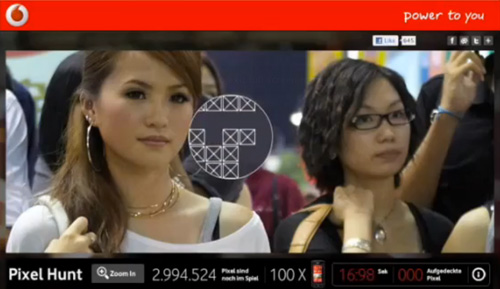
To promote the new Vodafone LG Optimus Windows 7 phone with 5 Megapixel camera, German ad agency Jung von Matt/Alster launched a website where the users had to search for the winning pixels in a picture of 5 millions pixels. There were one hundred winning pixels and each one of the winning pixels contained a brand new LG Optimus Windows 7 phone with 5 Megapixel camera.

In under a month, the entire 5 Million Pixels were clicked out by over 300,000 visitors (pixel by pixel). Thereby making this a great example of how a simple engagement campaign can generate the best results.

Renault Facebook “Likes” in real life

For the Amsterdam Motorshow, Renault introduced the possibility of “liking” real objects (offline) and immediately sharing them online via the Facebook wall. They created this innovative and real-time social sharing experience with the help of a RFID Facebook card.

Specially made Facebook pillars were placed in front of the Renault cars. All the visitors had to do was hold their pass in front of these pillars and an automatic connection would be made to their Facebook profile, with the car being “shared” on their wall. This way their offline car experience was instantly shared with their online friends.

Renault has used the RFID technology well, but last year Coca Cola has used the same in a more engaging manner at their Coca Cola Village event in Israel.

Lacta Chocolate Facebook App

There are some Facebook apps that generate hundreds of thousands of fans while others just flop. This is because of 3 very basic factors…

  1. Simplicity – a couple of clicks to get to the app and to the point of action
  2. Shareability – has all the standard sharing features for viraling the app
  3. Insight – what a fan might actually use, comment and share on

Take that and you have the Lacta Chocolate Facebook App. The app was built around a simple insight that people would compare their loved ones with chocolates.

Once again OgilvyOne Athens got into action and created an app that lets the people customize a Lacta chocolate wrapper in their loved ones name and compare them to a particular Lacta flavour before using the wall to wall post feature to get the message across.

In just over a month the app generated over 150,000+ fans with thousands using personalised chocolate wrappers as profile pics.

KLM Surprise

KLM launched a great Social Media Customer Engagement campaign which involved monitoring people who check in via foursquare for flights or tweet about waiting to board the next KLM service, and they called it “KLM Surprise” as their aim was to bring random surprises and happiness to the boring wait for flights.

Once the customer was chosen for the KLM Surprise, the team would then come up with the perfect (small) gift based on the customers various social networking profiles. The gift would then be hand delivered to the surprised customer at the airport gates.

Greeting your customers and thanking them for visiting your business after they’ve checked in is, of course, a best practice for any company using foursquare, but KLM Surprise takes it to a whole new level. The personal touch that’s exhibited through each of the interactions shows that the KLM team is really looking to make peoples days while they’re traveling, and that goes a long way to “spreading happiness”.

Talent poaching via Facebook Places

Creativity has a new mini case study of an “innovative” recruitment program done by ad agency Jung Von Matt in Stuttgart, Germany. In the proud tradition of agencies buying competitor keywords for jobs ads, Jung Van Matt decided to do something similar, but with location-based services.

Weeks before the official Facebook Places launch in Germany, a VPN Tunnel that simulated an US IP-Address allowed Jung von Matt/Neckar to create places in Facebook. So they created places for their competitors like Neue Digitale / Razorfish (Frankfurt), Interone (Hamburg), Fork Unstable Media (Hamburg), Kolle Rebbe (Hamburg), AKQA (Berlin) and Argonauten G2 (Berlin).

This not only showed that they were faster than the others, but also raised attention for Jung von Matt/Neckar with the high profile digital creatives. So when they checked in at their agencys they received messages like:

First! Want to join? Check in at www.jvm-neckar.de/jobs, we are hiring.

Hi, from the trojan horses inside. Want to join? Check in at www.jvm-neckar.de/jobs, we are hiring.

Of course the targeted creatives also spread Jung von Matt/Neckar message to their whole networks via Facebook. 😎

Facebook integration at the Coca Cola Village

Publicis (E-dologic) and Promarket developed an innovative experiential event for Coca Cola Israel that synced everyone who participated, live with their friends on Facebook!

The Coca Cola Village 2010 event in Israel was run through Facebook, with teenagers needing to collect 10 Coca Cola caps each and eight friends who did the same. After registering online through Facebook they got an exclusive entry.

At the Coca Cola Village, they were asked to setup a special wrist band that would securely hold their Facebook login / password. Every time they swiped, it instantly updated their status with what they were doing at the event, keeping their friends up to date in real time. Plus the wrist band also allowed for automatic tagging of all the photos taken at the Coca Cola Village.

The event held 650 teenagers a day, and with the seamless Facebook integration, they generated 35,000+ posts every day for the three days totaling over 100,000 posts for the event!